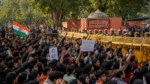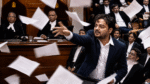
Prabal pratap yadav supreme court judicial servant

Supreme Court “Judicial Servant” Incident Exposes India’s Judicial System Crisis: Colonial Legacies, Administrative Bottlenecks, and the Path to Reform

The Supreme Court “Judicial Servant” incident was more than a courtroom disruption. It exposed deeper concerns about judicial backlog, colonial legal culture, police bureaucracy, procedural barriers and the growing frustration of ordinary citizens seeking timely justice.

Supreme Court “Judicial Servant” Incident Exposes India’s Judicial System Crisis: Colonial Legacies, Administrative Bottlenecks, and the Path to Reform Read More »

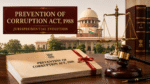
Prevention of Corruption Act 1988 jurisprudential evolution with Supreme Court of India, scales of justice, gavel and legal files

Prevention of Corruption Act 1988: Supreme Court Case Laws, Public Servant, Sanction & Demand Proof Explained

A critical analysis of the Prevention of Corruption Act, 1988 through leading precedents on public servant status, demand and acceptance, Section 17A approval, Section 19 sanction, legislative immunity, and evidentiary standards in corruption prosecutions.

Prevention of Corruption Act 1988: Supreme Court Case Laws, Public Servant, Sanction & Demand Proof Explained Read More »

Electronic evidence under BSA Section 63 showing digital certificate, legal scales and Indian court background

Electronic Evidence under BSA: Section 63 Certificate, Admissibility and IT Act Explained

BSA Section 63 is the new gatekeeper for electronic evidence in Indian courts. It explains how electronic records such as WhatsApp chats, emails, CCTV footage, screenshots, call recordings, PDFs, server logs and digital documents can be admitted as evidence. This article critically examines Sections 63, 64 and 65 of the Bharatiya Sakshya Adhiniyam, 2023 and explains their connection with the Information Technology Act, 2000.

Electronic Evidence under BSA: Section 63 Certificate, Admissibility and IT Act Explained Read More »

Burari Deaths forensic criminological and legal analysis showing an investigative scene with case files, evidence board and symbolic family silhouettes

Burari Deaths Case Explained: Shared Delusion, Forensic Evidence & Legal Closure

The Burari deaths case remains one of India’s most disturbing examples of how belief, family dynamics, psychological control and ritual thinking can intersect with criminal investigation. This article examines the case through forensic criminology, police procedure, legal closure and the unanswered public questions around shared delusion.

Burari Deaths Case Explained: Shared Delusion, Forensic Evidence & Legal Closure Read More »

Bharat Bhushan Tiwari standing opposite Bihar Police during Bhojpur encounter controversy in Bilauti village

Fatal Police Encounter of Bharat Bhushan Tiwari in Bilauti

The death of Bharat Bhushan Tiwari in a police encounter at Bilauti village, Bhojpur, has become one of Bihar’s most controversial law-and-order cases. Viral video claims, family allegations, police defence, public protests, suspensions, and a judicial inquiry now raise one central question: was the police firing lawful self-defence or excessive force?

Fatal Police Encounter of Bharat Bhushan Tiwari in Bilauti Read More »

Supreme Court of India ruling on PMLA and BNSS Section 223 requiring accused hearing before cognizance

PMLA and BNSS Section 223: Supreme Court Says Accused Must Be Heard Before Cognizance

Supreme Court ने PMLA complaint cases में साफ किया कि BNSS Section 223(1) के तहत cognizance लेने से पहले accused को hearing देना mandatory है. बिना hearing लिया गया cognizance order void ab initio होगा, लेकिन prosecution खत्म नहीं होगी; Special Court को cognizance stage दोबारा कानून के अनुसार proceed करना होगा.

PMLA and BNSS Section 223: Supreme Court Says Accused Must Be Heard Before Cognizance Read More »

Supreme Court of India featured image for hate speech judgment on judicial restraint and separation of powers

Judicial Restraint in Hate Speech Cases: Supreme Court’s Ruling in Ashwini Kumar Upadhyay v Union of India

The Supreme Court of India refused broad continuing monitoring of hate speech cases but clarified that prior sanction is not required for a Magistrate to order FIR registration under Section 156(3) CrPC. This article analyses the judgment through judicial restraint, separation of powers, and criminal-law remedies.

Judicial Restraint in Hate Speech Cases: Supreme Court’s Ruling in Ashwini Kumar Upadhyay v Union of India Read More »

Prime Minister Narendra Modi positioned between US-Israel alliance imagery and Iran conflict visuals symbolizing India’s geopolitical dilemma.

Modi’s Ultimate Test: Betray Iran or Defy America

It’s February 28th, 2026. The simmering conflict between Iran and the West has just boiled over. The United States and Israel have launched significant military strikes against Iran. US President Donald Trump has confirmed that major combat operations are underway, with the stated goal of regime change. At the same time, reports indicate Israeli strikes

Modi’s Ultimate Test: Betray Iran or Defy America Read More »