
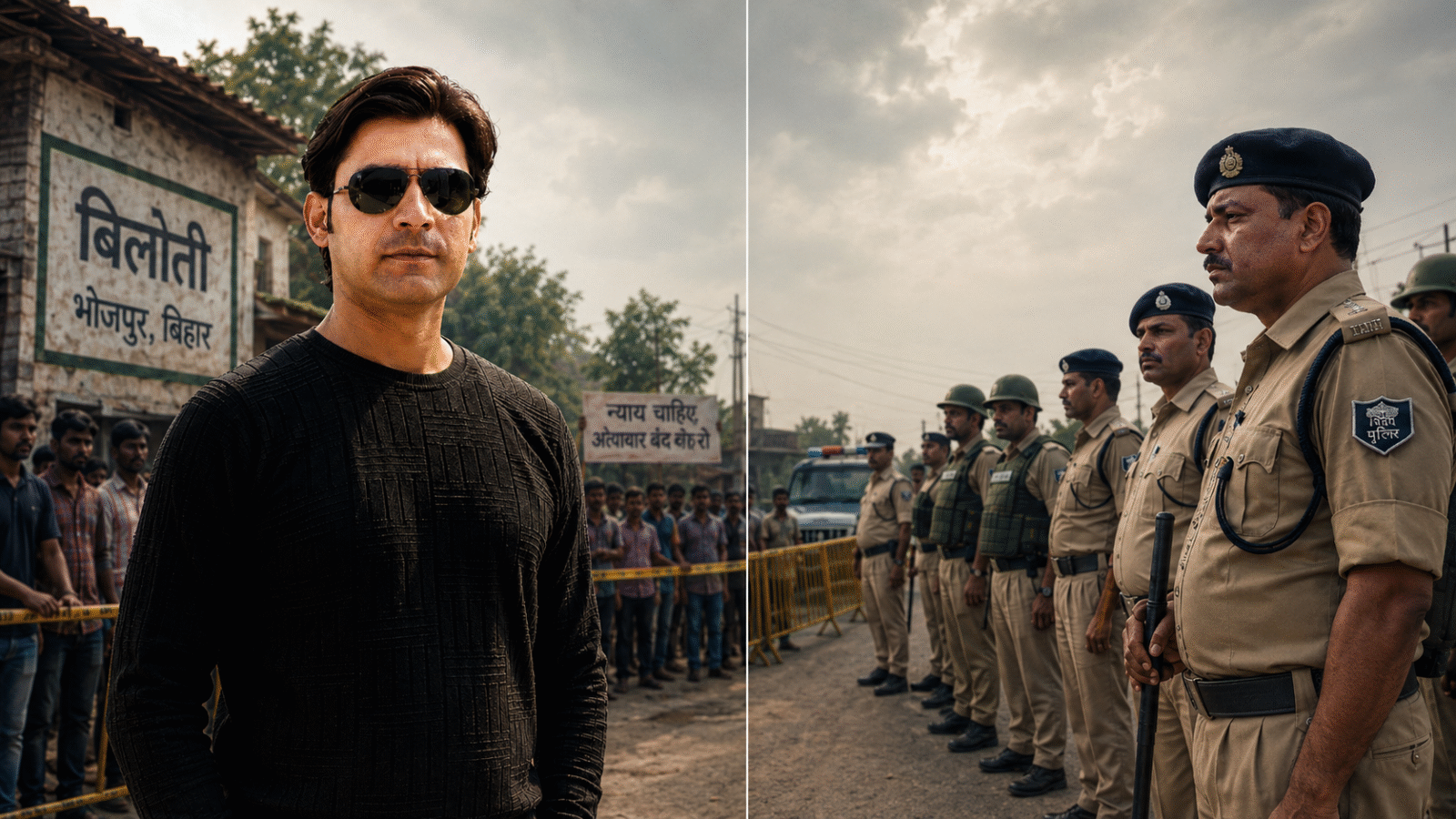
Detailed Report: Fatal Police Encounter of Bharat Bhushan Tiwari in Bilauti Village, Bhojpur, Bihar — June 2026
The Bharat Bhushan Tiwari encounter in Bilauti village, Shahpur, Bhojpur district, Bihar has triggered massive public outrage after reports of a viral surrender video, conflicting Bihar Police claims, suspension of police officers and an independent judicial inquiry by a retired High Court judge. This detailed report examines who Bharat Bhushan Tiwari was, what happened during the police-STF operation, why locals allege a fake encounter, what the police version says, and what legal questions the judicial inquiry must answer.
1. Executive Summary
Bharat Bhushan Tiwari, a young resident of Bilauti village under Shahpur police station in Bhojpur district, Bihar, died after being shot during a police/STF operation on 17 June 2026. The incident has triggered major public outrage, road blockades, political criticism, suspension of police personnel, and an official judicial inquiry by a retired High Court judge.
The controversy is not simply that Bharat Tiwari was shot by police. The controversy is that viral videos and local accounts allegedly show him surrendering or throwing away his weapon before being shot. The police, however, claim that he was armed, firing, and posed an immediate danger to officers and public safety.
Because of the public anger, political pressure, and serious doubts around the use of force, Bihar Chief Minister Samrat Choudhary ordered an independent judicial inquiry to examine all aspects of the encounter.
2. Identity and Background of Bharat Bhushan Tiwari
Bharat Bhushan Tiwari was a resident of Bilauti village under Shahpur police station limits in Bhojpur district. Some reports describe him as around 30 years old, while social media and local narratives describe him as 28. His father is reported as Kashinath Tiwari.
Family members and local supporters say Bharat was not a hardened criminal. His father reportedly stated that Bharat had no FIR, no charge-sheet, and no criminal case against him. Local narratives describe him as a socially active youth who raised local public issues and questioned the administration.
Supporters portray him as someone who spoke for ordinary villagers and raised issues affecting the poor and marginalized. Some accounts describe him as a local activist who used social media to criticize political and administrative failure.
The police version reportedly described him as mentally unsound or disturbed. This label has been strongly challenged by his family and supporters, who argue that he was a politically vocal and socially active youth, not a person whose criticism should be dismissed as mental instability.
3. Immediate Trigger: The Two-Day Standoff
The trigger appears to have begun around 16–17 June 2026. According to police reporting cited in news accounts, police received information that Bharat Tiwari was moving around with a pistol, firing in the air, and creating a threat to public safety.
He was reportedly active on Facebook Live during the period and openly challenged the police. Reports say he livestreamed his confrontation with the police, displayed a pistol, and made statements against the administration.
In his own framing, he appeared to present himself as a “krantikari” or protest figure rather than a criminal. He reportedly claimed that the administration wanted to eliminate him because he was exposing failures and raising public issues. He also allegedly indicated that he was willing to lay down his weapon if authorities engaged with his demands.
This creates the central contradiction of the case: police saw an armed man creating a public-safety threat; supporters saw a distressed but politically vocal activist trying to force the administration to listen.
4. Police Version of the Encounter
The police version, as reported by media, is that police received information around 9 a.m. on 17 June that Bharat Tiwari was armed with a pistol and firing in the air. A police team and STF personnel reached Bilauti village and asked him to surrender.
According to the police account cited in reports, Bharat continued firing intermittently at the police. The police say they fired in self-defence. Bharat sustained bullet injuries, reportedly in the legs/thigh region, and was taken for treatment. He was first taken locally and later referred to Patna Medical College and Hospital, where he died during treatment.
The police version therefore rests on three claims:
- Bharat was armed.
- Bharat fired or threatened police personnel.
- Police firing was defensive and intended to neutralize the threat.
5. Family, Local, and Viral Video Version
The family and local version is sharply different. They allege that Bharat had surrendered or had thrown away/handed over his pistol before the police fired at him.
Several reports mention viral video clips which allegedly show Bharat giving up or throwing away the weapon before being shot. His father reportedly claimed that Bharat had surrendered, was not a criminal, and had no previous criminal case. Locals and family members therefore characterize the incident as a staged or fake encounter.
Some reports also refer to allegations that Bharat was hit by multiple bullets even after he was no longer armed. His mother and family have reportedly made further allegations of brutality, including claims that require independent verification through medical records, post-mortem evidence, hospital records, and judicial inquiry.
At this stage, these are serious allegations, not judicial findings.
6. Public Outrage and Protest
After Bharat Tiwari’s death, public anger spread across Bhojpur. Reports say thousands of villagers and supporters gathered, placed his body on the Ara–Buxar four-lane road / highway stretch, and blocked traffic while demanding justice and action against the police personnel involved.
Police reportedly used lathi-charge to disperse crowds, but the protest continued due to the intensity of anger. The public demand was not merely compensation; protesters demanded accountability, dismissal/arrest of responsible police personnel, and an independent inquiry.
The protest became politically sensitive because the deceased was not being publicly viewed as a gangster or hardened offender. The allegation that he had no criminal record intensified the backlash.
7. Administrative Action Taken
Following outrage, police personnel connected to the incident were suspended. Reports vary on the exact initial number, with some reports mentioning three or four and later reports mentioning six personnel, including the Shahpur SHO, a Sub-Inspector, and an Assistant Sub-Inspector.
This suspension is administrative action, not a final finding of guilt. It indicates that the government and police administration considered the incident serious enough to remove involved personnel from active duty pending inquiry.
The major step came on 20 June 2026, when Bihar Chief Minister Samrat Choudhary announced a judicial inquiry by a retired High Court judge. The stated purpose was to ensure independent, impartial, and transparent examination of all aspects of the 17 June encounter in Bilauti village.
8. Political Fallout
The incident crossed ordinary law-and-order boundaries and became a political issue. Opposition figures criticized the government and questioned the encounter. More significantly, criticism also reportedly came from within or around the ruling coalition space, including senior leaders who publicly expressed discomfort with the police action.
Former senior police officers, including former Bihar DGPs, reportedly questioned whether such force was necessary if Bharat had thrown away the weapon or surrendered. One criticism raised in reports is that if police themselves considered him mentally unsound, the appropriate response should have been controlled negotiation, medical handling, or non-lethal containment, not a fatal outcome.
The government’s decision to order a judicial inquiry appears to be the result of three pressures: viral video evidence, public outrage, and political pressure from multiple sides.
9. Key Legal and Constitutional Issues
A. Was the use of force necessary and proportionate?
The first legal question is whether Bharat presented an immediate threat at the exact moment police fired. If he was still armed and firing, police may claim self-defence. If he had already thrown away the weapon and was surrendering, the legal justification collapses.
B. Was there an opportunity to arrest him without lethal or near-lethal force?
The videos, distance, police deployment, STF presence, and available non-lethal options become important. A judicial inquiry must examine whether police had time and means to de-escalate.
C. Was the “mental unsoundness” claim used responsibly?
If police believed Bharat was mentally disturbed, the response should have included trained negotiation, medical crisis handling, or controlled containment. A mental-health label cannot become a shortcut to excessive force.
D. Were Supreme Court encounter guidelines followed?
Indian law requires strict procedural safeguards after encounter deaths. These include prompt registration of information, independent investigation, forensic preservation, magisterial inquiry in case of death, and reporting to human-rights authorities. The inquiry must test whether these safeguards were followed.
E. Was evidence preserved?
The viral videos, police body/location footage if any, call logs, Facebook Live recordings, weapon recovery, ballistic evidence, injury pattern, medical treatment records, and post-mortem report are critical. Any delay or tampering risk would weaken the police version.
10. Issues the Judicial Inquiry Must Examine
The judicial inquiry should specifically answer:
- What exact information did police receive before reaching Bilauti village?
- Was Bharat firing at police at the time of shooting?
- At what distance were police personnel when they fired?
- Had Bharat thrown away or surrendered the pistol before being shot?
- How many bullets were fired by police and from which weapons?
- How many bullet injuries did Bharat suffer, and where?
- Was firing aimed only at disabling him, or was it excessive?
- Was any police officer injured?
- Was negotiation attempted?
- Was any mental-health professional or trained crisis team called?
- Were Supreme Court encounter guidelines followed?
- Was the weapon seized properly and forensically examined?
- Were all viral videos and livestreams preserved?
- Did any officer act beyond lawful self-defence?
- Was the subsequent medical treatment timely and adequate?
11. Preliminary Assessment
On available public reporting, the incident raises serious doubts about proportionality and necessity of police force. The strongest point against the police version is the reported viral video evidence allegedly showing surrender or disposal of the weapon before firing. The strongest point in favour of police caution is that Bharat was reportedly armed, had fired or threatened firing, and had created a two-day public-safety crisis.
However, once the weapon was allegedly thrown away, the legal question changes completely. The police are not permitted to punish, silence, or eliminate a person because he was earlier armed or abusive. Force must be justified at the precise moment it is used.
The government’s decision to order a judicial inquiry confirms that the matter cannot be treated as a routine encounter. The public outrage, suspension of personnel, and political criticism show a serious trust deficit in the police narrative.
12. Conclusion
The Bharat Bhushan Tiwari encounter has become a major test of police accountability in Bihar. It sits at the intersection of public protest, mental-health handling, armed standoff management, social-media evidence, and encounter jurisprudence.
If the police version is true, the inquiry must explain why firing was unavoidable. If the family and viral-video version is true, the case may move from “encounter” to an unlawful police killing.
The central question is simple:
Was Bharat Tiwari shot because he was still a real and immediate threat — or was he shot after the threat had ended?
Until the judicial inquiry, forensic evidence, post-mortem report, ballistic findings, and full video record are examined, no final conclusion should be presented as fact. But the available material is strong enough to justify independent scrutiny, and the Bihar government’s judicial inquiry is now the most important step toward establishing the truth.
Sources consulted
- ABP Live — reported that CM Samrat Choudhary ordered a judicial inquiry by a retired High Court judge into the 17 June police encounter at Bilauti village, Shahpur, Bhojpur.
- Times of India — reported the police version: Bharat Bhushan Tiwari, son of Kashinath Tiwari, resident of Bilauti village, allegedly brandished/fired a pistol; police/STF asked him to surrender; he later died at PMCH after bullet injuries.
- Navbharat Times, Ara report — reported public outrage, body placed on Ara–Buxar four-lane, lathi-charge, and suspension of police personnel including Shahpur police officials.
- Navbharat Times, surrender-video report — reported the allegation that a video showed Bharat giving/throwing away the pistol before being shot, and quoted his father saying Bharat had no FIR/charge-sheet and had surrendered.
- Navbharat Times, political fallout analysis — reported criticism from BJP leaders and former DGPs, the “mentally unsound” police claim, and questions over necessity/proportionality of firing after alleged surrender.
- The Indian Awaaz — reported the early controversy, police claim of continuous firing, and family allegation that Bharat was shot after surrender.
- UNI — reported CM’s judicial inquiry order, the statement that the inquiry would be by a retired High Court judge, and police’s version that officers went to recover illegal firearms based on inputs.
- Hindustan Times — reported CM’s X statement that a retired High Court judge would conduct an independent and impartial judicial inquiry into the 17 June Bilauti village encounter.
- Supreme Court / PUCL v State of Maharashtra materials — encounter-death safeguards require independent investigation, preservation of evidence, and reporting/inquiry safeguards in police-action deaths.