
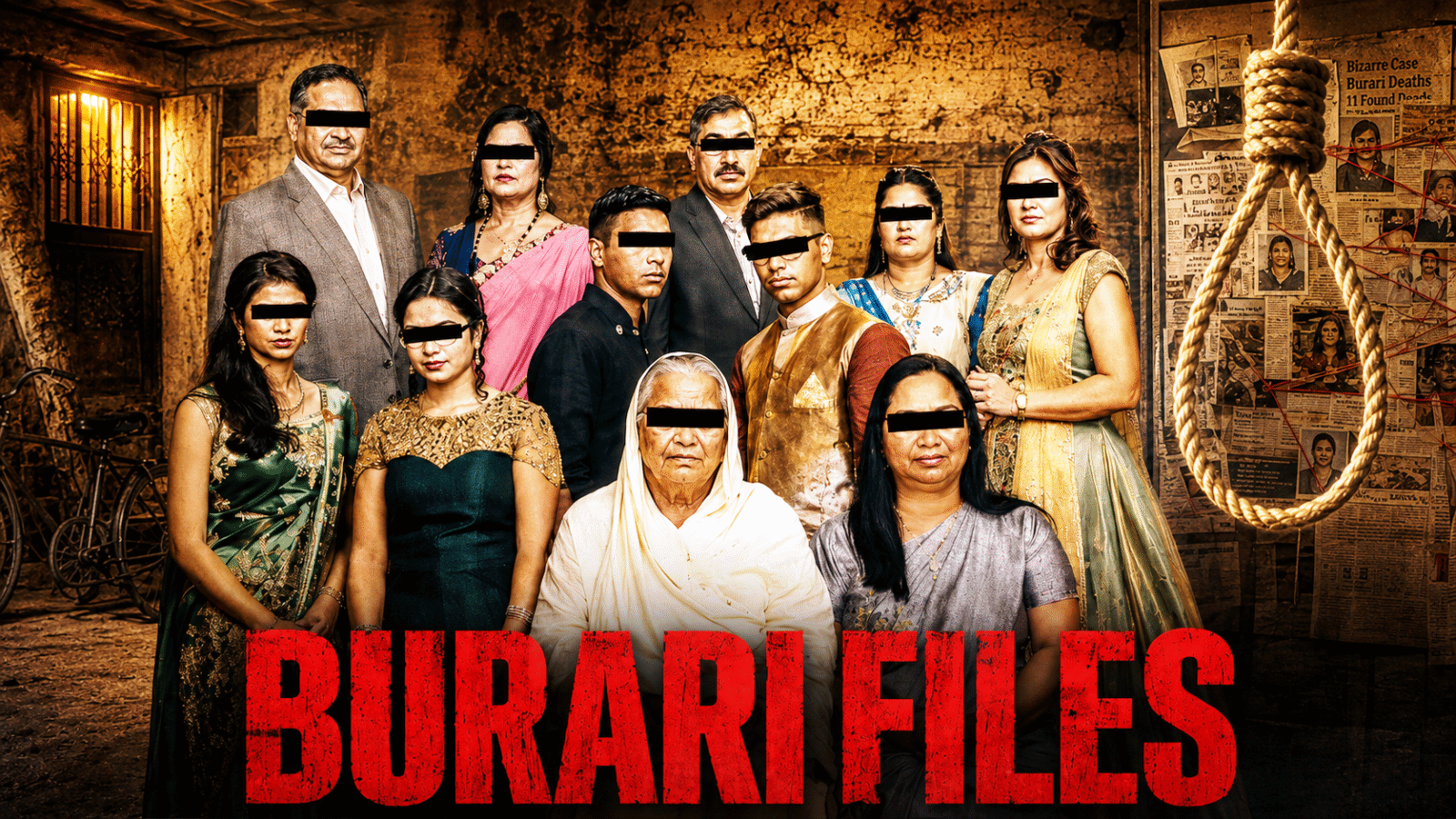
The discovery of eleven deceased members of the Chundawat family on the morning of July 1, 2018, inside their double-story residence in Sant Nagar, Burari, Delhi, remains one of the most complex challenges to modern Indian forensic science, investigative psychology, and criminal procedure.1 Ten of the eleven family members were found hanging in a precise, symmetrical, circular formation from an iron ventilating mesh grille attached to the ceiling of their central hallway.2 Their eyes were covered with cloth, their ears plugged with cotton, their mouths gagged and taped, and their limbs bound with cut bedsheets and telephone wires.2 The eleventh member, the elderly matriarch Narayani Devi, was found dead on the floor of an adjacent bedroom with ligature compression marks around her neck.2
Initially registered as a case of murder due to the bound limbs and covered faces of the deceased, the three-year investigation conducted by the Delhi Police Crime Branch ultimately ruled out external foul play.5 Instead, it unveiled a decade-long family delusion orchestrated by the youngest son, Lalit Singh Chundawat, who believed he was channeling the spirit of his deceased father, Bhopal Singh, to secure financial and spiritual salvation.1 This report evaluates the socio-psychological mechanisms of this shared delusion, outlines the forensic evidence compiled to eliminate external involvement, and analyzes the procedural and evidentiary mechanics utilized to achieve judicial closure when the primary instigator is deceased.
Initial Scene Discovery and Forensic Reconstruction
The sequence of events leading to the public discovery began in the early hours of July 1, 2018. Gurcharan Singh, a seventy-nine-year-old neighbor who frequently joined the family on morning walks, noticed that the family’s grocery and plywood shops—which consistently opened between 5:00 AM and 5:30 AM—remained closed.2 Upon approaching the unlocked residence at approximately 7:15 AM, Singh entered the house and discovered the ten suspended bodies.2 He immediately alerted the neighborhood, leading to a police control room call at approximately 7:30 AM.2
Head Constable Rajeev Tomar, the beat officer who was the first law enforcement official to cross the threshold, described the visual arrangement of the suspended bodies as resembling the “branches of a tree”.1 The physical scene was characterized by highly organized, ritualistic placements.5 Ten family members were suspended from a central iron ceiling grille, utilizing stools placed in close proximity to one another.2 The faces of the deceased were wrapped in cloth cut from a single bedsheet, their ears were plugged with cotton, their mouths were gagged and taped, and their hands and feet were tied behind their backs.2 The family dog, a mixed-breed pet named Tommy, was found chained on the terrace suffering from a high fever, serving as the sole surviving animal at the scene.2
The bizarre nature of the scene sparked a massive media frenzy and fueled multiple conspiracy theories.3 Public attention focused heavily on eleven plastic pipes protruding from a bare side wall of the house, seven facing downward and four straight.10 Speculation arose linking these pipes to the eleven deceased family members, split precisely between seven females and four males.3 Similarly, the press highlighted the presence of eleven iron window vents and eleven rods on the balcony railing.10
However, subsequent police and contractor testimonies debunked these theories, confirming the pipes were installed for ventilation and light during an ongoing renovation.10 Media sensationalism went as far as dragging the plumber’s daughter, a self-styled spiritual figure named Geeta Mata, into the investigation, accusing her of sorcery and orchestrating the mass suicide, a claim she vehemently denied and which the police subsequently disproved.10 The eldest surviving brother, Dinesh Singh Chundawat, eventually removed the pipes to dispel the persistent rumors of supernatural influence.11
Socio-Demographic Profile and Forensic Autopsy Findings
The Chundawat family had migrated from Tohana, Haryana, approximately twenty years prior to the incident, establishing a highly integrated and respected presence in the Sant Nagar community.2 Outwardly, they were educated, financially prosperous, and socially harmonious.1 Just fourteen days before the incident, the family had hosted a large celebration for the formal engagement of Priyanka Bhatia, a thirty-three-year-old software engineer.1
To reconstruct the exact physical and medical circumstances of the deaths, the Crime Branch relied on post-mortem examinations conducted at the All India Institute of Medical Sciences (AIIMS).14 The autopsies confirmed that all eleven individuals died of asphyxiation due to hanging or ligature strangulation, with no traces of chemical sedatives, tranquilizers, or poisons in their viscera.5
| Deceased Member | Age | Familial Relationship | Socio-Educational / Occupational Profile | Key Forensic and Post-Mortem Findings |
| Narayani Devi | 77 | Matriarch; mother of Bhuvnesh, Lalit, and Pratibha 2 | Homemaker; widow of late patriarch Bhopal Singh 2 | Found on the bedroom floor; died of asphyxiation due to ante-mortem ligature strangulation/partial hanging from an almirah handle.5 |
| Pratibha Bhatia | 57 | Widowed daughter of Narayani Devi 2 | Homemaker; mother of Priyanka 2 | Suspended from the iron ceiling grille, positioned slightly away from the central circle due to her widowed status.4 |
| Bhuvnesh Singh | 50 | Elder son of Narayani Devi 2 | Co-managed the family grocery and plywood business 1 | Suspended; post-mortem revealed minor superficial abrasions on his fingers and knuckles, indicating a late-stage, involuntary somatic struggle.12 |
| Lalit Singh | 45 | Younger son of Narayani Devi 2 | Co-managed the family business; primary initiator of the ritual 1 | Suspended in the central circle; hands and feet securely bound; no signs of external struggle.2 |
| Savita | 48 | Wife of Bhuvnesh Singh 2 | Managed household affairs 2 | Suspended in the central circle; blindfolded, gagged, and hands bound behind her back.2 |
| Tina | 42 | Wife of Lalit Singh 2 | Held a Master’s Degree in Sociology 13 | Suspended in the central circle; blindfolded, gagged, and hands bound.2 |
| Priyanka | 33 | Daughter of Pratibha Bhatia 2 | Software Engineer at an MNC; recently engaged 6 | Suspended in the central circle; co-authored the daily ritual diaries with Lalit.5 |
| Neetu | 25 | Elder daughter of Bhuvnesh Singh 2 | Educated; assisted in coordinating family routines 2 | Suspended in the central circle; eyes covered, ears plugged, and limbs bound.2 |
| Monu (Maneka) | 23 | Younger daughter of Bhuvnesh Singh 2 | Pursued a B.Sc. in Forensic Science from Delhi University 2 | Suspended in the central circle; eyes covered, ears plugged, and limbs bound.2 |
| Dhruv | 15 | Son of Bhuvnesh Singh 2 | School Student 2 | Suspended in the central circle; hands and feet bound with telephone wires.2 |
| Shivam | 15 | Son of Lalit Singh 2 | School Student 2 | Suspended in the central circle; hands and feet bound with telephone wires.2 |
A critical anatomical observation during the autopsies was the presence of semi-digested food in the stomachs of all ten family members who hung themselves, along with substantial fecal waste in their large intestines.12 In forensic pathology, individuals experiencing severe psychological distress, acute fear, or anticipation of death typically exhibit gastrointestinal disturbances or somatic clearing of the bowel.12 The presence of normal digestive waste and fecal matter confirmed that the family members were not in a state of physiological panic or pre-death anxiety prior to suspension, aligning with the theory that they believed they would survive the ritual.12
Psychological Genesis and the Delusional Framework
The psychological trajectory of the Chundawat family was fundamentally altered in 2007 following the death of the family patriarch, Bhopal Singh, from natural causes.2 Bhopal Singh had governed the multi-generational household with absolute, centralized authority.10 His death created a severe structural power vacuum and induced intense grief within the family.8
The younger son, Lalit Singh, had suffered multiple physical and psychological traumas prior to this loss, including a near-fatal assault that had left him temporarily mute.8 The family had historically ignored Lalit’s psychological struggles, associating psychiatric therapy with social shame and madness.8 During the ten-day mourning period for Bhopal Singh, while the family was listening to the recitation of the Garuda Purana, Lalit suddenly regained his speech.1 Rather than recognizing this as a psychosomatic resolution of trauma, the family interpreted it as a divine miracle, establishing Lalit’s spiritual authority.1
Following his recovery, Lalit convinced the family that the spirit of Bhopal Singh had possessed his body to guide them toward prosperity and general betterment.1 Lalit, primarily assisted by his nieces Priyanka and Neetu, began documenting these perceived visitations in eleven diaries spanning from 2007 to 2018.1 The diaries dictated strict, micro-managed household rules, financial choices, daily routines, and strict behavioral guidelines, such as the prohibition of non-vegetarian food and alcohol.1 Because the family’s economic status, business ventures, and social standing grew during these eleven years, the family members internalized a deep-seated cognitive reinforcement: absolute obedience to the diaries yielded safety, order, and prosperity.3
The Dynamics of Folie à Plusieurs (Shared Psychotic Disorder)
The Burari deaths are classified in psychiatric literature as a classic case of folie à plusieurs (specifically folie à famille), a rare shared psychotic disorder in which a dominant individual’s delusional system is systematically transmitted to and adopted by closely bound, insular family members.5 The psychological mechanisms that facilitated this cognitive encapsulation include:
- Insularity and Household Isolation: Although the family engaged normally with neighbors and customers, they maintained an impenetrable boundary regarding their internal spiritual practices.1 This structural isolation prevented external rational inputs from disrupting the growing delusion.5
- Patriarchal Cognition and Conformity: In highly patriarchal joint family structures, the authority of the male elder is absolute.10 Lalit successfully exploited this cultural script by positioning himself as the literal conduit of the deceased patriarch.1 Challenging Lalit’s commands was framed as filial impiety and spiritual rebellion.13
- Overriding Rationality via Cognitive Subordination: The presence of highly educated individuals—such as Priyanka (a software engineer), Tina (a sociology postgraduate), and Monu (a forensic science student)—presents a stark paradox.13 Forensic psychologists note that in environments of intense emotional proximity and shared trauma, religious and familial authority can easily bypass scientific or rational reasoning, especially when the ritual is not framed as a terminal act of self-destruction.13
The final entries in the diaries detailed a salvation ritual known as badh tapasya (banyan tree worship).1 The family was instructed to hang themselves in a formation resembling the aerial roots of a banyan tree to appease the spirits and achieve financial and spiritual elevation.1 Crucially, the diary notes explicit instructions regarding the post-ritual phase, detailing how they would assist one another in untying their hands after the process was completed.4 The family went to their deaths fully believing they would survive, expecting that the spirit of Bhopal Singh would intervene at the final moment to rescue them.4 This absolute conviction explains the lack of defensive wounds, the absence of panic, and the highly organized execution of the hanging.4
Procedural Mechanics of Investigation and Final Case Closure
Upon discovering the crime scene on July 1, 2018, the Delhi Police initially registered a case of murder under Section 302 of the Indian Penal Code (IPC).5 This registration was legally necessary due to the highly suspicious nature of the bindings, blindfolds, and gagged mouths, which strongly suggested external execution or coercion.5 However, the investigation was quickly transferred to the Crime Branch, led by DCP Joy N. Tirkey, which systematically utilized multi-disciplinary forensic techniques to eliminate external involvement.12
Digital and Physical Surveillance Analysis
The Crime Branch examined high-definition Closed-Circuit Television (CCTV) cameras positioned in the narrow lane directly facing the entrance of the house.12 The footage covered the entire window preceding the deaths.5 It conclusively demonstrated that no external individual had entered or exited the house during the critical hours of June 30 and July 1, 2018.5 Furthermore, the footage captured Tina and her teenage son, Shivam, purchasing the stools and the electrical/telephone wires used in the hangings earlier that evening, establishing that the physical apparatus of death was brought inside by the victims themselves.5
Forensic Document and Handwriting Examination
The discovery of eleven handwritten diaries next to the household temple was the turning point of the investigation.12 The Forensic Science Laboratory (FSL) in Delhi conducted a comprehensive forensic linguistic and handwriting comparison.11 They compared the diary entries spanning over a decade with writing samples found in school notebooks, office files, and personal records of the deceased.11 The FSL confirmed that the handwritings belonged exclusively to Lalit Singh and his niece Priyanka, aligning precisely with the theory that Lalit dictated the entries while Priyanka acted as his primary scribe.5
Navigating an Investigation with No Living Perpetrator
Under Indian criminal jurisprudence, when a First Information Report (FIR) is registered, the police are mandated to conduct a complete investigation.22 Upon completion, the Investigating Officer (IO) must submit a final report to the magistrate under Section 173 of the Code of Criminal Procedure, 1973 (now corresponding to Section 193 of the Bharatiya Nagarik Suraksha Sanhita, 2023 – BNSS).22
If the investigation yields insufficient evidence of an external crime, or if the primary accused is dead, the police do not file a charge sheet (which seeks prosecution).22 Instead, they file a “Closure Report” (specifically referred to as a “Cancellation Report” or “Final Report – Abated”).7
Legally, if an individual induces, coerces, or orchestrates the suicide of others, they can be prosecuted posthumously for Murder (Section 302) or Abetment to Suicide (Section 306 of the IPC / Section 108 of the Bharatiya Nyaya Sanhita, 2023 – BNS).5 In this tragedy, Lalit Singh was identified as the primary agent of influence who exerted cognitive coercion over the other ten family members.9 However, because Lalit Singh also died during the execution of the banyan tree ritual, any criminal proceeding against him stood abated.25 Under Indian law, criminal liability is personal, and the death of the sole accused terminates the prosecution’s power to try the individual.25 The trial court, upon receiving proof of death (the post-mortem and cremation records), enters an order of abatement, legally closing the case against the deceased.25
A police closure report is not binding upon the judiciary.22 When a closure report is presented, the Metropolitan Magistrate has three distinct legal paths 22:
- Accept the closure report and formally terminate the proceedings.22
- Reject the closure report, take cognizance of any perceived offense based on the recorded evidence, and summon suspects.22
- Direct the police to conduct “further investigation” under Section 173(8) of the CrPC / Section 193(9) of the BNSS if gaps exist.22
To protect the principles of natural justice, the court must issue a notice to the original informant or the immediate next of kin of the deceased before accepting a closure report.25 This gives the family the right to file a “Protest Petition” challenging the police findings and demanding reinvestigation.25
In the Burari case, the eldest surviving son, Dinesh Singh Chundawat, initially expressed deep dissatisfaction with the “ritual accident” theory, finding it implausible that his mother could have hung herself from a weak almirah handle.17 He threatened to contest the closure report.17 However, after reviewing the exhaustive multi-disciplinary evidence compiled by the Crime Branch, including the handwriting analyses matching his sister Priyanka and brother Lalit, the family did not file a formal Protest Petition.17 Consequently, in late 2021, the court accepted the Delhi Police’s closure report, marking the final legal termination of the case.29
Process and Court Admissibility of a Psychological Autopsy under Indian Law
Recognizing that conventional physical evidence alone could not explain the bizarre collective behavior of the Chundawat family, the Delhi Police requested the Central Forensic Science Laboratory (CFSL) of the Central Bureau of Investigation (CBI) to conduct a “psychological autopsy”.7
Process of Conducting a Psychological Autopsy
A psychological autopsy is a retrospective mental state evaluation designed to reconstruct a deceased individual’s cognitive, emotional, and psychological state preceding their death.21 Unlike physical autopsies that dissect the body, a psychological autopsy reconstructs the “mind”.33 The process is highly methodical, typically following structured forensic guidelines:
- Source Material Analysis: Deep linguistic and structural examination of personal documents, diaries, registers, letters, and digital footprint records (search histories, messages, social media posts) of the deceased.21
- Collateral Interviews: Conducting structured and cognitive interviews with surviving relatives, neighbors, friends, colleagues, and healthcare professionals who interacted with the deceased.21
- Timeline Reconstruction: Mapping the deceased’s behavioral shifts, lifestyle changes, and emotional triggers during the weeks or months leading up to the incident.21
- Expert Synthesis: A multidisciplinary team (comprising forensic psychologists, psychiatrists, and medical officers) reviews the synthesized data to determine the presence or absence of suicidal intent (animus moriendi) or psychopathology.21
The CFSL team analyzed the eleven diaries recovered from the Burari house alongside statements from Dinesh Singh Chundawat, Sujata Nagpal, and other close associates.30 The psychological autopsy report, submitted in September 2018, explicitly concluded that the deaths were not suicides in the traditional criminological sense, but rather a “ritualistic accident”.30 The family members did not possess animus moriendi (the intention to die).30 They were acting under a shared delusion of physical preservation, firmly believing that they would step down from the stools alive, spiritually elevated, and physically unharmed.4
Admissibility under Section 45 of the Indian Evidence Act / Section 39 of the BSA
The primary statutory gateway for introducing a psychological autopsy is Section 45 of the Indian Evidence Act, 1872 (or Section 39 of the BSA, 2023), which governs expert opinions.35 The statute states:
“When the Court has to form an opinion upon a point of foreign law, or of science, or art, or as to identity of handwriting or finger impressions, the opinions upon that point of persons specially skilled in such foreign law, science or art… are relevant facts.” 35
Because psychological autopsy is conducted by qualified forensic psychologists and psychiatrists utilizing structured clinical methods, its proponents argue it qualifies as an expert opinion on “science” under Section 45.32
The “Soft Science” Challenge and Jurisprudential Vacuum
Despite falling under Section 45, Indian courts maintain a highly cautious stance toward psychological evaluations.32 There are no binding Supreme Court or High Court precedents establishing standard guidelines or recognizing the psychological autopsy as a standalone, substantive scientific method.34
- Substantive vs. Corroborative Value: Courts consistently hold that psychological autopsies, like polygraphs or brain-mapping tests, do not possess substantive evidentiary value.34 They cannot form the sole basis of a conviction or legal finding.34 Rather, they are strictly corroborative in nature, serving only to bolster, explain, or contextualize hard physical evidence, such as autopsies, toxicological reports, and suicide notes.35
- The Daubert Standard Equivalence: In international jurisprudence, scientific evidence must meet the Daubert standard, which requires proof of reliability, peer-reviewed standardization, and a known error rate.32 Indian courts, while not explicitly bound by Daubert, apply a similar rigorous filter.32 Because the subject of a psychological autopsy is deceased, the clinical evaluation relies on secondary, retrospective, and potentially biased narratives provided by grieving family members.21 This inherent subjectivity makes it difficult to satisfy the court’s demand for objective, replicable scientific proof, leading judges to prioritize “hard sciences” like forensic toxicology and pathology over “soft sciences” like behavioral reconstruction.32
An opinion-based questionnaire survey among Indian forensic psychologists, mental health professionals, and academicians revealed that in eighty-four percent of professional jurisdictions, the psychological autopsy is not utilized as a standard investigative tool.21 Additionally, seventy-two percent of professionals emphasize that the psychological autopsy must be conducted within one to two months of the death, as the collateral information gathered from family and friends tends to suffer from memory decay and emotional bias over time.21
Comparative Psychological Autopsy Applications in Indian Jurisprudence
While still an emerging specialty in Indian forensic psychology, the psychological autopsy has been deployed in several other complex investigations:
| Feature / Case | The Sunanda Pushkar Case (2014) | The Burari Deaths Case (2018) | The Sushant Singh Rajput Case (2020) |
| Investigating Agency | Special Investigation Team (SIT), Delhi Police 35 | Crime Branch, Delhi Police; CFSL-CBI 5 | Central Bureau of Investigation (CBI); CFSL 37 |
| Primary Methodology | Structured interviews of 7 close associates; analysis of clinical history 35 | Exhaustive analysis of 11 diaries; interviews with surviving siblings 5 | Review of extensive diary notes, social media posts, WhatsApp chats, and interviews 41 |
| Core Behavioral Finding | Reconstructed a pattern of intense marital distress and emotional vulnerability 35 | Identified a shared delusional system (folie à famille) led by a dominant figure 5 | Studied behavioral changes and lifestyle trajectory from early days to death 41 |
| Final Intent Determination | Suicide influenced by persistent mistreatment and psychological stress 40 | Accidental tragedy; absence of animus moriendi (intention to die) 30 | Reconstructed mind to confirm depression-driven suicide vs. homicide 41 |
| Legal Outcome / Admissibility | Corroborated charges of abetment to suicide filed against the husband 35 | Enabled the acceptance of the closure report by the Metropolitan Magistrate 17 | Supported the elimination of homicidal theories, confirming suicide 41 |
While a psychological autopsy report is not permissible as primary, independent evidence to prove guilt in court, its legal utility in the pre-trial and investigative phases is profound.7 It assists investigating agencies in distinguishing between equivocal deaths (such as distinguishing between a highly staged homicide and a suicide pact).32 Furthermore, when reviewing a closure report, a magistrate must be convinced that the state is not prematurely terminating a homicide investigation.22 The psychological autopsy provides a rational, scientifically backed narrative that bridges the gap between physical anomalies and human behavior, allowing the magistrate to accept a closure report with confidence.34
Criminological Conclusions
The Burari deaths of 2018 represent a tragic intersection of deep psychological trauma, structural joint-family isolation, and absolute cultural subordination to patriarchal authority.8 The case remains a landmark in forensic criminology, illustrating how a shared delusion (folie à famille) can systematically override the cognitive and survival instincts of eleven individuals, including highly educated professionals.5
From a procedural perspective, the investigation demonstrates the efficiency of multi-disciplinary forensic science.5 By seamlessly combining digital surveillance, forensic linguistics, pathology, and toxicology, the Delhi Police Crime Branch successfully constructed an airtight case eliminating external foul play.5 This comprehensive evidence allowed them to file a definitive closure report under Section 173 of the CrPC, providing a clear legal resolution to a case devoid of a living perpetrator.16
Finally, the case highlighted the critical, albeit limited, role of the psychological autopsy in modern Indian jurisprudence.34 While psychological autopsies remain inadmissible as primary substantive evidence under Section 45 of the Indian Evidence Act due to the subjective nature of retrospective mental reconstruction, they have proven to be an indispensable investigative tool.7 They provide a crucial corroborative bridge that helps law enforcement decode bizarre human behavior, satisfies the judicial conscience of reviewing magistrates, and ensures that legal closure can be achieved in the face of otherwise inexplicable human tragedies.34
Top 10 Reliable Sources
1. The Times of India (Official Investigative & Closure Report Coverage)
- Reference Details: Sakshi Chand, “Burari deaths: Delhi Police closure report mentions no foul play” (The Times of India, October 21, 2021). 16
- Scope & Relevance: This report details the official conclusion of the three-year probe by the Delhi Police Crime Branch. It highlights the formal submission of the final closure report to the court, the FSL handwriting validation of the diaries, and mobile forensic findings that systematically ruled out third-party involvement.
- Source Link:(https://timesofindia.indiatimes.com/city/delhi/burari-deaths-police-closure-report-mentions-no-foul-play/articleshow/87169901.cms) 16
2. The Hindu (Primary Socio-Demographic & Scene Reconstruction)
- Reference Details: Hemani Bhandari, “Burari deaths: 11 bright people with one dark secret” (The Hindu, July 16, 2018). 1
- Scope & Relevance: An in-depth socio-demographic investigation outlining the multi-generational household structure, testimony of first-responding beat officer Head Constable Rajeev Tomar, the family’s background, and the immediate psychological shifts following the death of the patriarch in 2007.
- Source Link:(https://www.thehindu.com/news/cities/Delhi/11-bright-people-with-one-dark-secret/article24428709.ece) 42
3. Central Bureau of Investigation (CBI) Forensic Findings via NDTV
- Reference Details: Press Trust of India, “Delhi’s Burari Deaths Not Suicide But An Accident: Psychological Autopsy Report” (NDTV News, September 15, 2018).
- Scope & Relevance: Documents the official submission of the retrospective mental state evaluation conducted by the CBI’s Central Forensic Science Laboratory (CFSL). It details how linguistic analysis of the registers and collateral family interviews legally established the absence of animus moriendi (suicidal intent).
- Source Link:(https://www.ndtv.com/delhi-news/delhis-burari-deaths-not-suicide-but-an-accident-psychological-autopsy-report-1916739) 30
4. BSSS Journal of Management (Academic Literature on Folie à Famille)
- Reference Details: Anusha Sharma, “Burari Deaths: When Delusion Sublimates into Faiths” (BSSS Journal of Management, Vol. XVI, Issue I, 2025).
- Scope & Relevance: A peer-reviewed behavioral study analyzing the psychological parameters of shared psychotic disorder (folie à famille). It examines the role of Lalit Chundawat as the primary dominant agent and the gendered/patriarchal realities that bound the multi-generational family to the delusion.
- Source Link:(https://bssspublications.com/PublishedPaper/Publish_748.pdf) 43
5. The International Journal of Indian Psychology (Criminological Point-Cluster Study)
- Reference Details: “Point Cluster Suicide: Investigating PTSD and Quality of Life in The Community” (The International Journal of Indian Psychology, Vol. 12, Issue 1, 2024). 12
- Scope & Relevance: This academic paper evaluates the Burari deaths under the Center for Disease Control’s (CDC) criteria for “point-cluster suicides,” examining how sudden mass-fatalities in close-knit communities trigger post-traumatic stress and alter the quality of life within the neighborhood.
- Source Link: IJIP Journal 44
6. Indian Journal of Forensic Medicine and Toxicology (Forensic Prevalence & Protocol Analysis)
- Reference Details: Mayuri Sahay, “Psychological Autopsy as an Investigative Tool in India” (Indian Journal of Forensic Medicine and Toxicology, Vol. 18, No. 2, 2024). 18
- Scope & Relevance: An empirical study reflecting the scientific application, procedural methodology, and current institutional barriers to psychological autopsies. It emphasizes the critical 1-to-2-month post-death window required to prevent retrospective recall bias from family members.
- Source Link: Medico Publication 21
7. Medico-Legal Update / ResearchGate (Psychological Autopsy Scientific Framework)
- Reference Details: Dr. Sindhu Sudha Sahu, “Psychological Autopsy: A Tool for Resolving Equivocal Deaths” (Medico-Legal Update / AIIMS Bhubaneswar). 36
- Scope & Relevance: A comprehensive review mapping out the clinical protocols for retrospective mental evaluations, including face-to-face collateral interviews, health histories, and the application of Shneidman’s 16-point scientific criteria.
- Source Link: IJOP Portal 36
8. Indian Kanoon (Judicial Decision on Psychological Autopsy Admissibility)
- Reference Details: Smt. Kanaka Lakshmi B.M. vs State of Karnataka, Criminal Petition No. 4873 of 2025 (Karnataka High Court, Decided April 22, 2025).
- Scope & Relevance: A pivotal judicial precedent under Section 108 of the BNS/BNSS, 2023, where the High Court formally scrutinized a Psychological Autopsy Report (conducted in collaboration with NIMHANS) to determine the presence of mental entrapment, hopelessness, and its value as corroborative circumstantial evidence.
- Source Link: Indian Kanoon
9. Deccan Herald (State Application of Forensic Psychological Autopsies)
- Reference Details: Chetan B C, “State’s first: Forensic psychological autopsy used to probe suicide” (Deccan Herald, April 22, 2025). 37
- Scope & Relevance: This journalistic and forensic review tracks how Indian state CID departments are actively implementing forensic psychological autopsies (FPA) through clinical bodies like NIMHANS to dissect complex or equivocal suicides.
- Source Link:(https://www.deccanherald.com/india/karnataka/state-s-first-forensic-psychological-autopsy-used-to-probe-suicide-3505336) 37
10. Jus Corpus Law Journal (Occult & Legal Interplay Case Study)
- Reference Details: Meghana G & Tanush B, “From Belief to Tragedy: Unveiling the Layers of the Burari Case” (Jus Corpus Law Journal, September 2023). 29
- Scope & Relevance: This paper presents a complete legal analysis of the case, exploring how Indian criminal law navigates investigations involving extreme superstitious beliefs, shared delusional disorders, and the boundaries between religious devotion and fatal psychopathology.
- Source Link:(https://www.scribd.com/document/733745288/burari-murder-case) 29
Works cited
- Burari deaths: 11 bright people with one dark secret – The Hindu, accessed July 1, 2026, https://www.thehindu.com/news/cities/Delhi/11-bright-people-with-one-dark-secret/article24428709.ece
- Burari deaths – Wikipedia, accessed July 1, 2026, https://en.wikipedia.org/wiki/Burari_deaths
- On The New Delhi Murders and the Indian True Crime Boom, accessed July 1, 2026, https://crimereads.com/on-the-new-delhi-murders-and-the-indian-true-crime-boom/
- THE BURARI DEATH CASE – Jyoti Judiciary CLAT, accessed July 1, 2026, https://www.jyotijudiciaryclat.com/the-burari-death-case/
- Burari deaths – Grokipedia, accessed July 1, 2026, https://grokipedia.com/page/Burari_deaths
- Summary – Delhi’s Darkest Secret: The Burari Mass Suicide [VIDEO] – AI Podcast Transcript, accessed July 1, 2026, https://podcasttranscript.ai/library/delhi-s-darkest-secret-the-burari-mass-suicide
- Burari deaths: post-mortem reports likely on July 9 – The Hindu, accessed July 1, 2026, https://www.thehindu.com/news/cities/Delhi/burari-deaths-post-mortem-reports-likely-on-july-9/article24362635.ece
- The House that Fell Silent: The Untold Story of the Burari Deaths – Reflections.live, accessed July 1, 2026, https://reflections.live/articles/26233/house-that-fell-silent-the-untold-story-of-the-burari-deaths-by-arushi-mishra-29691-mnraddwr.html
- Burari Deaths: The Legal and Psychological Investigations of a Family Tragedy – Attorneys.Media, accessed July 1, 2026, https://attorneys.media/burari-deaths-legal-psychology/
- burari deaths: when delusion sublimates into faiths – BSSS Publications, accessed July 1, 2026, https://bssspublications.com/Home/IssueDetailPage?IsNo=748
- A year on, Burari house fights ‘horror’ tag – The Hindu, accessed July 1, 2026, https://www.thehindu.com/news/cities/Delhi/a-year-on-burari-house-fights-horror-tag/article28139591.ece
- Burari death case – iPleaders, accessed July 1, 2026, https://blog.ipleaders.in/burari-death-case-insight/
- House of Secrets: The Burari Deaths And The Gendered Realities Of Our Households, accessed July 1, 2026, https://feminisminindia.com/2021/11/09/house-of-secrets-the-burari-deaths-and-the-gendered-realities-of-our-households/
- Aakhri Sach – Grokipedia, accessed July 1, 2026, https://grokipedia.com/page/Aakhri_Sach
- Burari Deaths: Post-Mortem Confirms No Foul Play, Says Police – The Quint, accessed July 1, 2026, https://www.thequint.com/news/india/police-say-post-mortem-reports-burari-deaths-rule-out-foul-play
- Burari deaths: Delhi Police closure report mentions no foul play – The Times of India, accessed July 1, 2026, https://timesofindia.indiatimes.com/city/delhi/burari-deaths-police-closure-report-mentions-no-foul-play/articleshow/87169901.cms
- Burari: A Year Since Delhi Family Deaths, Relative Says Dissatisfied With Probe – NDTV, accessed July 1, 2026, https://www.ndtv.com/delhi-news/burari-a-year-since-delhi-family-deaths-relative-says-dissatisfied-with-probe-2061851
- The Secrets of the Burari Deaths: A Tale Between Delusion and Faith – The Academic, accessed July 1, 2026, https://theacademic.in/wp-content/uploads/2026/03/195a.pdf
- EXPLORING THE ROLE OF LANGUAGE AND FORENSIC SCIENCE IN CRIMINAL INVESTIGATIONS; WITH A CASE STUDY ON THE BURARI MASS SUICIDES Ri – JLRJS, accessed July 1, 2026, https://jlrjs.com/wp-content/uploads/2025/06/117.-Riddhi-Kalan.pdf
- the burari enigma: a forensic linguistic investigation of shared psychotic disorder – ResearchGate, accessed July 1, 2026, https://www.researchgate.net/publication/391547901_THE_BURARI_ENIGMA_A_FORENSIC_LINGUISTIC_INVESTIGATION_OF_SHARED_PSYCHOTIC_DISORDER
- Exploring the Prevalence of Psychological Autopsy in Indian Context, accessed July 1, 2026, https://medicopublication.com/index.php/ijfmt/article/download/20827/17307/42703
- 2 FREQUENTLY ASKED QUESTIONS ( FAQs) – Maharashtra Civil Service, accessed July 1, 2026, https://maharashtracivilservice.org/cdn/51deb94e9160b.pdf
- CrPC Qn No Ouestion Question Type Year of Question 1 Who is, accessed July 1, 2026, https://drnishikantjha.com/booksCollection/crpc.pdf
- 05.06.2026 HIGH COURT OF DELHI AT NEW DELHI No. 184 /Rules/DHC Dated, accessed July 1, 2026, https://delhihighcourt.nic.in/files/2026-06/cause-list/combined_cause_list_05.06.2026.pdf
- Reserved On: 04.04.2024 vs State Of Jammu And Kashmir Th.Director on 20 April, 2024 – Indian Kanoon, accessed July 1, 2026, https://indiankanoon.org/doc/89335510/
- criminal-law-judgement-compilation-2020.pdf, accessed July 1, 2026, https://ladc.mizoram.gov.in/uploads/attachments/2024/11/35103f2e8db943bc0bd3c268903639cf/criminal-law-judgement-compilation-2020.pdf
- State vs Ricky on 18 October, 2025 – Indian Kanoon, accessed July 1, 2026, https://indiankanoon.org/doc/155241690/
- citedby: 117903 – Indian Kanoon, accessed July 1, 2026, https://indiankanoon.org/search/?formInput=citedby%3A%20117903&pagenum=8
- (PDF) OTT Platforms & Digital Media – ResearchGate, accessed July 1, 2026, https://www.researchgate.net/publication/360411296_OTT_Platforms_Digital_Media
- Delhi’s Burari Deaths Not Suicide But An Accident: Psychological Autopsy Report – NDTV, accessed July 1, 2026, https://www.ndtv.com/delhi-news/delhis-burari-deaths-not-suicide-but-an-accident-psychological-autopsy-report-1916739
- It was an accident: Report reveals how ritual went wrong for Burari family – India Today, accessed July 1, 2026, https://www.indiatoday.in/india/story/it-was-an-accident-report-reveals-how-ritual-went-wrong-for-burari-family-1340281-2018-09-15
- Psychological Autopsies – ResearchGate, accessed July 1, 2026, https://www.researchgate.net/publication/288177382_Psychological_Autopsies
- APPLICATION OF PSYCHOLOGICAL AUTOPSY IN … – Brillopedia, accessed July 1, 2026, https://www.brillopedia.net/post/application-of-psychological-autopsy-in-investigation-of-suicidal-deaths-in-india-an-insight
- Psychological Autopsy: Supreme & High Court Rulings?, accessed July 1, 2026, https://supremetoday.ai/issue/psychological-autopsy-supreme-court-decisions
- Psychological Autopsy: A key to unsolved Mystery – The Times of India, accessed July 1, 2026, https://timesofindia.indiatimes.com/readersblog/the-lawyers-leaflet/psychological-autopsy-a-key-to-unsolved-mystery-44735/
- Psychological Autopsy: A Tool for Resolving Equivocal Deaths, accessed July 1, 2026, https://ijop.net/index.php/mlu/article/download/3686/3046/7416
- State’s First Forensic Psychological Autopsy Used in Suicide Probe – Deccan Herald, accessed July 1, 2026, https://www.deccanherald.com/india/karnataka/state-s-first-forensic-psychological-autopsy-used-to-probe-suicide-3505336
- helik psychological examination, accessed July 1, 2026, https://www.helik.in/psy
- Evidentiary Value of Forensic Psychological Investigative Techniques in Indian Judiciary – A Case Study of Judgments. – Jetir.Org, accessed July 1, 2026, https://www.jetir.org/papers/JETIR2212061.pdf
- The psychological autopsy: Unraveling the mind of the deceased – Type of the Paper (Article, accessed July 1, 2026, https://ampphealthjournal-network.org/wp-content/uploads/2024/12/AMPPH_2025_196_201.pdf
- Sushant Singh Rajput death case: CBI CFSL team to conduct psychological autopsy. Details here – India Today, accessed July 1, 2026, https://www.indiatoday.in/movies/celebrities/story/sushant-singh-rajput-death-case-cbi-cfsl-team-to-conduct-psychological-autopsy-details-here-1714748-2020-08-25
- Ritualistic Murders In India – IJCRT, accessed July 1, 2026, https://ijcrt.org/papers/IJCRT2506412.pdf
- BURARI DEATHS: WHEN DELUSION SUBLIMATES INTO FAITHS – BSSS Publications, accessed July 1, 2026, https://bssspublications.com/PublishedPaper/Publish_748.pdf
- Point Cluster Suicide: Investigating PTSD and Quality of Life in The Community – IJIP, accessed July 1, 2026, https://ijip.in/wp-content/uploads/2024/02/18.01.079.20241201.pdf
- Burari Murder Case | PDF | Veneration Of The Dead | Anthropology – Scribd, accessed July 1, 2026, https://www.scribd.com/document/733745288/burari-murder-case