
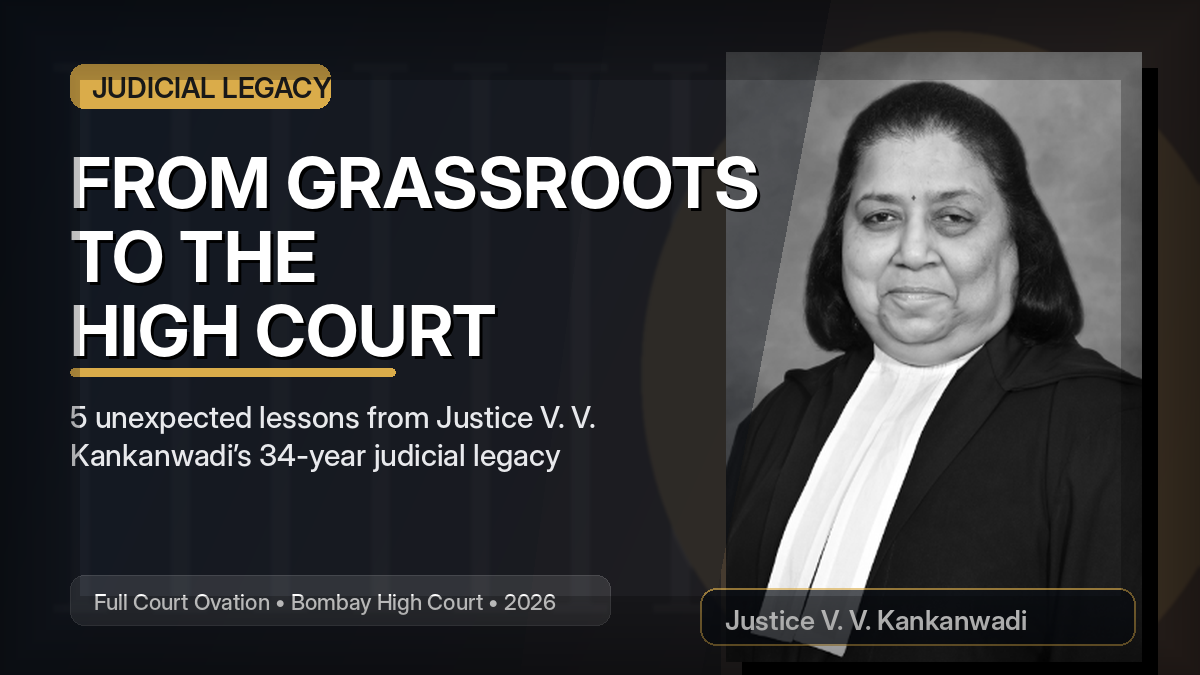
At exactly 4:45 PM on June 23, 2026, the central hall of the Bombay High Court witnessed a rare and evocative scene: a Full Court Ovation1. The atmosphere was dense with the solemnity of an era ending as members of the Bar and Bench converged to honor Justice Vibha Vasant Kankanwadi1. For a judicial historian, this valedictory moment represented more than a standard career conclusion; it marked the culmination of a marathon of service spanning exactly 33 years, 11 months, and 22 days2. Her journey—a rise from the absolute bottom of the judicial hierarchy to the constitutional bench of the High Court—stands as a compelling validation of the “cadre” system within the Indian judicial architecture2.
This historic transition occurred during a period of leadership change at the Bombay High Court, following the appointment of Justice Ravindra V. Ghuge as the Acting Chief Justice on June 2, 20264, succeeding Chief Justice Shree Chandrashekhar, who was elevated to the Supreme Court of India5. Justice Kankanwadi’s retirement speech emphasized that a judge’s solemn duty is to administer justice, protect constitutional values, and maintain public confidence in the judicial system1. Her career offers profound administrative, gender, and socio-legal insights into the evolution of contemporary Indian jurisprudence.
The structural mechanics of the grassroots ascent
In the landscape of the Indian judiciary, elevation to a constitutional court typically follows one of two paths: direct appointment from the practicing Bar or promotion from the senior District Judge cadre3. Justice Kankanwadi’s trajectory was far more exceptional. She began her career at the very first rung of the ladder as a Civil Judge Junior Division (CJJD) and Judicial Magistrate First Class (JMFC), having entered through the entry-level competitive examination on July 1, 1992, in Thane2.
This grassroots ascent represents a significant institutional milestone. By rising from the local trial courts to the High Court, she validated the aspirations of the lower ranks of the state judiciary. Reflecting on this rare feat, her career is viewed not as a mere job, but as the fulfillment of a solemn responsibility to uphold the faith of litigants—a journey proving that the highest judicial offices are accessible through merit, patience, and persistence1.
A career judge who transitions through every layer of the judicial hierarchy possesses a highly granular understanding of trial court realities. Direct-Bar appointees often lack immediate familiarity with the administrative bottlenecks, police investigation deficits, and ground-level evidentiary challenges that define the lower courts. Justice Kankanwadi’s career trajectory reflects this comprehensive experience.
| Position / Designation | Jurisdiction / Venue | Tenure / Appointment Date | Key Institutional Impact & Functions |
| Advocate | Satara, Pune, and Bombay High Court Appellate Side | 1987 – 1992 | Practiced civil and criminal law within the local and appellate structures2. |
| Civil Judge Junior Division & JMFC | Thane, Kolhapur, and Pune Cantonment | July 1, 1992 | Entered the state judicial services through a competitive, entry-level cadre exam2. |
| Additional District & Sessions Judge | Sangli, Jaysingpur, and Kolhapur | March 26, 2002 | Managed intermediate civil appeals and sessions trial jurisdictions2. |
| Joint Director & Deputed Trainer | Judicial Officers’ Training Institute, Nagpur & Maharashtra Judicial Academy, Uttan | Intermittent Deputations | Shaped, mentored, and trained over 300 to 350 junior judicial officers2. |
| District & Sessions Judge | Nagpur and Sangli | Post-2002 | Directed district-level judicial administration and presided over major sessions trials2. |
| Principal District & Sessions Judge | Wardha and Solapur | June 2013 | Supervised the administrative machinery of the district courts as principal officer2. |
| Additional Judge | Bombay High Court | June 5, 2017 | Promoted to the High Court bench, validating the upward mobility of the cadre system2. |
| Permanent Judge | Bombay High Court | April 12, 2019 | Confirmed as a permanent constitutional judge3. |
Criminal adjudication and the deconstruction of gender stereotypes
Justice Kankanwadi’s tenure was marked by her quiet dismantling of entrenched gendered expectations. Upon her arrival at the High Court, there was an initial apprehension among certain sections of the Bar regarding a female judge presiding over heavy criminal rosters, most notably quashing proceedings under Section 482 of the Code of Criminal Procedure (CrPC)1. This doubt was rooted in a misguided stereotype that female judges might lack the temperament or analytical detachment required for high-stakes criminal adjudication.
She responded to these apprehensions with procedural discipline, meticulous preparation, and absolute impartiality1. By providing every counsel a fair opportunity to argue and demonstrating an exhaustive command of criminal jurisprudence, she effectively erased those initial prejudices. Ultimately, she carved out a historic legacy, becoming the first female administrative judge of the Aurangabad Bench, commanding immense institutional respect1.
Her contribution to gender-sensitive and child-centric jurisprudence is illustrated by her landmark rulings. In XYZ vs. State of Maharashtra (2023), her division bench upheld a life conviction sentence for a father convicted of raping his 12-year-old daughter6. The defense had argued that the victim’s failure to immediately disclose the incident to her mother cast doubt on the prosecution’s case6. Justice Kankanwadi introduced critical psychological realism into the evaluation of evidence, observing:
“Unless the comfort is given to the girl, she will not disclose such facts to anybody. That comfort appears to have been given by the mother or after she saw mother, she became comfortable and then she disclosed the incident to her mother.”6
She further noted that the relationship between the accused and the victim introduces severe psychological pressure, requiring courts to analyze the child’s specific temperament rather than expecting uniform behavior across all victims6.
Furthermore, in a highly publicized case involving the execution of a Daanpatra (donation deed) on stamp paper, where a father “donated” his minor daughter to a self-styled village temple priest, Justice Kankanwadi intervened proactively7. She asserted that “a girl is not a property which can be given in donation,” directing the local Child Welfare Committee to hold an expedited inquiry to secure the minor’s future7.
Operational efficiency and bureaucratic accountability
The volume of Justice Kankanwadi’s work is historically significant. During her nine-year tenure at the High Court, she disposed of nearly 24,000 cases1. This productivity was sustained by her commitment to continuous professional development. Despite a heavy caseload, she maintained her academic edge—having ranked fourth in Shivaji University during her first year of LLB2—and holding a specialized Diploma in Cyber Law from Asian Law School to navigate complex digital evidence and modern legal issues2.
Her judicial philosophy was anchored in a profound sense of independence. As she noted during her farewell address:
“The satisfaction of work can be achieved or felt when you do your job to the best of your ability. But this isn’t a job which can be done to the satisfaction of others or please anyone.”1
This unyielding stance on integrity was echoed by Acting Chief Justice Ghuge, who commended her for judging with a clear conscience and maintaining the highest moral traditions of the bench1.
Justice Kankanwadi actively used her administrative authority to challenge bureaucratic delays that directly impacted citizens. In Writ Petition No. 1520 of 2026, she addressed delays in the “Shalarth Pranali” (the electronic grant-in-aid salary verification system for teachers in Maharashtra)8. Her division bench observed that salaries cannot be held hostage to administrative delays and established a clear timeline to prevent such bottlenecks8.
The court ruled that when a teacher’s appointment is approved, the Education Officer must complete the initial verification within 30 days, and the Divisional Deputy Director of Education must finalize the Shalarth ID issuance within another 30 days8. This systemic reform sought to ensure that administrative systems function as tools of efficiency rather than instruments of bureaucratic delay8.
| Adjudicatory Subject | Standard Adjudicatory Framework | Justice Kankanwadi’s Jurisprudential Intervention |
| Teacher Service Approvals | Educational departments often delay teaching approvals and salary disbursements indefinitely. | Mandated a strict 60-day deadline for verification and electronic integration into the Shalarth electronic grant-in-aid system8. |
| Trial Court Cruelty Process | Trial courts frequently issue criminal process under Section 498-A IPC without scrutinizing structural relationships. | Censured trial courts for issuing process mechanically without examining if the accused is a relative of the husband9. |
| Guardianship & Minor Rights | Guardians occasionally attempt to execute personal deeds involving minors, treating them as personal property. | Asserted that a minor child cannot be treated as property to be donated under a “Daanpatra,” ordering protective child welfare interventions7. |
| Juvenile Justice Gaps | State bodies frequently allow key vacancies in child welfare panels to linger, offering brief, ritualistic police training. | Mandated a June 30, 2026 deadline for filling CWC and JJB vacancies and criticized short training schedules as inadequate10. |
The judicial mentor and trial-level system reformer
Justice Kankanwadi’s long-term impact on the state judiciary is preserved through her roles at the Judicial Officers Training Institute (JOTI) in Nagpur and the Maharashtra Judicial Academy at Uttan, Thane2. In these institutions, she personally trained and mentored over 300 to 350 judicial officers, bridging the gap between abstract academic doctrine and the practical realities of the district judiciary2.
Her training philosophy focused heavily on addressing systemic deficiencies in the lower courts. She was a vocal critic of the mechanical manner in which some trial courts and police officers approach criminal investigations and matrimonial disputes. For example, in Jyoti Mahire vs. State of Maharashtra, her bench quashed a criminal process issued under Section 498-A of the Indian Penal Code against a woman, criticizing the trial court for failing to assess the essential ingredients of the offense9. She observed:
“The order of issuing process is a serious matter and cannot be done without proper application of mind. However, trial courts nowadays are not paying attention to the ingredients of the offence and the facts.”9
Her commitment to structural reform was further demonstrated in her handling of child welfare. In a 2026 suo motu public interest litigation concerning child protection systems, her division bench pulled up the Maharashtra government for systemic gaps in district Child Welfare Committees (CWCs) and Juvenile Justice Boards (JJBs)10. She set a strict deadline of June 30, 2026, for filling all key vacancies and criticized the state’s proposed six-day training program for Special Juvenile Police Units (SJPUs) as inadequate10. She insisted that training on sensitive legislation like the POCSO Act and anti-human trafficking protocols must be substantive and not “a mere ritualistic exercise”10.
Philosophical synthesis and legacy
The farewell proceedings for Justice Kankanwadi reflected the Sanskrit motto Yato Dharmastato Jayah (यतो धर्मस्ततो जयः), which translates to “Where there is righteousness (dharma), there is victory”1. This principle highlights that the application of law must be guided by ethical standards, equity, and a commitment to justice.
This commitment to ethical balance extended to her personal life. While managing a heavy caseload and disposing of thousands of cases, she also personally cared for her elderly father, often declining public invitations to fulfill her caregiving duties.
Ultimately, Justice Kankanwadi’s journey shows that the authority of the bench is best sustained not through the exercise of raw power, but through a steady, quiet commitment to righteous service1. Her legacy challenges the legal community to maintain patience, thoroughness, and a clear conscience in an increasingly hurried world1.
10 Top Reliable Sources
- Bombay High Court Official Roster (cdnbbsr.s3waas.gov.in): Contains official records on the approved judge strength of the Bombay High Court and the service-cadre tenure of Justice Vibha Vasant Kankanwadi3.
- CaseOn Judge Profile (caseon.in): Provides a detailed chronology of her education, early bar practice (1987–1992), and appointments through the judicial hierarchy starting as Civil Judge Junior Division on July 1, 19922.
- LiveLaw Farewell Report (livelaw.in): Documents her valedictory address on Tuesday, June 23, 2026, detailing her comments on the role of advocacy, judicial character, and administrative milestones at the Aurangabad Bench1.
- LawBeat Case Report on XYZ v. State of Maharashtra (lawbeat.in): Outlines the child psychology analysis and evidentiary standards used by her division bench in POCSO-related criminal appeals6.
- The Times of India Case Analysis (Jyoti Mahire Case) (timesofindia.indiatimes.com): Examines her bench’s critique of the mechanical issuance of process by trial courts under Section 498-A of the IPC9.
- The Hindustan Times Legal Report on the Daanpatra Case (hindustantimes.com): Highlights her landmark single-bench ruling declaring that minor daughters cannot be treated as property to be given in donation7.
- Bombay High Court Official Profile of ACJ Ravindra Ghuge (bombayhighcourt.gov.in): Details the notification, background, and assumption of leadership by Acting Chief Justice Ghuge on June 2, 20264.
- Wikipedia Entry on Shree Chandrashekhar (en.wikipedia.org): Records the legal transitions of the 49th Chief Justice of the Bombay High Court, Shree Chandrashekhar, to the Supreme Court on June 2, 20265.
- Bombay High Court Judgment in Writ Petition No. 1520 of 2026 (bombayhighcourt.nic.in): Features the division bench’s ruling on electronic grant-in-aid verification (“Shalarth Pranali”) and strict timelines for educational approvals8.
- The Times of India Report on Child Welfare PIL (timesofindia.indiatimes.com): Details her division bench’s June 2026 orders demanding structural reforms, staffing of child protection panels, and extended training for police officers10.
Works cited
- Judge’s Job Is Not To Please Anyone, Satisfaction Lies In Doing Justice: Bombay High Court Justice Vibha Kankanwadi In Farewell Speech – LiveLaw, https://www.livelaw.in/high-court/bombay-high-court/bombay-high-court-justice-vibha-kankanwadi-retires-538719
- Justice V. V. Kankanwadi – Judge Profile – Caseon, https://www.caseon.in/judge/justice-smt-v-v-kankanwadi
- AS ON 01/07/2025, https://cdnbbsr.s3waas.gov.in/s35d6646aad9bcc0be55b2c82f69750387/uploads/2025/07/20250701245225626.pdf
- High Court of Bombay, https://bombayhighcourt.gov.in/bhc/judge-profile/eyJpdiI6IktIU3Y1WVdYOXVqTTBKNDdub09pcEE9PSIsInZhbHVlIjoidkExL3NpOUFuQkVKUzF4Y1g1T0hZZz09IiwibWFjIjoiOGEwYmUzZmE4NmQ2YjExMjAwMjFmYWMyYjMwNzE4MWY2YmM2NTZjMzZhMjQxN2U2ZDY3Y2FkMGY0YTJhZmY5ZCIsInRhZyI6IiJ9
- Shree Chandrashekhar – Wikipedia, https://en.wikipedia.org/wiki/Shree_Chandrashekhar
- Bombay High Court Upholds Life Imprisonment for Man Who Raped his Daughter – LawBeat, https://lawbeat.in/news-updates/bombay-high-court-upholds-life-imprisonment-man-who-raped-his-daughter
- Minor daughter not a property to be given away as Daan: HC – Hindustan Times, https://www.hindustantimes.com/cities/mumbai-news/minor-daughter-not-a-property-to-be-given-away-as-daan-hc-101643386565345.html
- 2026:BHC-AUG:10507-DB – Bombay High Court, https://bombayhighcourt.nic.in/generatepdf.php?bhcpar=cGF0aD0uL3dyaXRlcmVhZGRhdGEvZGF0YS9hdXJqdWRnZW1lbnRzLzIwMjYvJmZuYW1lPTIwMDEwMDAxNTIwMjAyNl8yLnBkZiZzbWZsYWc9TiZyanVkZGF0ZT0mdXBsb2FkZHQ9MTIvMDMvMjAyNiZzcGFzc3BocmFzZT0yMzAzMjYxNzAzNDEmbmNpdGF0aW9uPTIwMjY6QkhDLUFVRzoxMDUwNy1EQiZzbWNpdGF0aW9uPSZkaWdjZXJ0ZmxnPU4maW50ZXJmYWNlPU4=
- Trial courts not paying attention to ingredients of offence: HC bench – The Times of India, https://timesofindia.indiatimes.com/city/aurangabad/trial-courts-not-paying-attention-to-ingredients-of-offence-hc-bench/articleshow/118459786.cms
- HC pulls up Maharashtra govt over child welfare gaps after suo motu PIL, sets June 30 deadline for key appointments | Chhatrapati Sambhajinagar News – The Times of India, https://timesofindia.indiatimes.com/city/aurangabad/hc-pulls-up-maharashtra-govt-over-child-welfare-gaps-after-suo-motu-pil-sets-june-30-deadline-for-key-appointments/articleshow/131641404.cms