
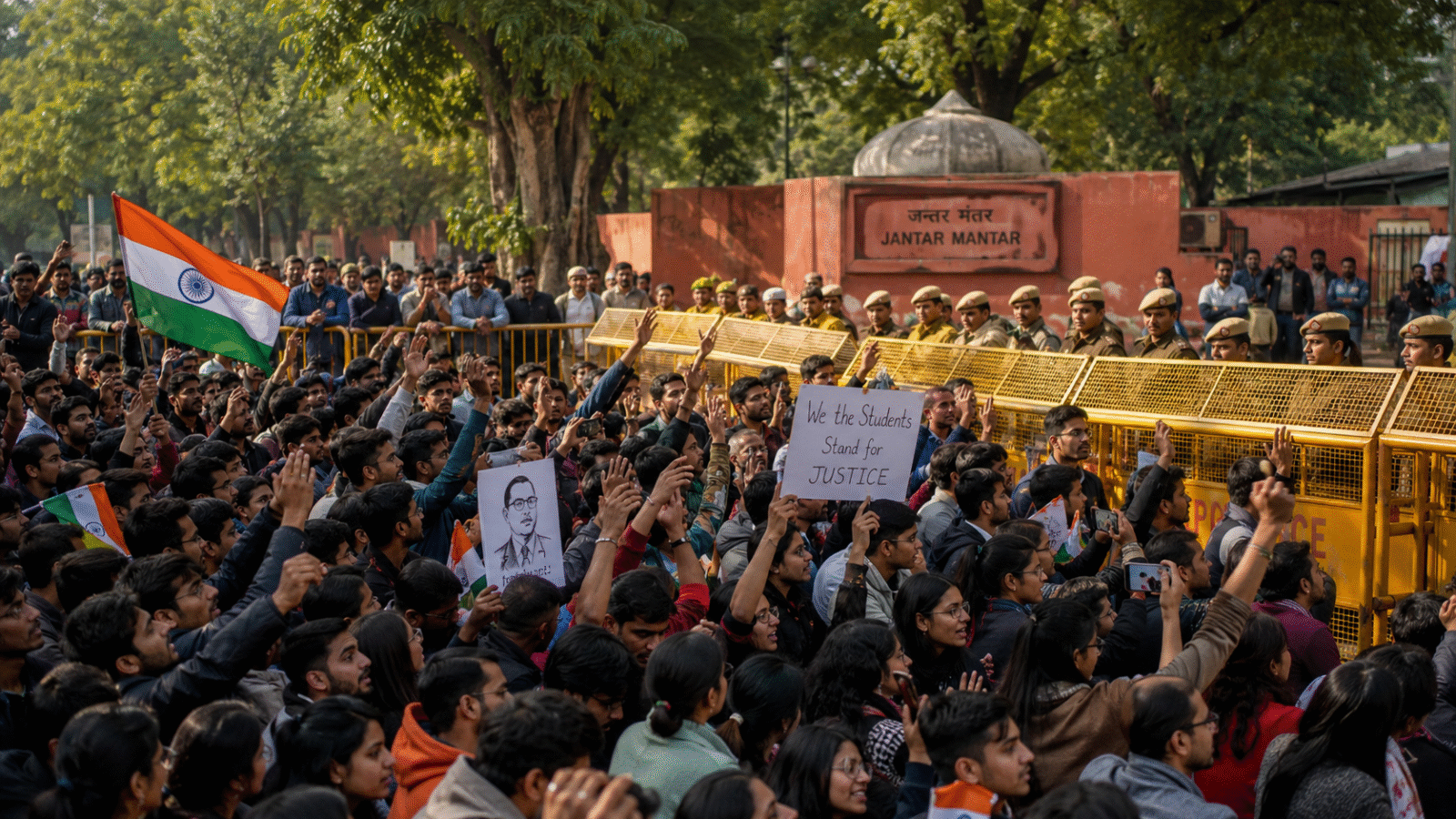
The Jantar Mantar student movement of 2026 emerged from growing anger over alleged NEET-UG paper leaks, CBSE evaluation failures and the absence of meaningful institutional accountability. Organised under the satirical banner of the Cockroach Janta Party, the campaign moved rapidly from social-media dissent to mass mobilisation, Sonam Wangchuk’s hunger strike and the controversial Sansad Chalo march. This research paper examines the movement’s educational, constitutional, administrative and political dimensions, including police action, Section 163 of the BNSS and allegations that political actors attempted to hijack a student-led campaign.
1. Introduction: Digital Precarity and the Rise of Parodic Resistance
In the contemporary digital landscape, outrage algorithms and meme cultures have fundamentally altered the dynamics of collective bargaining and political dissent10. The emergence of the Cockroach Janta Party (CJP) in mid-May 2026 illustrates how marginal, highly precarious youth demographics can weaponize state-level pathologization into a formidable instrument of street mobilization3.
The movement’s nomenclature is a direct response to oral observations made on May 15, 2026, during a Supreme Court contempt petition, Sanjay Dubey v. Registrar General, Delhi High Court & Anr.3. During a heated exchange regarding the delay in designating Senior Advocates and the prevalence of fraudulent law degrees, a two-judge bench comprising Chief Justice of India (CJI) Surya Kant and Justice Joymalya Bagchi criticized what they characterized as frivolous, systematic attacks on constitutional offices3. The Chief Justice observed:
“There are youngsters like cockroaches, who don’t get any employment or have any place in profession… and they start attacking everyone [on social media, RTI activism, etc.]… and they are like parasites of society”3.
Though the CJI issued an official clarification on May 16, 2026, stating his criticisms were strictly limited to individuals practicing with “fake and bogus degrees” rather than the broader Indian youth12, the “cockroach” label catalyzed immediate national outrage3.
Turning this pathologizing rhetoric on its head, Abhijeet Dipke, a 30-year-old digital strategist and Boston University graduate, founded the “Cockroach Janta Party” (CJP) as a parodic political front on May 16, 20263. Under the satirical tagline “Voice of the Lazy & Unemployed” and using AI tools to design a biting, populist manifesto, the CJP’s Instagram handle rapidly surpassed 22 million followers within under a week, outstripping the official pages of established political parties3. What began as social media parody, however, quickly found a structural base of material grievances on June 6, 2026, as millions of students confronted systemic failures in national examination frameworks2.
2. Chronological Escalation: From Localized Academic Grievances to National Confrontation
The trajectory of the July 2026 Jantar Mantar movement is characterized by a rapid, multi-stage escalation that systematically expanded the campaign’s scale, moral weight, and political dimensions:
[May 15, 2026] ———-> [May 16, 2026] ———> [June 6, 2026] ———> [June 28, 2026] ——–> [Mid-July 2026] ——-> [July 20, 2026]
CJI “Cockroach” Abhijeet Dipke First Offline Sonam Wangchuk Celebrity & Sansad Chalo
Oral Observation Launches Parodic CJP Protest at Jantar Joins Protest with Opposition Influx March & Clash;
in Supreme Court Digital Platform Mantar (NEET Leak) Indefinite Fast to Protest Camp Gherao of Parliament
- The Satirical Spark (May 15–16, 2026): CJI Surya Kant’s courtroom remarks comparing unemployed activists to “cockroaches” ignited online fury3. Digital strategist Abhijeet Dipke launched the “Cockroach Janta Party” (CJP) as a parody on May 16, which immediately achieved massive viral reach3.
- Taking to the Streets (June 6, 2026): The CJP transitioned from a social media phenomenon into a physical street protest, holding its first major demonstration at Jantar Mantar to demand the resignation of Union Education Minister Dharmendra Pradhan2.
- The Moral Core (June 28, 2026): Eminent Ladakhi educator and activist Sonam Wangchuk joined the protest camp, initiating an indefinite, non-violent hunger strike2. His participation shifted the movement’s image from an online youth meme into a serious moral campaign, drawing middle-class parents, senior citizens, and civic organizations to Jantar Mantar2.
- The Celebrity and Political Influx (Mid-July 2026): As Wangchuk’s health deteriorated, prominent public figures, Bollywood celebrities (such as Shabana Azmi and Prakash Raj), and senior opposition leaders visited the camp, amplifying the movement’s visibility on a national scale4.
- The Transition to Confrontation (July 20, 2026): Shifting away from static demonstrations, the movement announced a “Sansad Chalo” march to coincide with the opening day of the Monsoon Session of Parliament2. This marked the movement’s transition from a localized student sit-in into a direct, confrontational challenge to the state9.
3. Structuring Grievances: NEET-UG Exam Leaks and the CBSE OSM Scandal
The offline mass mobilization of the CJP was fueled by two concurrent institutional crises within India’s educational evaluation infrastructure2:
3.1 The NEET-UG Paper-Leak Crisis
The immediate trigger for widespread student participation was the 2026 National Eligibility-cum-Entrance Test (NEET-UG) scandal, affecting over 2.3 million medical aspirants competing for a mere 130,000 seats13. Systemic leakage of examination papers to commercial syndicates compromised the integrity of the test, forcing cancellations and subsequent retakes on June 21, 20261. The administrative failure and associated uncertainty triggered a severe mental health crisis, directly linking the state’s regulatory failures to more than twenty student suicides1.
3.2 The CBSE On-Screen Marking (OSM) Controversy
Simultaneously, the Central Board of Secondary Education (CBSE) Class 12 evaluation process faced an unprecedented technological crisis2. In February 2026, CBSE introduced digital answer-sheet evaluation (OSM) for over 98 lakh answer books (amounting to 1.96 crore scanned pages)21. The contract was awarded to Hyderabad-based Coempt Eduteck under standard Quality-and-Cost Based Selection (QCBS) after two previous bidding rounds failed to attract eligible candidates22. Coempt, formerly operating as Globarena Technologies, was previously linked to a disastrous 2019 grading fiasco in Telangana that similarly resulted in student suicides and National Human Rights Commission (NHRC) interventions20.
To accommodate the selected vendor under a truncated six-month timeline, CBSE relaxed key tender requirements22:
- It lowered the minimum scanning resolution from 300 to 200 DPI22.
- It dropped the explicit mandate for high-speed robotic scanners22.
The digital rollout was marred by critical glitches20:
- Mismatched answer sheets and candidate profiles, where students accessed sheets belonging to other candidates20.
- Software anomalies where additional marks calculated by examiners were recorded as deductions6.
- Widespread scan blurriness, forcing the emergency manual checking of over 13,000 answer books21.
In May 2026, 17-year-old student Sarthak Sidhant published a forensic blog post titled “How CBSE rewrote rules to favour Coempt EduTeck,” proving that CBSE had modified its RFP to mask Coempt’s historical blacklisting as Globarena23. This document went viral, transforming individual student anxiety into structured political outrage23.
| Technical Parameter | NEET-UG Examination | CBSE Class 12 OSM Process |
| Primary Systemic Failure | Pre-examination paper leak and illicit commercialization13 | Software glitches, scan blurriness, and mismatched candidate scripts20 |
| Contractual Controversy | Administrative leaks within the National Testing Agency / Education Ministry13 | Modified tender requirements favoring Coempt Eduteck (formerly Globarena)20 |
| Relaxation of Standards | Institutional failure to secure physical test material13 | Resolution lowered to 200 DPI and removal of robotic scanner mandate22 |
| Political Demands | Resignation of Dharmendra Pradhan and suicide compensation2 | Independent audit, complete script recheck, and systemic procurement reform6 |
4. The Confluence of Civil Disobedience: Sonam Wangchuk’s Hunger Strike
On June 28, 2026, the Ladakhi environmental activist, educator, and innovator Sonam Wangchuk joined Jantar Mantar and declared an indefinite, non-violent hunger strike in solidarity with the students2. His physical presence shifted the movement’s character from online youth satire to a serious moral campaign, drawing middle-class families and civil society networks13.
By mid-July, Wangchuk’s condition had deteriorated critically, with his weight dropping from 66 kg to 57.15 kg and his clinical vitals reaching perilous levels7. On July 15, 2026, advocate Rakesh Saini filed a PIL in the Delhi High Court (Rakesh Kumar Saini v. Union of India & Anr.), asserting that the state had a constitutional “duty of care” under Article 21 to preserve Wangchuk’s life, even if it required force-feeding him a liquid diet25. This petition highlighted a profound constitutional tension between state-enforced life preservation and personal bodily autonomy27:
- State Custody vs. Bodily Autonomy: While historically the state used Section 309 of the Indian Penal Code (IPC) to arrest hunger strikers for “attempted suicide” and force-feed them through nasogastric tubes (as with Manipur’s Irom Sharmila)28, modern jurisprudence under Common Cause v. Union of India (2018) recognizes a competent adult’s right to refuse medical intervention as an intrinsic component of dignity under Article 2114.
- The High Court Directive: On July 16, 2026, the Division Bench of the Delhi High Court disposed of the PIL by recording the Solicitor General’s assurance that Wangchuk’s vitals would be monitored daily by government experts, directing authorities to take necessary, life-saving steps strictly guided by accepted clinical protocols30.
Taking advantage of this judicial mandate, the Delhi Police, under newly appointed Commissioner Anurag Kumar, moved to dismantle the Jantar Mantar camp16. In the early hours of July 18, 2026, police deployed white sheets to shield the stage and forcibly transferred the weakened activist to Safdarjung Hospital16. Wangchuk’s wife, Gitanjali J. Angmo, immediately challenged this action, characterizing his hospital confinement as “illegal detention” and presenting a private laboratory test showing normal potassium levels of 3.5 in contrast to the government hospital’s “life-threatening” reading of 2.9, which had been used to justify the intervention16.
On July 20, 2026, the Delhi High Court declined to grant interim relief to shift Wangchuk to a private medical facility, ruling that the medical transfer to Safdarjung Hospital was a necessary, non-arbitrary response to preserve his life36. Sequestered in the hospital, Wangchuk refused all intravenous lines, accepting only oral potassium syrup and electrolytes with consent30. He declared that he would break his fast only if three conditions were met39:
- The government accepts responsibility for failures in the education system and paper leaks39.
- Protesters are allowed to march to Parliament, and lawmakers pledge to raise the issues in both Houses40.
- Alternatively, Members of Parliament visit him at the hospital to provide these assurances39.
5. Spatial Conflict and the July 20 “Sansad Chalo” Escalation
The tension surrounding Wangchuk’s forced hospitalization directly catalyzed the “Sansad Chalo” march on Monday, July 20, 2026, the opening day of the Monsoon Session of Parliament1.
5.1 Legal Geography: Section 163 of the BNSS, 2023
To contain the march, Delhi Police Commissioner Anurag Kumar enforced prohibitory orders under Section 163 of the newly enacted Bharatiya Nagarik Suraksha Sanhita (BNSS), 2023 (which replaced Section 144 of the CrPC on July 1, 2024) across the entire New Delhi district24. Section 163 empowers executive magistrates to issue preventive written orders to prohibit assemblies of five or more persons to prevent public disturbance42.
While the designated protest space at Jantar Mantar remained open with prior permission, any attempt to move outside this perimeter was deemed an “unlawful assembly”43. The Delhi Metro closed five critical stations near the parliament, and mobile internet was shut down in central Delhi2.
5.2 Kinetic Confrontation and Casualties
Despite these barriers, an estimated crowd of tens of thousands descended on Jantar Mantar and attempted to advance toward the Parliament building1. When demonstrators attempted to scale the metal barricades near Parliament Street, Shastri Bhawan, and the Constitution Club, security forces launched a kinetic crackdown, deploying tear gas, water cannons, and executing extensive lathi charges11.
The resulting clashes left at least 118 security personnel and dozens of student protesters injured2. Demonstrators retaliated by pelting stones, damaging approximately 15 to 20 government vehicles, and vandalizing two Delhi Police buses2. Over 70 individuals were detained, with 53 protesters transported to Chhatrasal Stadium, which had been designated as a temporary holding facility8.
Amid the escalating violence, a CJP delegation led by Saurav Das and Ashutosh Ranka was escorted to the residence of Union Health Minister J.P. Nadda2. During the ten-minute meeting, the delegation formally submitted their demands: the immediate release of Sonam Wangchuk, the resignation of Dharmendra Pradhan, and a ₹1 crore compensation package for the families of NEET suicide victims2. While Nadda accepted the written petition and urged the CJP to end their sit-in, he made no binding commitments, leaving the political deadlock unresolved1.
6. The “Hijacking” Debate: Student Movement vs. Political Flashpoint
The fundamental shift in the movement’s methods—moving from static, peaceful demonstrations for NEET reform at Jantar Mantar to an aggressive, unauthorized “gherao” of Parliament on July 20—has sparked a fierce debate over whether the student agitation has been politically co-opted or “hijacked”1.
6.1 The Case for Political Hijacking
Critics and government officials argue that the movement has lost its organic, student-led character and has been transformed into a political weapon to target the central government4.
- Dilution of Original Grievances: Critics point out that the initial focus of the protests—technical examination integrity, paper leaks, and CBSE grading issues—has been sidelined4. The rhetoric on the streets on July 20 shifted toward highly political anti-government slogans, such as “Go, Pradhan, Go, Saat Mein Modi Ko Bhi Lo! (Take Modi along with you too!)”19.
- Opposition Co-optation: The influx of senior opposition leaders has fueled accusations that political parties are using the students as proxies4. Prominent figures from the Congress Party, Samajwadi Party (SP), Aam Aadmi Party (AAP), and Left-wing student organizations (such as AISA and SFI) have actively positioned themselves at the forefront of the agitation2. During the Monsoon Session, Leader of the Opposition Mallikarjun Kharge raised the Jantar Mantar lathi-charge in the Rajya Sabha, while Samajwadi Party MP Dimple Yadav led a solidarity march of parliamentarians to the site46. Critics argue that their presence has turned a technical administrative grievance into a partisan struggle4.
- Shift to Confrontation: The decision to organize a “Sansad Chalo” march despite explicit police warnings and active prohibitory orders under Section 163 BNSS is viewed by the administration as a deliberate attempt to cause public disorder in a high-security legislative zone42. Government officials argue that peaceful students do not scale metal barricades, vandalize police buses, or pelt stones, suggesting that external, politically motivated actors have hijacked the crowd to provoke a state reaction8.
6.2 The Case for Organic Escalation
Conversely, movement organizers, student leaders, and their supporters strongly reject the “hijacking” narrative, claiming the escalation is a necessary and organic response to state indifference:
- A Reaction to Government Silence: Protesters argue that the government’s refusal to engage in meaningful dialogue or accept accountability for the exam leaks for over a month left them with no choice but to march to Parliament4. They assert that in a democracy, street pressure is the only mechanism to force executive responsiveness4.
- A Broadened Youth Crisis: CJP founder Abhijeet Dipke maintains that the movement has expanded organically because the exam failures represent a broader, systemic failure of the job market and youth opportunities4. They argue that demanding the resignation of the political head of education is a standard democratic demand, not a partisan conspiracy4.
- Non-Partisan Symbolic Directives: Organizers point out that they explicitly instructed all march participants to avoid carrying political or organizational flags, asking them instead to carry only the national flag and copies of the Constitution to maintain a non-partisan identity2. They argue that the presence of opposition politicians is a standard feature of any major civic protest and does not mean the students have surrendered their autonomy15.
7. Media Mapping: Discourses on Containment and Dissent
The confrontation at Jantar Mantar has been covered extensively by various media houses, each adopting distinct analytical lenses and reporting frameworks:
7.1 Accountability and Socio-Legal Framing (The Hindu & The Wire)
These outlets have focused heavily on investigative journalism and the constitutional implications of the conflict:
- CBSE OSM Dissection: The Hindu and The Wire have published detailed analyses of the CBSE On-Screen Marking tender, tracing how key norms (such as scanning resolutions and robotic scanner mandates) were altered to facilitate the contract award to Coempt Eduteck6.
- Surveillance and Privacy Rights: They have provided prominent coverage of the PIL filed by former JNU Students’ Union President Aishe Ghosh52. Their reports highlight the “intrusive police surveillance” at Jantar Mantar—including the construction of a permanent surveillance tower and the alleged threats to send footage to students’ parents—framing it as a critical violation of privacy under the Puttaswamy precedent52.
7.2 On-Ground Logistics and Administrative Shifts (Hindustan Times & India Today)
These mainstream outlets focus on immediate, high-impact news updates, logistics, and personnel shifts:
- The Scale of Protest: Hindustan Times reported on the sheer scale of the July 20 march, documenting estimations of up to 50,000 protesters taking to the streets45.
- Police Shake-ups: India Today broke detailed reports on the sudden removal of Delhi Police Commissioner Satish Golcha and his replacement by Anurag Kumar, specifically highlighting internal allegations that Golcha’s “unprofessional” handling of the early CJP protests and lingering departmental corruption cases prompted the home ministry’s rapid intervention32.
- Vandalism and Injuries: They have heavily documented the physical toll of the July 20 clashes, citing official figures of over 50 injured police officers, 5 injured IPS officers, and the vandalism of Delhi Police buses8.
7.3 Judicial and Courtroom Proceedings (Live Law & Bar and Bench)
These specialized legal portals avoid political rhetoric and focus strictly on the constitutional battles playing out in the Delhi High Court and the Supreme Court:
- The “Cockroach” Transcripts: They provided the original, verbatim records of CJI Surya Kant’s May 15 oral remarks and his subsequent May 16 clarification, ensuring the legal context of the “parasites” and “cockroaches” remarks was preserved3.
- The Force-Feeding & Transfer Cases: They have meticulously covered the legal arguments surrounding advocate Rakesh Kumar Saini’s PIL to force-feed Sonam Wangchuk under the state’s “duty of care”25. They also detailed the subsequent High Court hearings on Gitanjali Angmo’s petition to shift Wangchuk from Safdarjung Hospital, focusing on the legal debates surrounding patient autonomy, bodily integrity, and Article 2130.
7.4 Political Standoffs and Conspiracy Angles (NDTV)
NDTV has focused on the intense political debate surrounding the protest’s identity:
- Student vs. Political Flashpoint: Their broadcasts have directly explored the question of whether the “paper leak fury” has transitioned into an aggressive political flashpoint9.
- The “Conspiracy” Probe: They have reported on the Delhi Police’s active investigations into “conspiracy angles” behind the July 20 violence, detailing police claims that several detained individuals were not actual students, and that suspicious social media handles (some allegedly operating from Pakistan) were used to spread misleading information to fuel the clashes8.
7.5 Global Democratic Perspective (The Guardian, AP News, & Reuters)
International outlets have framed the movement as a significant public challenge to Prime Minister Narendra Modi’s third term:
- Youth Unemployment & Authoritarianism: The Guardian and AP have linked the student anger over exam leaks to broader issues, such as India’s high graduate youth unemployment rate (estimated at nearly 40% for those under 25)13. They characterize the protest as a rare, highly coordinated show of defiance against a right-wing government often accused of shrinking the space for civic dissent1.
- Documentation of Police Force: While local authorities denied claims of excessive violence, international reports systematically documented the direct use of baton charges, tear gas, and physical confrontations on the streets, contrasting the official state narrative with on-ground visual evidence1.
8. Conclusion: The Slippery Slope of Containment
The confrontation between the Cockroach Janta Party and the Indian state raises profound questions regarding the interpretation of constitutional rights and the shifting dynamics of democratic dissent in the digital age27. The legal battles fought in the corridors of the Delhi High Court over mass surveillance, bodily autonomy, and preventive detention under Section 163 of the BNSS highlight the evolving interface between state authority and individual liberty27.
Ultimately, the July 2026 protests reveal a critical shift in how political movements operate5. The transition of the CJP from a satirical online joke into a formidable street movement demonstrates the power of modern “outrage algorithms” to translate digital precarity into real-world collective action5. By reclaiming a dehumanizing slur used by the highest judicial office and pairing it with serious demands for academic integrity, India’s youth have created a new style of civic engagement4.
However, the state’s multi-layered response—combining kinetic police force, digital censorship, preventive detention, and paternalistic medical interventions—shows the formidable capacity of the administrative apparatus to adapt and preserve its authority3. As the political deadlock over the examination system persists, the “Cockroach” movement serves as a stark reminder of the deep structural issues facing the country’s youth, and the increasingly sophisticated legal and physical battles being fought to define the limits of dissent in the world’s largest democracy5.
Works cited
- Tens of thousands of Cockroach movement protesters defy police with Delhi march, https://www.theguardian.com/world/2026/jul/20/cockroach-janta-party-protest-march-sonam-wangchuk-india-parliament
- 2026 Delhi Jantar Mantar protests – Wikipedia, https://en.wikipedia.org/wiki/2026_Delhi_Jantar_Mantar_protests
- Cockroach Janta Party – Wikipedia, https://en.wikipedia.org/wiki/Cockroach_Janta_Party
- India’s Gen Z ‘cockroaches’ took protest to the streets. Now they rally around a hunger strike, https://apnews.com/article/india-cockroach-janta-party-sonam-wangchuk-688cd957d2db3b1206193df046140bb4
- India’s cockroach politics is no joke – Al Jazeera, https://www.aljazeera.com/opinions/2026/7/19/indias-cockroach-politics-is-no-joke
- CBSE Faces Fresh Scrutiny Over Ignoring OSM Tender Warnings, Dry Run Flags – The Wire, https://m.thewire.in/article/education/cbse-faces-fresh-scrutiny-over-ignoring-osm-tender-warnings-dry-run-flags/amp
- Sonam Wangchuk’s past hunger strikes explained: Causes, outcomes and the Jantar Mantar protest, https://www.livemint.com/politics/news/sonam-wangchuk-5-hunger-strikes-explained-causes-outcomes-and-the-jantar-mantar-protest-dipke-cjp-neet-pradhan-11784174825356.html
- Cockroach Janta Party Protest Highlights: Delhi Police probe Pak-linked Social Media handles over violence claims – India Today, https://www.indiatoday.in/india/story/cockroach-janta-party-protest-in-delhi-live-updates-cjp-sonam-wangchuk-abhijeet-dipike-parliament-march-2951604-2026-07-20
- Video | Protesters Clash With Cops In Delhi, Parliament Security Put On High Alert, https://www.ndtv.com/video/protesters-clash-with-cops-in-delhi-parliament-security-put-on-high-alert-1130398
- “Don’t Be Sentimental”: CJI Surya Kant On ‘Cockroach Janta Party’ Viral Campaign – LawBeat, https://lawbeat.in/top-stories/dont-be-sentimental-cji-surya-kant-on-cockroach-janta-party-viral-campaign-1595536
- CJI Surya Kant’s ‘cockroach’ comment back in focus as MP says ‘thanks’ amid CJP march, https://www.hindustantimes.com/india-news/cji-surya-kants-cockroach-remark-returns-to-focus-as-mp-sanjay-raut-says-thanks-amid-cjp-march-wangchuk-strike-101784562412074.html
- ‘Cockroach Comment For Those With Fake Degrees,’ Clarifies CJI Surya Kant – The Quint, https://www.thequint.com/news/breaking-news/cockroach-comment-for-those-with-fake-degrees-clarifies-chief-justice-of-india-surya-kant
- Who are India’s Cockroach Janta party and why are they staging protests?, https://www.theguardian.com/world/2026/jul/20/who-are-indias-cockroach-janta-party-and-why-are-they-staging-protests-
- ‘I’m sorry but I’m unable to speak’: hero of India’s Cockroach party weakens on 19th day of hunger strike, https://www.theguardian.com/global-development/2026/jul/17/indian-protester-hunger-strike-modi-government-sonam-wangchuk
- ‘Right to raise voice peacefully’: Shabana Azmi joins CJP’s Jantar Mantar protest, https://indianexpress.com/article/india/shabana-azmi-prakash-raj-cjp-jantar-mantar-protest-sonam-wangchuk-parliament-march-10794057/
- Indian activist linked to Cockroach party moved to hospital after 20-day hunger strike, https://www.theguardian.com/world/2026/jul/18/indian-activist-linked-to-cockroach-party-moved-to-hospital-after-20-day-hunger-strike
- Indian police battle ‘Cockroach’ protesters with batons and tear gas, https://www.ft.com/content/7b19969f-3c3c-4e45-9eb4-aac02519ad46?syn-25a6b1a6=1
- Indian minister breaks silence on viral ‘cockroach’ movement calling for his resignation, https://www.independent.co.uk/asia/india/cockroach-party-protest-dharmendra-pradhan-resign-b3001886.html
- ‘Black Day for Democracy’: Indian Police Bash and Gas Youth-Led ‘Cockroach’ Protesters, https://www.commondreams.org/news/cockroach-janta-protest
- 2026 CBSE On-Screen Marking controversy – Wikipedia, https://en.wikipedia.org/wiki/2026_CBSE_On-Screen_Marking_controversy
- How not to roll out On-Screen Marking – The New Indian Express, https://www.newindianexpress.com/explainers/2026/Jun/06/how-not-to-roll-out-on-screen-marking
- Did changes to OSM tender norms help Coempt secure CBSE contract? – India Today, https://www.indiatoday.in/education-today/news/story/cbse-class-12-osm-tender-two-failed-bids-led-to-relaxation-of-key-conditions-in-third-round-2918876-2026-05-29
- CBSE class XII exam results: OSM tender doctored, claims teen, triggers a political row, https://timesofindia.indiatimes.com/education/news/osm-tender-doctored-claims-teen-triggers-a-political-row/articleshow/131431865.cms
- Jantar Mantar protest highlights: Wangchuk will end fast if Parliament session focuses on education accountability, says Gitanjali Angmo – The Hindu, https://www.thehindu.com/news/national/cjp-sonam-wangchuk-2026-protest-cockroach-janata-party-abhijeet-dipke-hunger-strike-july-19-2026-updates/article71240515.ece
- Sonam Wangchuk Hunger Strike: Delhi High Court Seeks Centre’s Response On PIL For Urgent Medical Intervention – LawBeat, https://lawbeat.in/news-updates/sonam-wangchuk-hunger-strike-delhi-high-court-seeks-centres-response-on-pil-for-urgent-medical-intervention-1612443
- Sonam Wangchuk Hunger Strike: Delhi HC PIL Seeks Directions To Shift Him To Govt Hospital, Force-Feed Him – LawBeat, https://lawbeat.in/news-updates/sonam-wangchuk-hunger-strike-delhi-hc-pil-seeks-directions-to-shift-him-to-govt-hospital-force-feed-him-1612435
- From Ramlila Maidan to Jantar Mantar: What the Law Says About the “Cockroach Janta Party” Hunger Strike as Protest – LawStreet Journal, https://lawstreet.co/know-the-law/from-ramlila-maidan-to-jantar-mantar-what-the-law-says-about-the
- Wangchuk might end his hunger strike today. No two fasts end the same way, https://www.indiatoday.in/india/story/sonam-wangchuk-hunger-strike-sansad-march-cjp-protests-india-parliament-march-2951063-2026-07-20
- Is It Legal To Force-Feed Sonam Wangchuk To Make Him Break His Fast? – ED Times, https://edtimes.in/is-it-legal-to-force-feed-sonam-wangchuk-to-make-him-break-his-fast/
- Hospitalisation Was to Save His Life, Not Confine Him: Delhi HC Declines to Order Transfer of Sonam Wangchuk to Medanta; He Sets 3 Conditions to Break His Fast – SCC Online, https://www.scconline.com/blog/post/2026/07/20/delhi-hc-sonam-wangchuk-hospital-transfer-plea-declined-safdarjung/
- Delhi Police ‘won’t allow’ CJP’s Parliament march on July 20, calls it ‘illegal’, https://www.hindustantimes.com/india-news/delhi-police-won-t-allow-cjps-parliament-march-on-july-20-calls-it-illegal-101784400532930.html
- Centre Removes Delhi Police Commissioner Satish Golcha Reportedly Over “Unprofessional” Handling of CJP Protest, IPS Anurag Kumar Takes Charge, https://www.newsgram.com/delhi/2026/07/18/satish-golcha-replaced-by-anurag-kumar-delhi-police-commissioner
- Indian police forcibly hospitalize a prominent Cockroach Party activist on hunger strike, https://apnews.com/article/india-cockroach-janta-party-sonam-wangchuk-hunger-strike-0bb7c16a58f21649fb5df72db9714c31
- Sonam Wangchuk Shifted to Safdarjung Hospital on Day 21 of Hunger Strike; CJP Founder Abhijeet Dipke Begins Indefinite Fast | Cockroach Janta Party, https://cockroachjantaparty.raizian.in/bulletin/sonam-wangchuk-hospitalized-safdarjung-hunger-strike
- ‘Lost faith in Safdarjung Hospital’: Sonam Wangchuk’s wife moves Delhi HC over transfer plea, https://m.economictimes.com/news/india/lost-faith-in-safdarjung-hospital-sonam-wangchuks-wife-moves-delhi-hc-over-transfer-plea/articleshow/132489778.cms
- Delhi HC rejects plea seeking transfer of activist Sonam Wangchuk from Safdarjung hospital, https://m.economictimes.com/news/india/delhi-hc-rejects-plea-seeking-transfer-of-activist-sonam-wangchuk-from-safdarjung-hospital/articleshow/132493065.cms
- Hospital shift not arbitrary, says Delhi high court, rejects plea to move Sonam Wangchuk out, https://timesofindia.indiatimes.com/city/delhi/hospital-shift-not-arbitrary-says-delhi-high-court-rejects-plea-to-move-sonam-wangchuk-out/articleshow/132503948.cms
- Delhi High Court declines to shift Sonam Wangchuk out of Safdarjung Hospital – The Leaflet, https://theleaflet.in/amp/story/leaflet-reports/delhi-high-court-declines-to-shift-sonam-wangchuk-out-of-safdarjung-hospital
- Sonam Wangchuk’s wife Angmo moves Delhi HC again challenging Safdarjung hospital transfer denial, https://m.economictimes.com/news/india/sonam-wangchuks-wife-moves-delhi-high-court-against-safdarjung-hospital-transfer-denial/articleshow/132505240.cms
- India police use tear gas to stop march on Parliament by Cockroach movement supporters, https://apnews.com/article/india-cockroach-janta-party-sonam-wangchuk-hunger-strike-cbeb4773e89d67250f0bcad1670fcd38
- Tear Gas, Lathicharge As At Least 20000 March With CJP To Parliament – NDTV, https://www.ndtv.com/india-news/cjp-parliament-march-chaos-lathicharge-by-cops-ahead-of-cjps-march-to-parliament-11794248
- Section 163 of BNSS: Features, Powers, Duration, Punishment, Case Laws & UPSC Notes, https://testbook.com/ias-preparation/section-163-of-bnss
- Delhi Police imposes ‘section 163’ ahead of CJP’s ‘Chalo Sansad’ parliament march, https://www.businesstoday.in/latest/trends/story/delhi-police-imposes-section-163-ahead-of-cjps-chalo-sansad-parliament-march-543852-2026-07-20
- CJP protest in Delhi LIVE: Dipke, protesters reclaim dismantled Jantar Mantar protest site, as CJP awaits Govt response to demands – The Hindu, https://www.thehindu.com/news/national/cjp-protest-july-20-2026-cockroach-janata-party-jantar-mantar-parliament-march-sonam-wangchuk/article71242448.ece
- Police use baton charge, fire tear gas at Cockroach Janta Party protests in Delhi, https://www.tbsnews.net/world/south-asia/police-use-baton-charge-fire-tear-gas-cockroach-janta-party-protests-delhi-1493376
- ‘Neet hai ya cheat hai?’ Dimple Yadav joins CJP’s ‘Sansad Chalo’ protest at Jantar Mantar, https://timesofindia.indiatimes.com/india/neet-hai-ya-cheat-hai-dimple-yadav-joins-cjps-sansad-chalo-protest-at-jantar-mantar/articleshow/132508394.cms
- ‘We made govt bow and listen to us’: CJP after meeting Nadda; protest continues at Jantar Mantar, https://timesofindia.indiatimes.com/india/dipke-ends-hunger-strike-cjp-spokespersons-to-meet-nadda-key-points-from-sansad-chalo-march/articleshow/132504100.cms
- CJP Parliament March LIVE: Delhi Police Says More Than 70 People Detained; Sonam Wangchuk Vows To Continue Fast Amid Sansad Chalo March – ETV Bharat, https://www.etvbharat.com/en/bharat/live-blog–cockroach-janta-party-cjp-parliament-march-live-updates-delhi-jantar-mantar-sansad-chalo-abhijeet-dipke-dharmendra-pradhan-sonam-wangchuk-enn26072001149
- I spent a night as a cockroach at CJP’s Jantar Mantar protest. This is what I saw, https://www.indiatoday.in/india/story/night-at-cockroach-janta-party-protest-jantar-mantar-sonam-wangchuk-hunger-strike-2948080-2026-07-15
- CJP representatives to meet JP Nadda, govt reached out for talks, says party spokesperson — top developments, https://timesofindia.indiatimes.com/india/cjps-chalo-sansad-march-protesters-gather-at-jantar-mantar-amid-heavy-security/articleshow/132504100.cms
- The Cockroach Janta Party — Voice of India’s Burnt-Out Youth, https://www.thecockroachjantaparty.org.in/
- Delhi HC to hear PIL alleging ‘intrusive police surveillance’ of Cockroach Janta Party protesters – The Hindu, https://www.thehindu.com/news/national/delhi-hc-to-hear-pil-alleging-intrusive-police-surveillance-of-cockroach-janta-party-protesters/article71232912.ece
- Delhi Police denies ‘intrusive surveillance’ of ‘Cockroach’ protest; videography for ‘law and order’ – The Hindu, https://www.thehindu.com/news/cities/Delhi/delhi-police-denies-intrusive-surveillance-of-cockroach-protest-videography-for-law-and-order/article71245523.ece/amp/
- Anurag Kumar is new Delhi Police Commissioner: Who is he? – The Hindu, https://www.thehindu.com/news/cities/Delhi/anurag-kumar-delhi-police-commissioner-satish-golcha-who-is-he/article71233299.ece