
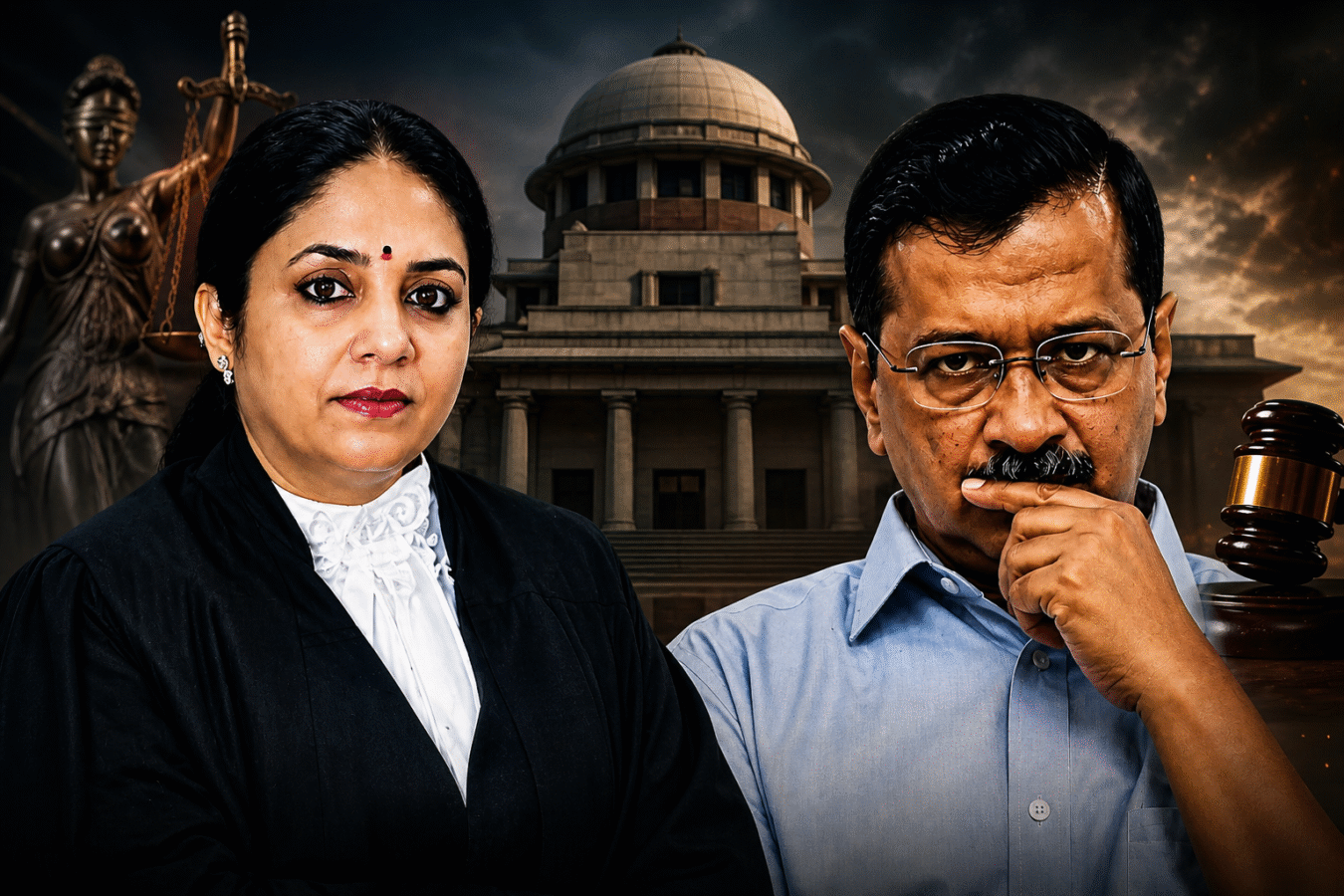
The modern courtroom has increasingly become a theatre of high-stakes ethics. In this arena, the central drama is often not the physical evidence of a crime, but the perceived impartiality of the arbiter. Recent proceedings involving Arvind Kejriwal in the Delhi High Court offer a sophisticated masterclass in this “theatre.” The visual of a sitting Chief Minister appearing personally to argue not on the merits of his discharge, but on the professional associations and subjective ethics of the judge, highlights the “invisible rules” that underpin judicial legitimacy.1
As a legal analyst at kanoonplus, the fascinating aspect of this saga is how it forces a direct confrontation between the rigid letter of the law and the fluid perception of fairness. Below are the five most significant takeaways from the recent recusal developments.
1. The “Seen to be Done” Rule: Justice Tejas Karia’s Professional Mirror
Judicial recusal is frequently a quiet affair, but Justice Tejas Karia’s voluntary exit from a Public Interest Litigation (PIL) sent a ripple through the legal community on April 22, 2026.3 This specific PIL, filed by Advocate Vaibhav Singh, alleged a “larger conspiracy” involving the unauthorized recording and circulation of court proceedings from April 13.
Justice Karia’s decision to step down was rooted in a professional “mirror” that underscores the high bar of judicial propriety. While in private practice in 2024, Justice Karia had represented Meta Platforms (Facebook) in a separate PIL—also filed by Vaibhav Singh—concerning the circulation of court videos by Sunita Kejriwal.4 Because Meta is a respondent in the current PIL, and because the petition seeks a Special Investigation Team (SIT) and aggressive content-monitoring directions for social media giants, Justice Karia opted for a “quiet exit”. His recusal serves as a pristine reminder of the classic legal maxim: “Justice must not only be done but must also be seen to be done”.
2. The “Mind of the Party” Test: A Counter-Intuitive Legal Standard
One of the most technically precise arguments presented by Kejriwal during his personal appearance relied on the Supreme Court’s ruling in Ranjit Thakur v. Union of India. The “Mind of the Party” test shifts the focus of bias from the judge’s internal conscience to the litigant’s external perspective.5
Kejriwal argued that his “reasonable apprehension” of bias was not a slight against the judge’s integrity, but a logical conclusion drawn from the court’s prior conduct.7 He specifically pointed to the March 9 order, where the High Court declared the trial court’s discharge order “erroneous” after only five minutes of hearing, without having the 40,000-page trial court record present.7 The Ranjit Thakur standard dictates: “The proper approach for the judge is not to look at his own mind and ask himself, however honestly, ‘Am I biased?’; but to look at the mind of the party before him”.5
3. The Recusal Paradox: Institutional Integrity vs. Subjective Propriety
The procedural divergence between Justice Karia and Justice Swarana Kanta Sharma illustrates the highly subjective threshold of judicial propriety. While Justice Karia recused over a past client overlap, Justice Sharma took a principled stand against what she termed “bench hunting”.1
Kejriwal’s application for her recusal cited a perceived conflict because her children served as Central Government panel counsel and highlighted her attendance at programs organized by the Adhivakta Parishad, which he characterized as an ideological body.1 Justice Sharma dismissed these concerns on April 20, 2026, asserting that attending professional legal programs does not equate to adopting a political ideology and that “a politician cannot be permitted to judge judicial competence”.1 She characterized the plea as a “Catch-22” maneuver: if she recused, the litigant “won” by choosing their bench; if she stayed, any adverse order could be framed as “predicted bias”.1
4. The Digital Battleground: Social Media as a Legal Liability
The core of the social media PIL is a conflict between the demand for transparency and the sanctity of the courtroom in a digital age. The allegations center on the unauthorized recording of proceedings on April 13, a violation of the Delhi High Court Video Conferencing (VC) Rules.
The petitioner, Vaibhav Singh, claims this was not a mere breach of protocol but a “pre-planned conspiracy” designed to mislead the public into believing the judiciary was working under pressure from the Central Government. The high stakes are evident in the demand for an SIT and potential contempt proceedings against several political figures and journalists. The Delhi High Court has already directed social media platforms like Google and Meta to remove these identified videos, reinforcing the court’s absolute control over its digital record.13
5. The “Undue Haste” Argument: Speed as a Proxy for Bias
In an era where judicial delay is the norm, the speed of Kejriwal’s proceedings is being framed as a proxy for bias. Kejriwal’s legal team presented a statistical analysis of the MP/MLA Roster, noting that while other petitions were granted three to six months to file replies, his rights were being closed with “undue haste”.15
Citing the Kanaklata v. State (NCT of Delhi) (2015) case, Kejriwal argued that “strong observations” combined with an accelerated timeline create a “grave suspicion” that the court has already committed itself to a specific outcome. This argument highlights a growing tension: when does judicial efficiency cross the line into a lack of judicial detachment?. The CBI countered that the discharge order was “perverse” and needed urgent rectification to prevent “prejudice to the system”.16
Conclusion: The Future of Judicial Perception
The Kejriwal recusal saga serves as a landmark for the hyper-polarized digital era. Following the dismissal of his recusal plea, Kejriwal, Manish Sisodia, and Durgesh Pathak informed the court they would no longer participate in the proceedings before Justice Sharma, choosing the “path of Satyagraha”.12
This saga underscores that in the eyes of the law—and the public—the perception of bias can be as legally significant as its reality. As the judiciary navigates this landscape, it faces a fundamental question: Is absolute neutrality possible when a judge’s past professional links and public appearances are instantly accessible? At kanoonplus, we believe this suggests that “judicial detachment” is no longer just a state of mind, but a carefully curated public-facing necessity.1
Key Sources
- Justice Swarana Kanta Sharma’s Order in CRL.M.A. 11377/2026 (April 20, 2026): The definitive judgment dismissing the recusal application and addressing the “bench hunting” doctrine.1
- Ranjit Thakur v. Union of India (1987) 4 SCC 611: The foundational Supreme Court precedent establishing the “Mind of the Party” test for judicial bias.5
- Kanaklata v. State (NCT of Delhi) (2015) 6 SCC 617: A three-judge bench ruling regarding the standard for reasonable apprehension of bias arising from judicial observations.
- Delhi High Court Rules for Video Conferencing for Courts, 2021: The regulatory framework governing the prohibition of unauthorized recording of court proceedings.
- Supreme Court Advocates-on-Record Association (SCAORA) v. Union of India (2015) 6 SCC 408: The precedent defining the “duty to sit” and standards for non-pecuniary bias.
Works cited
- Breaking: Justice Swarana Kanta Sharma Refuses To Recuse From …, accessed on May 3, 2026, https://www.verdictum.in/delhi-high-court/arvind-kejriwal-justice-swarana-kanta-sharma-recusal-plea-1612475
- ‘Defining moment’: Delhi HC judge Swarana Kanta Sharma refuses to recuse in Kejriwal liquor policy case | India News – Hindustan Times, accessed on May 3, 2026, https://www.hindustantimes.com/india-news/what-delhi-hc-judge-swarana-kanta-sharma-said-on-not-recusing-from-kejriwal-case-101776686471306.html
- Delhi HC judge recuses from hearing contempt plea against Kejriwal for ‘circulating’ court recordings | Legal News – The Indian Express, accessed on May 3, 2026, https://indianexpress.com/article/legal-news/arvind-kejriwal-delhi-hc-hearing-contempt-plea-recording-10649784/
- Arvind Kejriwal court video row deepens as Delhi high court judge recuses from contempt petition hearing – The Times of India, accessed on May 3, 2026, https://timesofindia.indiatimes.com/legal/news/delhi-high-court-judge-justice-recuses-from-pil-against-arvind-kejriwal-manish-sisodia-over-court-video-sharing/articleshow/130436089.cms
- JUDGES RECUSAL – Chinmaya IAS Academy – Current Affairs, accessed on May 3, 2026, https://currentaffairs.chinmayaias.com/judges-recusal/
- To Recuse or Not to Recuse – Law School Policy Review, accessed on May 3, 2026, https://lawschoolpolicyreview.com/2020/02/13/to-recuse-or-not-to-recuse/
- [Live Updates] Delhi HC hears Arvind Kejriwal for recusal of Justice Swarana Kanta Sharma in Excise case – Latestlaws.com, accessed on May 3, 2026, https://www.latestlaws.com/adr/latest-news/live-updates-delhi-hc-hears-arvind-kejriwal-for-recusal-of-justice-swarana-kanta-sharma-in-excise-case-236180/
- Kejriwal Lists 10 Reasons for Judge Recusal in Excise Case – Supreme Today AI, accessed on May 3, 2026, https://supremetoday.ai/arvind-kejriwal-seeks-recusal-in-delhi-hc-excise-policy-arvind-kejriwal-seeks-recusal-in-delhi-hc-excise-policy-20260413039
- Arvind Kejriwal News Highlights: Discharge order can’t remain on record even for a second: CBI to Delhi High Court in liquor policy case – The Indian Express, accessed on May 3, 2026, https://indianexpress.com/article/legal-news/excise-policy-case-delhi-high-court-hear-cbi-plea-against-discharge-arvind-kejriwal-10584230/
- Recusal of Judges – Drishti IAS, accessed on May 3, 2026, https://www.drishtiias.com/daily-updates/daily-news-analysis/recusal-of-judges-1
- ‘Won’t recuse’: Justice Swarana Kanta Sharma bins Arvind Kejriwal plea, accessed on May 3, 2026, https://indianexpress.com/article/legal-news/arvind-kejriwal-case-hearing-live-updates-delhi-high-court-hear-plea-in-excise-policy-case-10645815/
- Kejriwal says won’t appear before Justice Swarna Kanta who refused to recuse in excise case – The New Indian Express, accessed on May 3, 2026, https://www.newindianexpress.com/states/delhi/2026/Apr/27/kejriwal-says-wont-appear-before-justice-swarna-kanta-who-refused-to-recuse-in-excise-case
- Delhi High Court Orders Takedown Of Unauthorised Court Proceedings In Excise Policy Case – ETV Bharat, accessed on May 3, 2026, https://www.etvbharat.com/en/state/delhi-high-court-orders-takedown-of-unauthorised-court-proceedings-in-excise-policy-case-enn26042304023
- Delhi High Court Orders Social Media Removal of Kejriwal’s Judicial Hearing Video, accessed on May 3, 2026, https://m.dailyhunt.in/news/india/english/hindusthan+samachar+english-epaper-hinsamen/delhi+high+court+orders+social+media+removal+of+kejriwals+judicial+hearing+video-newsid-n709674458
- ‘Court almost declared me guilty’: Arvind Kejriwal lists 10 reasons for Justice Swarana Kanta Sharma’s recusal – The Leaflet, accessed on May 3, 2026, https://theleaflet.in/leaflet-reports/court-almost-declared-me-guilty-arvind-kejriwal-lists-10-reasons-for-justice-swarana-kanta-sharmas-recusal
- Order discharging Kejriwal can’t be on record ‘for a second more than necessary’, CBI tells Delhi HC – Scroll.in, accessed on May 3, 2026, https://scroll.in/latest/1091410/order-discharging-kejriwal-cant-be-on-record-for-a-second-more-than-necessary-cbi-tells-delhi-hc
- HC to hear CBI plea against discharge of Kejriwal, Sisodia on May 4, accessed on May 3, 2026, https://timesofindia.indiatimes.com/city/delhi/hc-to-hear-cbi-plea-against-discharge-of-kejriwal-sisodia-on-may-4/articleshow/130615493.cms
- Author: Gautam Bhatia – Constitutional Law and Philosophy, accessed on May 3, 2026, https://indconlawphil.wordpress.com/author/gautambhatia1988/