
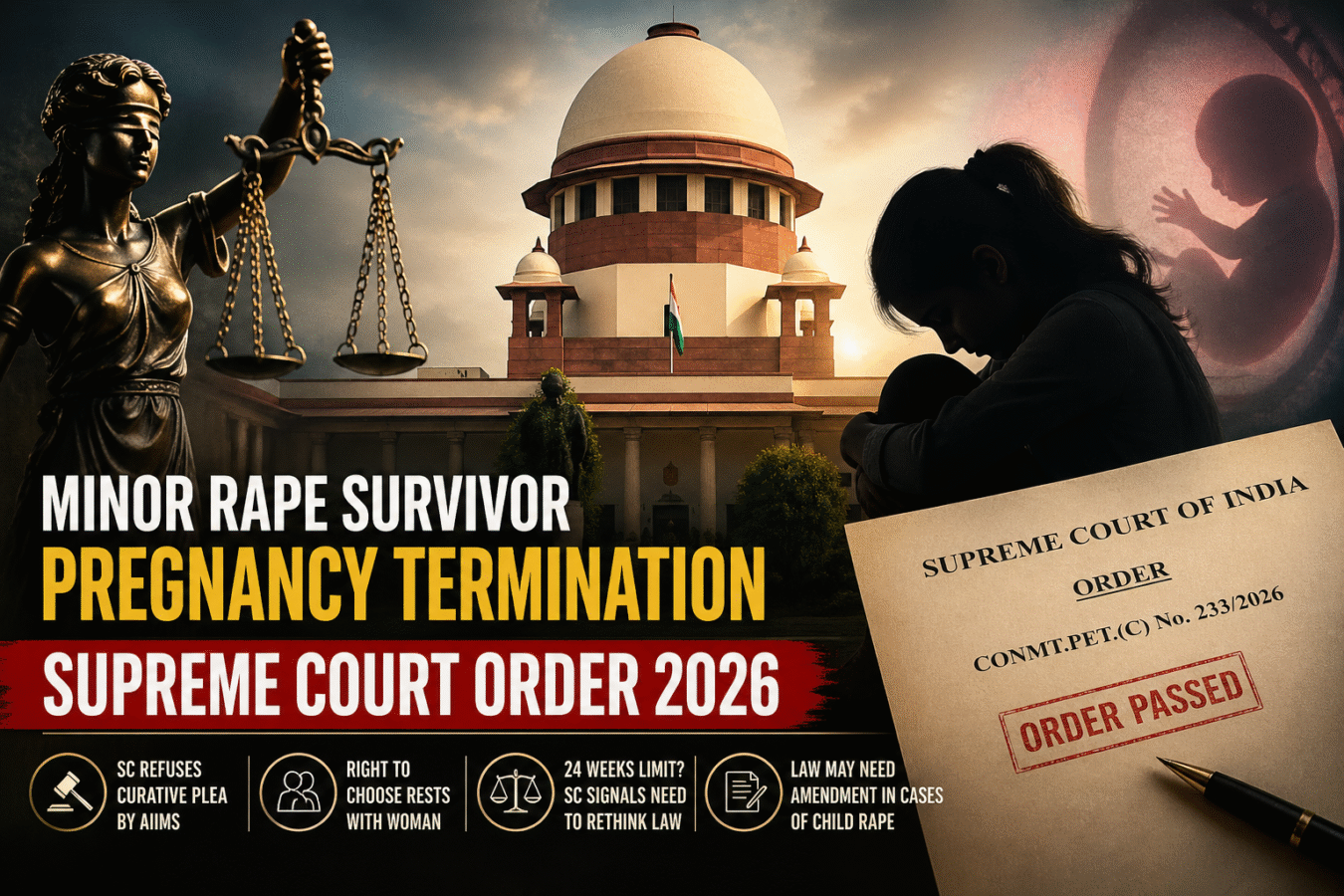
The Supreme Court of India, in a significant ruling on 24 April 2026, permitted the medical termination of pregnancy of a 15-year-old minor and set aside the refusal to grant such relief. The case has since taken a broader turn, with the Court also indicating that existing abortion law may require reconsideration in cases involving minor rape survivors.
Background
The case arose when the mother of a 15-year-old girl approached the Supreme Court after permission for termination of pregnancy was refused, even though the pregnancy had crossed 28 weeks.
The matter involved an AIIMS Medical Board report, which referred to medical risks and stated that no major psychiatric disorder was found. However, the Supreme Court examined the issue from the broader constitutional perspective of dignity, autonomy, mental health, and the best interests of the minor.
Supreme Court’s Ruling: Dignity and Autonomy Take Priority
A bench of Justice B. V. Nagarathna and Justice Ujjal Bhuyan allowed the termination of pregnancy.
The Court noted that the pregnancy was unwanted, the girl was a minor, and she had shown severe psychological distress, including suicide attempts. The Court also noted that she had clearly expressed unwillingness to continue the pregnancy.
The Court held that forcing the minor to continue the pregnancy would amount to a violation of her right to live with dignity under Article 21 of the Constitution.
Reaffirming constitutional principles, the Court observed that reproductive autonomy — including the decision to continue or terminate a pregnancy — is an integral part of personal liberty and bodily integrity.
Importantly, the Court made it clear that no woman, especially a minor, can be compelled to carry a pregnancy to full term against her will.
Adoption Argument Rejected
One argument placed before the Court was that the minor could give birth and the child could later be given up for adoption.
The Supreme Court rejected this reasoning, holding that such an approach cannot justify forcing a woman to continue an unwanted pregnancy. The Court emphasised that the choice of the pregnant woman must take precedence over abstract considerations relating to the unborn child.
Statutory Limits vs Constitutional Powers
Under the Medical Termination of Pregnancy Act, 1971, termination is generally permitted up to 20 weeks and, in specified categories, up to 24 weeks.
However, the Supreme Court clarified that constitutional courts are not powerless beyond these limits. The absence of a statutory remedy does not bar a constitutional remedy, especially where fundamental rights are at stake.
The Court also cautioned that a rigid application of statutory limits could push vulnerable women toward unsafe and illegal abortions.
Medical Board Report Not Conclusive
The Supreme Court found that the AIIMS Medical Board report failed to adequately consider the psychological and emotional impact on the minor.
While the report stated that no psychiatric disorder was diagnosed, the Court noted that the minor had attempted suicide twice, clearly indicating severe distress. The absence of a formal diagnosis, the Court held, does not negate real trauma.
Final Directions
Allowing the appeal, the Court permitted medical termination of pregnancy and directed that the procedure be carried out at AIIMS with necessary safeguards and at the earliest.
Latest Development: Supreme Court Signals Need for Law Reform
On 30 April 2026, during proceedings arising from a challenge by AIIMS, a bench comprising Chief Justice Surya Kant and Justice Joymalya Bagchi refused to entertain the plea.
During the hearing, the Court made an important oral observation that the law should be amended to remove time limits for termination of pregnancy in cases involving rape of minor girls.
The Court noted that by the time a minor becomes aware of pregnancy, understands legal remedies, and approaches the Court, the statutory time window is often already over. In such situations, rigid timelines can defeat the purpose of legal protection.
The bench also clarified that statutory limits primarily bind doctors, but do not restrict the Supreme Court when it exercises its constitutional powers to do complete justice.
Conclusion
This case goes beyond an individual dispute. It highlights a deeper constitutional question: whether statutory timelines can override the dignity, autonomy, and mental well-being of a minor.
By allowing termination and simultaneously indicating the need for reform, the Supreme Court has sent a clear signal — the law must evolve to reflect the realities faced by vulnerable individuals, particularly minor survivors.
Case Details
| Case Title | S versus Union of India & Others |
| Court | Supreme Court of India |
| Bench | Justice B. V. Nagarathna and Justice Ujjal Bhuyan |
| Order Date | 24 April 2026 |
| Subject | Medical termination of pregnancy of a minor; reproductive autonomy; Article 21; limits under the MTP Act |
Read the Official Supreme Court Order
Loading Viewer…