
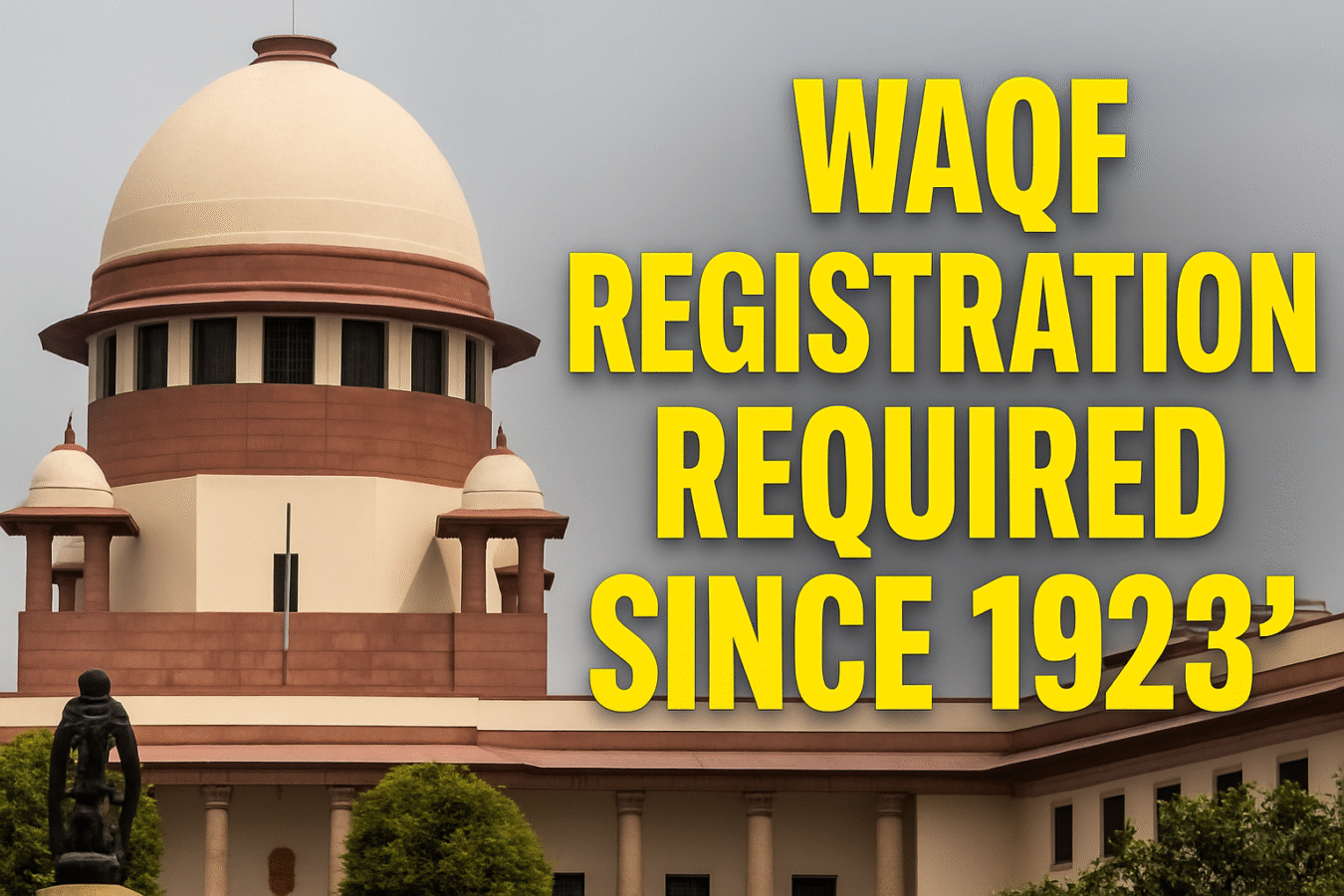
Case Reference: W.P.(C) No. 276/2025 and connected matters
Bench: CJI BR Gavai and Justice AG Masih
Date: Arguments heard on April 16, 17; May 20–22, 2025. Order Reserved on May 22, 2025
Source: Supreme Court of India
⚖️ Case Background
Multiple writ petitions were filed before the Supreme Court challenging the Waqf (Amendment) Act, 2025, seeking an interim stay on its operation.
Petitioners include a wide political and civil spectrum such as Asaduddin Owaisi (AIMIM), Mahua Moitra (TMC), Amanatullah Khan (AAP), Indian Union Muslim League, Samastha Kerala Jamiatul Ulema, among others.
Respondents include Union of India, represented by Solicitor General Tushar Mehta, and several BJP-led State Governments supporting the amendment.
📜 Key Events Timeline
- April 16–17, 2025: First detailed hearings before a 3-judge bench.
- May 20–22, 2025: Intensive three-day hearing on the interim stay request.
- May 22, 2025: Order reserved on interim relief.
📂 Key Issues and Provisions Under Challenge
- Abolition of “waqf-by-user” concept
- Exclusion of non-Muslims from Waqf creation
- 5-year Muslim practice precondition for creating waqf
- Invalidation of waqfs on ASI protected monuments
- Application of Limitation Act to Waqf matters
- Inclusion of non-Muslim members in Waqf Boards
- Empowerment of government officials to determine encroachments
- Cap on women members in Waqf bodies
- Scheduled area restrictions (Section 3E)
- Renaming to “Unified Waqf Management Act”
📌 Union Government’s Submissions
Represented by SG Tushar Mehta
- Waqf registration not new: Required since 1954; earlier laws from 1923, 1954, 1995 also emphasized documentation.
- Section 3E: Created to protect Scheduled Tribes; creation of waqf is irreversible and may prejudice tribal rights.
- On Non-Muslims’ rights: Historically not allowed to create waqf (1923 law). 2013 was an anomaly.
- On 5-year Islam clause: Claimed consistent with Shariat Application Act. Not intended to defeat claims.
- On “Waqf-by-user”: Its abolition does not violate essential practices.
- Section 3C: Only suspends waqf status during enquiry—not a final title decision.
- Central and State Waqf Boards: Perform secular functions; non-Muslim participation does not violate religious freedom.
📌 Petitioners’ Submissions
Led by: Kapil Sibal, Dr. AM Singhvi, Dr. Rajeev Dhavan, Huzefa Ahmadi, AM Dhar
- Sibal:
- The Amendment aims to capture waqf properties through non-judicial processes.
- Section 3D was not part of the JPC-approved draft.
- Only 2 Waqfs registered in Delhi; none in J&K, Telangana—due to State failure, not community fault.
- Registration cannot override waqf character, even if missing formalities.
- Government cannot benefit from its own default in registering waqfs.
- Section 3(1)(r) derecognizes waqfs if ownership is disputed or it’s govt land.
- Singhvi:
- Sections 36(1), 36(7A), 36(10) create a “vicious circle”—abolished waqfs cannot be registered.
- 5-year Islam practice clause creates reverse burden of proof, unlike other religions.
- Rajeev Dhavan:
- Waqf is a Quranic concept, hence essential religious practice.
- SG’s argument contradicts JPC report and govt’s earlier stance.
- Ahmadi:
- Section 3E discriminates against Muslim tribals, not aligned with ST protection objective.
- Concern raised on evacuee property and Limitation Act’s application.
- Dhar:
- Cited Quranic verses supporting waqf as religiously integral.
🧷 Other Key Submissions
- State Support:
- Rakesh Dwivedi (Rajasthan): Criticized comparing Waqf Act with Hindu endowment laws.
- Ranjeet Kumar (Haryana): Cited 500-acre land Waqf claim on mining land.
- Maninder Singh (Odisha): Defended amendments.
- Rejoinders:
- Petitioners rejected SG’s explanation on Section 3C as cosmetic, not legal.
- Argued for judicial determination rather than administrative handling of waqf status.
- A villager from Tamil Nadu intervened, saying her entire village, including temple, was declared as waqf.
🧠 Judicial Observations
- CJI Gavai:
- Clarified registration has been part of waqf framework since early laws.
- Noted that though 1923 lacked registration, it required information submission.
- Emphasized State failure to register cannot justify penalizing the community.
- Justice Masih:
- Disagreed with SG’s tribal argument. Stated Islam is one religion; cannot compartmentalize.
⚖️ Judgment Status
Order Reserved by the Supreme Court on May 22, 2025 regarding the interim stay on the Waqf (Amendment) Act, 2025.
📝 Conclusion
This high-stakes constitutional matter pits statutory reform against religious rights, with competing narratives of community protection, historical usage, and secular governance. The Court’s interim order—now reserved—will significantly influence the political, legal, and communal discourse surrounding religious property rights and state regulation in India.