
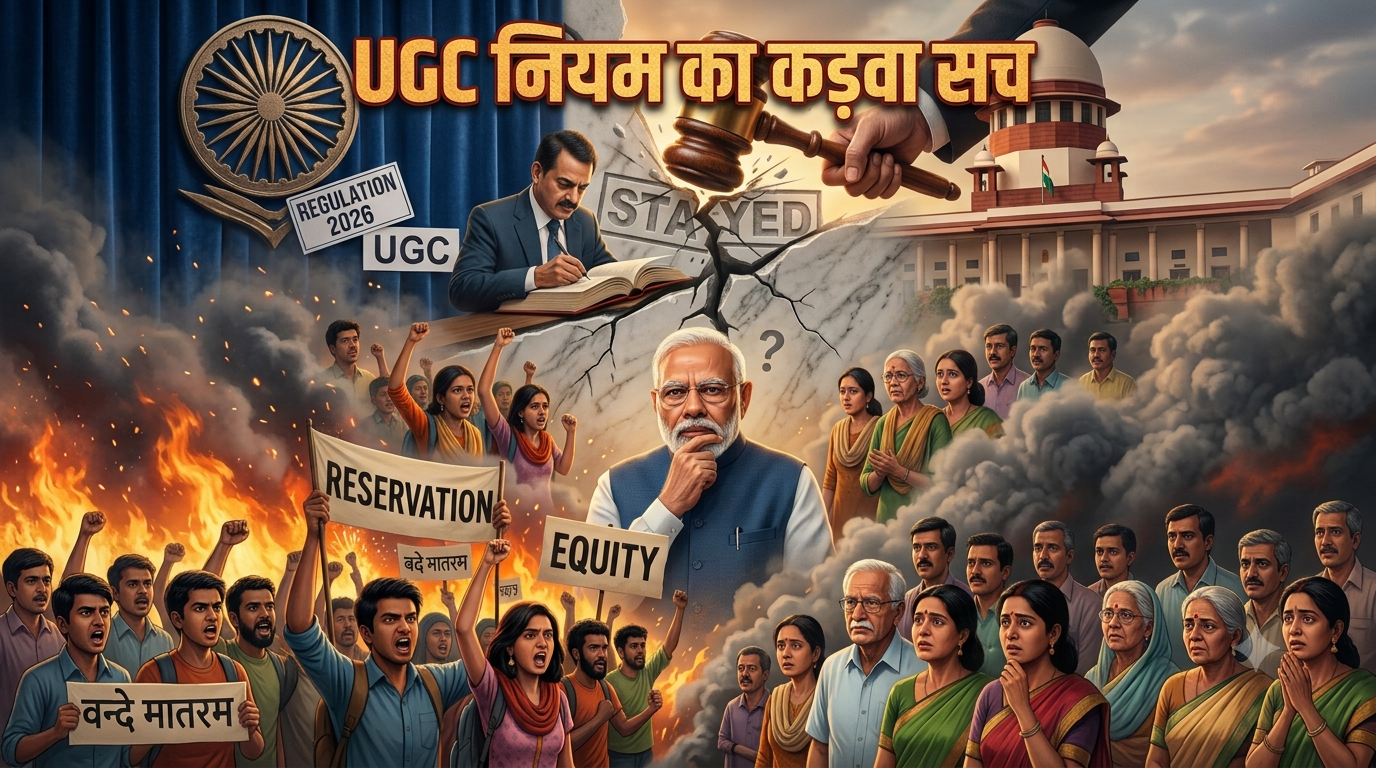
The intersection of higher education governance, subaltern social engineering, and judicial scrutiny has created a complex policy and political challenge for the administration of Prime Minister Narendra Modi. On January 13, 2026, the University Grants Commission (UGC) notified the Promotion of Equity in Higher Education Institutions Regulations, 2026, which came into effect on January 15, 2026. Designed to replace the largely advisory 2012 framework, the new regulations aimed to establish a mandatory, legally enforceable, and highly punitive anti-discrimination architecture across India’s higher education institutions (HEIs).1
However, the notification immediately triggered intense protests across northern India, culminating in a Supreme Court order on January 29, 2026, which stayed the implementation of the regulations.3 For the ruling Bharatiya Janata Party (BJP), this regulatory initiative has transformed from a court-mandated reform into a major political liability, exposing deep sociological fault lines between its core upper-caste support base and its extensive backward-class and Dalit outreach.
The Campus Crisis: Student Suicides and the Rise in Discrimination Complaints
The regulatory overhaul was prompted by a severe crisis of institutional alienation and student distress in India’s premier educational institutions. Between 2019 and 2023, data submitted to the Rajya Sabha revealed a disturbing concentration of student suicides among marginalized and backward communities.5
| Institution Type | Total Suicides (2019–2023) | Marginalized Communities % | Marginalized Categories Breakdown |
| Indian Institutes of Technology (IITs) | 31 | 54.83% | 5 SC, 1 ST, 9 OBC, 2 Minority 5 |
| All India Institutes of Medical Sciences (AIIMS) | 13 | 53.84% | 2 ST, 4 OBC, 1 Minority 5 |
| National Institutes of Technology (NITs) | 22 | 59.09% | 4 SC, 8 OBC, 1 Minority 5 |
This tragic trend was accompanied by a dramatic increase in formal complaints of caste-based discrimination. According to UGC data submitted to the Supreme Court and a parliamentary panel, recorded caste discrimination complaints in universities and colleges jumped by 118.4% over a five-year period, rising from 173 complaints in 2019–20 to 378 complaints in 2023–24, across 704 universities and 1,553 colleges.5 In total, institutions registered 1,160 complaints through their Equal Opportunity Cells and SC/ST Cells during this timeframe.5 This surge in documented bias underscored the systemic failure of the pre-existing regulatory mechanisms to foster inclusive campus environments.6
Evolution of the Regulatory Framework: 2012 vs. 2026
The legal trajectory of the 2026 regulations is rooted in the landmark public interest litigation Abeda Salim Tadvi v. Union of India, filed in the Supreme Court in 2019 by the mothers of Rohith Vemula and Payal Tadvi.7 Both students had died by suicide following sustained, institutionalized caste-based harassment. In January 2025, a Supreme Court bench comprising Justices Surya Kant and Ujjal Bhuyan observed that existing guidelines must be more than merely symbolic and directed the UGC to formulate enforceable standards to address discrimination and protect student mental health.5
A draft version of the regulations was released for public consultation in February 2025.10 This draft was subsequently reviewed by the Parliamentary Standing Committee on Education, headed by Congress leader Digvijaya Singh but containing a majority of BJP MPs.10 The committee unanimously adopted a report in December 2025, recommending that the definition of caste-based harassment be expanded to explicitly include Other Backward Classes (OBCs) in alignment with Articles 15(4) and 15(5) of the Constitution.11
However, when the UGC finalized and notified the regulations on January 13, 2026, it introduced several controversial deviations. While accepting the inclusion of OBCs, the UGC unilaterally rejected the parliamentary panel’s recommendations to mandate a woman member and SC/ST members on the relevant campus committees.11 Crucially, the UGC also independently removed a key protective clause from the 2025 draft that penalized students for lodging false or malicious complaints, and defined caste discrimination in a manner that excluded the general category entirely.7
| Feature | 2012 Regulations | 2026 Regulations |
| Legal Status | Advisory in practice; lacked enforcement capacity and systemic sanctions.1 | Mandatory and legally binding; directly linked to regulatory and financial sanctions.1 |
| Demographic Scope | Applied broadly to multiple groups but highlighted SC and ST students as the primary beneficiaries.2 | Formally and explicitly includes OBCs and EWS alongside SCs, STs, women, and PwD.2 |
| Campus Infrastructure | Centered on a single Anti-Discrimination Officer and an Equal Opportunity Cell.2 | Multi-layered: Equal Opportunity Centres, Equity Committees, Equity Squads, and Equity Ambassadors.2 |
| Resolution Timeline | Complaints were expected to be decided within 60 days.2 | Highly accelerated: Committee meeting within 24 hours of complaint; report in 15 working days; action in 7 days.2 |
| False Complaint Clause | Contained basic provisions to deter and investigate false allegations.2 | Dropped entirely from the final draft, leaving no explicit penalties for deliberate misuse.7 |
| Institutional Penalties | Non-compliance carried no meaningful administrative or financial consequences.2 | Severe: Withholding of UGC grants, debarment from UGC schemes, and revocation of university recognition.2 |
Legal Vulnerabilities and the Supreme Court Intervention
The rapid escalation of protests by general category students and faculty led to three writ petitions—filed by Mritunjay Tiwari, Advocate Vineet Jindal, and Rahul Dewan—challenging the constitutionality of the 2026 regulations.15 On January 29, 2026, a Division Bench of the Supreme Court, comprising Chief Justice Surya Kant and Justice Joymalya Bagchi, placed the regulations in abeyance.3 Utilizing its extraordinary powers under Article 142 of the Constitution, the court directed that the older 2012 regulations continue to operate in the interim to prevent a regulatory vacuum.3
The bench observed that the 2026 regulations were prima facie vague and easy to misuse.3 In its interim order, the court raised several critical legal and structural questions:
The Exclusionary Nature of Clause 3(c)
Advocate Vishnu Shankar Jain, representing the petitioners, argued that Clause 3(c)—which defined “caste-based discrimination” as discrimination on the basis of caste “only” against members of the SC, ST, and OBC categories—violates Article 14 of the Constitution. The petitioners contended that by failing to recognize general category individuals as potential victims, the definition lacked an intelligible differentia and operated on the false presumption that caste-based discrimination is entirely unidirectional.3 Justice Joymalya Bagchi questioned whether Clause 3(c) was redundant or in conflict with Clause 3(e), which defined “discrimination” more broadly across religion, race, gender, place of birth, and disability.3
The Danger of Segregation on Campuses
The court expressed deep unease regarding Regulation 7(d), which mandated that higher education institutions ensure “selection, segregation, or allocation” for hostels, classrooms, and mentorship is transparent and non-discriminatory.3 Chief Justice Surya Kant remarked, “For gods sake, please don’t do that,” drawing a direct analogy to the “separate but equal” doctrine historically used to justify racial segregation in the United States.3 The court warned that codifying a mechanism for segregation, even if framed as “fair,” risks institutionalizing social divisions rather than eradicating them.3
The Omission of Ragging and SC/ST Act Overlap
A primary source of anxiety for general category students was the omission of “ragging” from the 2026 regulations, despite it being the most prevalent form of campus harassment.3 Petitioners presented a scenario where a general category freshman resisting ragging by an SC/ST senior could face a retaliatory, false accusation of caste discrimination.3 Because the Scheduled Castes and Scheduled Tribes (Prevention of Atrocities) Act, 1989, restricts anticipatory bail, such a student could face immediate arrest and imprisonment, destroying their academic career on “the first day, first month and first year”.3 The bench noted that while ragging is governed by the UGC’s 2009 Anti-Ragging Regulations, its omission from the 2026 framework created a dangerous regulatory disconnect.3
The court proceedings also highlighted a passive stance from the Union Government.16 While Senior Advocate Indira Jaising, representing the mothers of Rohith Vemula and Payal Tadvi, argued forcefully that the stay was unwarranted and that the regulations were a necessary corrective to systemic bias, Solicitor General Tushar Mehta, representing the UGC and the Union, remained largely silent.3 He accepted notice on behalf of the government and the UGC, returnable on March 19, 2026, without presenting oral arguments in defense of the notified rules.3
The Savarna Backlash and Political Crisis for the BJP
The notification of the regulations triggered aggressive protests, rallies, and road blockages across northern states, including Uttar Pradesh, Bihar, Rajasthan, and Delhi.17 The general category (upper-caste or Savarna communities), which represents roughly 44.2% of total higher education enrollment, forms the oldest and most loyal electoral pillar of the BJP. By failing to incorporate basic procedural safeguards, the guidelines triggered a massive political crisis for the Modi administration among its core vote bank.
Core Fears and the “Oppressor” Presumption
The primary driver of anger among the forward classes was the perception that the regulations singled them out. Critics argued that the specific phrasing of Clause 3(c) legally codified a presumption that general category students could only be perpetrators of caste bias, never its victims.
Furthermore, the introduction of “Equity Squads”—mobile vigilance teams patrolling canteens, hostels, and canteens—coupled with the complete removal of the 2025 draft’s “false complaint” penalties, created what critics labeled a “surveillance state” on campuses. General category groups feared that highly politicized campus environments (such as Delhi University or JNU) would weaponize the “Zero Risk” complaint mechanism to settle personal, academic, or political scores, leaving accused students defenseless and vulnerable to reputational destruction.
Organizational Fractures and Localized Revolts
The backlash quickly shifted from university gates to the BJP’s internal organizational machinery, particularly in the electorally crucial state of Uttar Pradesh:
- High-Profile Resignations: In Noida, Raju Pandit, the Vice President of the BJP Yuva Morcha, resigned in protest, publicly labeling the regulations a “black law” that was biased against upper-caste youth. Similar localized revolts saw the resignation of ten other BJP office-bearers in the Lucknow unit.
- Bureaucratic Dissent: In a highly unusual administrative protest, Alankar Agnihotri, the City Magistrate of Bareilly, resigned on January 26, 2026, condemning the regulations as a “Black Law” that was actively fueling an “anti-Brahmin campaign”. His exit became a major rallying point for upper-caste consolidation across UP.
- Electoral Paralysis Ahead of UP Polls: The timing of the crisis was highly damaging for the BJP, as Uttar Pradesh was gearing up for local panchayat elections and crucial state assembly elections the following year. Several BJP MLAs and local leaders informed the party top brass that they could not safely visit their constituencies due to intense hostility from their core forward-caste supporters. To defuse the localized anger, UP Deputy Chief Minister Keshav Prasad Maurya quickly announced that the state government would fully comply with the Supreme Court’s stay order.
- The 2018 Flashback: Senior party leaders privately drew parallels to the 2018 crisis when the Modi government brought an ordinance to bypass a Supreme Court ruling that had diluted the SC/ST Act. That move triggered a severe heartland Savarna backlash, forcing the BJP to hastily introduce the 10% Economically Weaker Sections (EWS) quota to regain their trust. Party insiders warned that the 2026 UGC regulations had “divided the party on caste lines” and threatened to decimate their carefully crafted UP electoral arithmetic.
The “Subaltern Hindutva” Tightrope and Opposition Strategy
Since 2014, the BJP’s dominant electoral strategy has been to construct a broad “rainbow social coalition” of non-dominant OBCs, Dalits, and Scheduled Tribes under the umbrella of Hindu unity (Hindutva). Retaining the core upper-caste support base while aggressively reaching out to lower-caste and marginalized groups requires a delicate policy balancing act.
The OBC Bracketing Dilemma
OBCs represent approximately 35.8% of India’s higher education enrollment, equivalent to 1.48 crore students.18 The bracketing of OBCs with SCs and STs in the 2026 regulations (a change pushed by the parliamentary panel 10) was a major policy outreach designed to cement the BJP’s pro-OBC credentials.
However, this structural move directly threatened the traditional space occupied by forward classes in higher education. The resulting backlash from the BJP’s upper-caste base has placed the party in a “lose-lose” political dilemma: rolling back the regulations risks a massive backlash from Dalits and OBCs who view the rules as a long-overdue shield against campus discrimination, while implementing them threatens to permanently alienate their core upper-caste vote bank.
Opposition Exploitation
The BJP’s top leadership maintained a conspicuous silence as the protests grew, hoping to avoid hardening positions. This silence allowed opposition parties to capitalize on the tension.
In Uttar Pradesh, Samajwadi Party chief Akhilesh Yadav, fresh off his successful “PDA” (Picchda, Dalit, Adivasi) campaign, adopted a highly diplomatic but politically effective stance. He welcomed the Supreme Court’s stay order, stating that “true justice does not involve injustice to anyone,” simultaneously protecting his lower-caste base while signaling to upper-caste voters that the BJP’s regulations lacked basic due-process safeguards. Conversely, social justice champions like Prakash Ambedkar (Vanchit Bahujan Aghadi chief) and CPM MP John Brittas heavily criticized the stay, with Brittas accusing the BJP of deliberately whipping up the controversy to escape its internal policy contradictions.
Internal Government and Ideological Friction
The crisis exposed deep coordination failures and public disagreements within the Union Cabinet and the wider Sangh Parivar:
The Cabinet Divide
The policy division within the government was highlighted by the contrasting responses of two Union Ministers:
- Dharmendra Pradhan (Education Minister): An OBC leader from Odisha, Pradhan actively championed and defended the guidelines. Even amid escalating protests, he held a press conference to reassure the public that “no one will be subjected to harassment” and that the regulations were constitutionally sound.
- Giriraj Singh (Textiles Minister): A prominent upper-caste Bhumihar leader from Bihar, Singh publicly broke ranks. Hours after the Supreme Court stay on January 29, 2026, Singh posted a tweet on X celebrating the stay as “significant for protecting India’s cultural unity and Sanatan values,” explicitly calling the UGC regulations “Sanatan ko baatne wala” (divisive of Sanatan Dharma). Although Singh deleted the post an hour later to align with the official “Sabka Saath, Sabka Vikas” narrative, the public contradiction laid bare the severe internal ideological friction within the Modi cabinet.
ABVP’s Tactical Shift
The Akhil Bharatiya Vidyarthi Parishad (ABVP), the student wing of the RSS, faced intense campus-level heat from general category students. Originally, the ABVP had issued statements welcoming the 2026 guidelines while requesting minor “clarity and balance”.10 However, as the Savarna backlash grew, the student body executed a swift U-turn.10 On the evening of the Supreme Court stay, the ABVP posted a social media statement welcoming the judicial intervention, claiming it would “halt the ongoing confusion across the country”.10
Broader Institutional Friction: Faculty Vacancies and Appointments
The controversy over the 2026 regulations occurred alongside ongoing tensions regarding affirmative action in higher education administration. In July 2025, a reply in the Rajya Sabha revealed substantial backlog vacancies for reserved category faculty in Central Universities, highlighting a persistent gap between policy and implementation.6
| Social Category | Central University Faculty Vacancy Rate (as of July 2025) |
| Scheduled Castes (SCs) | 31% 6 |
| Scheduled Tribes (STs) | 37% 6 |
| Other Backward Classes (OBCs) | 40% 6 |
In an effort to address these representation deficits, the UGC issued a directive on February 16, 2026, signed by Secretary Prof. Manish R. Joshi.20 The circular mandated that all central, state, deemed, and law universities strictly implement reservation policies for temporary and contractual appointments lasting 45 days or more.20 To ensure compliance, the UGC required universities to submit comprehensive data on all contractual appointments made during the 2023-24 and 2024-25 academic years via the UGC UAMP Portal.20
This continuous administrative push has kept the issue of campus reservation and representation highly visible, amplifying the anxieties of general category students and faculty who fear that accelerated compliance mechanisms lack appropriate procedural safeguards.17
Conclusions and Policy Recommendations
The judicial stay on the 2026 UGC Equity Regulations has created a court-mandated pause in a sensitive political dispute.16 By attempting to transition from advisory guidelines to a binding regulatory framework, the UGC addressed long-standing institutional failures but introduced constitutional and social friction points.7
For the Modi administration, resolving this policy challenge prior to the next Supreme Court hearing requires balancing robust protection for marginalized groups with due-process guarantees for all stakeholders.21 To strengthen the regulations and withstand constitutional scrutiny, several key refinements are necessary:
- Clarifying the Scope of Clause 3(e): The regulations must feature unambiguous language confirming that general anti-discrimination protections and campus grievance mechanisms remain fully available to all students under Clause 3(e), ensuring that no student is left without a remedy based on their demographic background.21
- Reintroducing Balanced Procedural Safeguards: The UGC should establish a clear mechanism to identify and penalize demonstrably malicious or frivolous complaints.21 Distinguishing clearly between “unproven” complaints and “provably false” allegations would address the fears of general category students and faculty without creating a chilling effect for genuine victims.21
- Demarcating Campus Discipline from Criminal Prosecution: The framework should explicitly separate internal university grievance processes from criminal proceedings under the SC/ST Act.21 Campus committees should focus on academic, social, and administrative remediation, leaving criminal allegations to be handled by law enforcement under standard statutory procedures.21
- Incorporating External Oversight: The credibility and neutrality of university Equity Committees would be enhanced by mandating the inclusion of independent, external members, such as retired jurists or civil society experts.21 This would help insulate the grievance process from internal university politics and reduce the potential for arbitrary or biased decisions.21
Works cited
- UGC Anti-Discrimination Rules 2026: Key Provisions, EOCs, Ombudsperson, Penalties, accessed July 3, 2026, https://pwonlyias.com/ugc-anti-discrimination-rules-2026/
- UGC anti-discrimination rules 2026 vs 2012: Key changes, safeguards and concerns, accessed July 3, 2026, https://www.indiatoday.in/education-today/featurephilia/story/ugc-anti-discrimination-rules-2026-vs-2012-key-changes-safeguards-and-concerns-2858444-2026-01-27
- Supreme Court stays 2026 UGC equity regulations, accessed July 3, 2026, https://www.scobserver.in/journal/supreme-court-stays-2026-ugc-equity-regulations/
- UGC 2026 Row Live: SC stay ‘appropriate’, Mayawati calls for inclusive consultation, accessed July 3, 2026, https://www.indiatoday.in/education-today/news/story/ugc-bill-protest-live-updates-equity-regulations-row-guidelines-2858313-2026-01-27
- Explained: Why the New UGC Rules on Caste-Based Discrimination …, accessed July 3, 2026, https://thewire.in/rights/explained-why-the-new-ugc-rules-on-caste-based-discrimination-have-sparked-outrage
- Equity on Hold: Supreme Court’s interim stay of the UGC … – CJP, accessed July 3, 2026, https://cjp.org.in/equity-on-hold-supreme-courts-interim-stay-of-the-ugc-regulations-2026/
- Supreme Court stays 2026 UGC Equity Regulations – News Details, accessed July 3, 2026, https://samsamayikghatnachakra.com/current_news/17505?language=all&user_id=
- UGC (PROMOTION OF EQUITY IN HEIs) REGULATIONS, 2026 …, accessed July 3, 2026, https://blog.lukmaanias.com/2026/04/23/ugc-promotion-of-equity-in-heis-regulations-2026-and-issues/
- Promoting Equity in Higher Education – Economic and Political Weekly, accessed July 3, 2026, https://www.epw.in/journal/2026/11/special-articles/promoting-equity-higher-education.html
- Leaders welcome Supreme Court stay of UGC equity rules – The Hindu, accessed July 3, 2026, https://www.thehindu.com/news/national/political-reactions-on-supreme-court-stay-on-ugc-equity-rules-updates-january-29/article70565043.ece
- ‘Entirely Up to UGC and Education Ministry’: Digvijaya Singh on …, accessed July 3, 2026, https://m.thewire.in/article/caste/entirely-up-to-ugc-and-education-ministry-digvijaya-singh-on-resolution-to-issues-in-new-guidelines/amp
- UGC Regulation 2026 explained | SCC Times, accessed July 3, 2026, https://www.scconline.com/blog/post/2026/01/28/ugc-regulation-2026-explained/
- UGC Anti-Discrimination Rules 2026 for Colleges & Universities: Key Guidelines, Compliance & Penalties | CollegeDekho, accessed July 3, 2026, https://www.collegedekho.com/articles/ugc-anti-discrimination-rules-2026-for-colleges-and-universities-key-guidelines-compliance-and-penalties-gtat/
- Explained: UGC 2026 regulations to ensure equity and end caste bias in higher education, accessed July 3, 2026, https://timesofindia.indiatimes.com/education/news/explained-ugc-2026-regulations-to-ensure-equity-and-end-caste-bias-in-higher-education/articleshow/126548122.cms
- Quota Norms Deserve Scrutiny – Chintan – India Foundation, accessed July 3, 2026, https://chintan.indiafoundation.in/articles/quota-norms-deserve-scrutiny/
- Regulatory hurdles – Supreme Court Observer, accessed July 3, 2026, https://www.scobserver.in/journal/regulatory-hurdles-ugc-2026-regulations-supreme-court/
- UGC Equity Regulations, 2026 – Wikipedia, accessed July 3, 2026, https://en.wikipedia.org/wiki/UGC_Equity_Regulations,_2026
- www.ijlra.com Volume 2 Issue 9 | Jan 2026 ISSN: 2582-6433, accessed July 3, 2026, http://www.ijlra.com/uploads/1788244852.pdf
- Equality on paper? The UGC’s social justice framework examined, accessed July 3, 2026, https://www.scobserver.in/journal/equality-on-paper-the-ugcs-social-justice-framework-examined/
- Implement reservation policies in temporary appointments: UGC directive to Universities – Babushahi.com, accessed July 3, 2026, https://www.babushahi.com/education.php?id=217684&headline=Implement-reservation-policies-in-temporary-appointments:-UGC-directive-to-Universities
- Supreme Court Halts 2026 UGC Equity Regulations Amid Protests – Kashmir Times, accessed July 3, 2026, https://kashmirtimes.com/opinion/comment-articles/equity-outrage-and-judicial-pause