
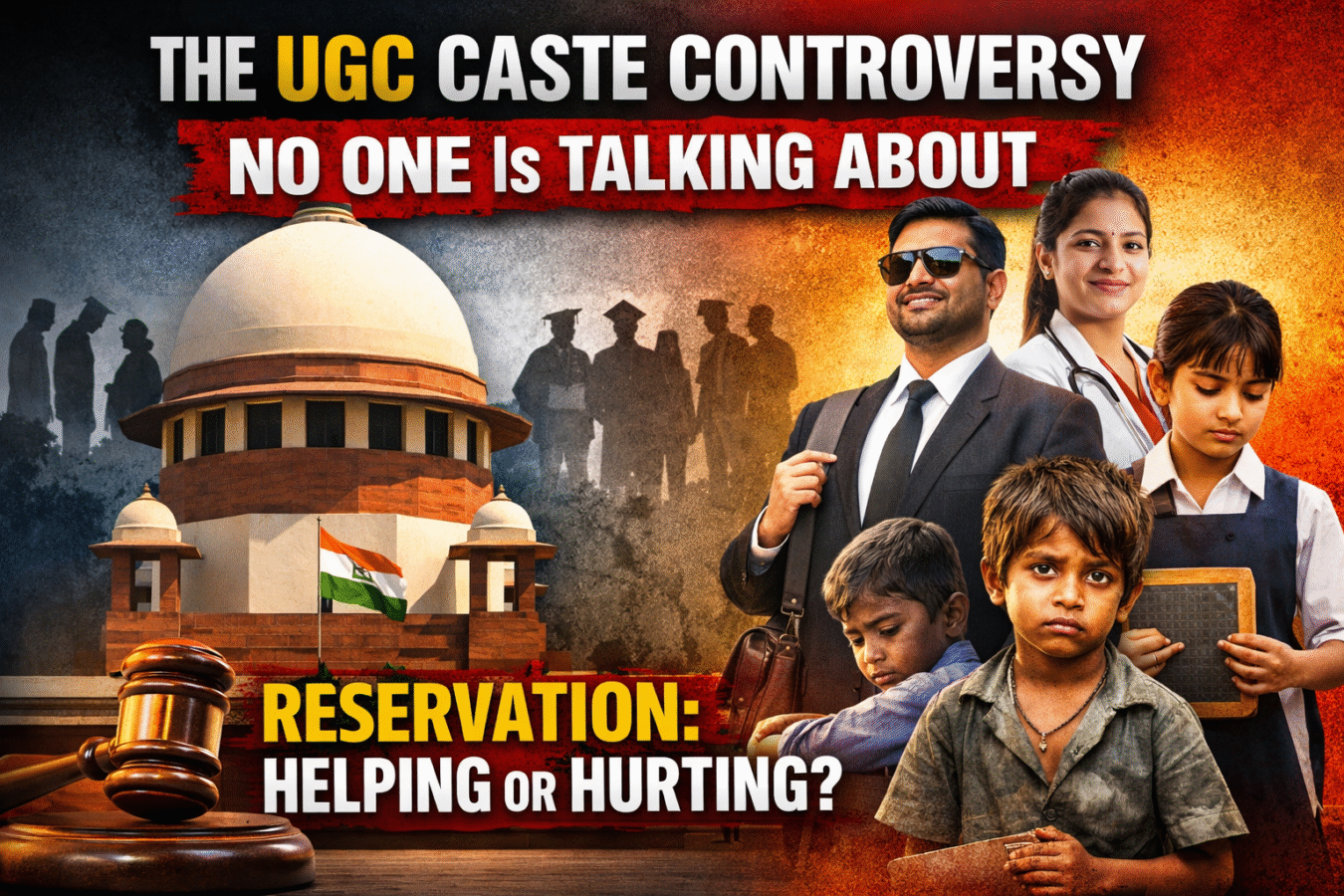
On January 13, 2026, the University Grants Commission, the UGC, rolled out new rules to fight caste discrimination in colleges. Just sixteen days later, on January 29, the Supreme Court of India hit the brakes. The headlines blew up, painting a simple picture: a battle between social justice and old-school tradition.
But that’s not the real story. What if this whole firestorm is just a symptom of a much deeper problem? What if I told you the reservation system, created 75 years ago to heal old wounds, is now creating new ones? The real story isn’t the one being screamed in the headlines. It’s hiding in plain sight.
(Section 1: The Spark – What Just Happened?)
So, what are these rules that caused such a stir? The “UGC Promotion of Equity Regulations 2026” were supposed to be a hammer against caste-based discrimination on campus. They mandated things like Equal Opportunity Centres and put colleges on the hook—threatening to pull funding or recognition if they didn’t take complaints seriously.
These rules came about because of a Supreme Court case filed by the mothers of Rohith Vemula and Dr. Payal Tadvi. They were two students whose tragic deaths, allegedly linked to caste discrimination, exposed the failures of the old 2012 guidelines. The court demanded something with real teeth.
But the moment the rules dropped, the fight began. It all came down to one clause: Regulation 3(c). Petitions argued this clause defined “caste-based discrimination” so narrowly that it only protected SC, ST, and OBC students. Critics yelled that this ignored other forms of discrimination and was unfair to the general category.
On January 29, a Supreme Court bench led by Chief Justice Surya Kant put the regulations on ice. The court called the rules “prima facie vague” and warned they were so sweeping they could be used for personal vendettas and would only divide society more. So, using its special powers, the court paused the new regulations, brought back the old 2012 rules, and ordered a review.
On the surface, it’s a legal tiff over wording. But to get what’s really going on, you have to understand the history.
(Section 2: The Fire – How Did We Get Here?)
To understand today’s fight, you have to go back to the birth of the Indian Republic. The writers of the Constitution had a huge problem: how do you build an equal nation on a foundation of centuries of inequality? The caste system had locked entire communities out of education and opportunity.
The solution was reservation. Articles 15 and 16 of the Constitution gave the government the power to create “special provisions” for SCs, STs, and later, OBCs. This was India’s version of affirmative action, designed to give a leg up to communities that had been pushed down for generations. The goal was noble, and necessary. It was supposed to be a temporary bridge to equality, not a permanent address.
But over 75 years later, that bridge has led us in circles. The very tool designed to dismantle the caste pyramid is now, ironically, making caste identities stronger and creating new battle lines. This UGC mess is just the latest tremor from these old fault lines.
(Section 3: The Real Story – A System Betraying Itself)
This is the part that gets lost in all the shouting. The real crisis isn’t one new UGC rule. It’s that the entire reservation system is failing.
First, let’s talk about the “dynasty effect.” The system was meant to uplift the deprived. But what has happened? The benefits have been captured by a handful of families within the reserved categories, who then pass them down to their children, and their children’s children. It’s created a new privileged class—a reservation dynasty.
The Justice Rohini Commission, set up to study this, found shocking proof. Its data showed that just 25% of OBC sub-castes had taken almost 97% of all reserved jobs and university seats. Meanwhile, nearly a thousand OBC communities had zero representation. Let that sink in. A system built to create equality has ended up creating its own aristocracy, while the truly deprived in those same communities get nothing.
And here’s the bigger problem: after getting all these benefits—becoming civil servants, doctors, and earning good money—this new elite is no longer deprived. They are powerful. Yet, they still claim benefits in the name of caste disparity. They should be making way for others in their community who are still struggling, but they aren’t.
This leads to the second disaster: we’re now trying to create equality by depriving deserving people of opportunities. Instead of focusing on better training and education for everyone, the system penalizes talented people simply because they don’t have the right last name. It gives more value to someone less trained just because they come from a particular background. This has turned the whole debate into a toxic game of merit versus social justice, pitting students against each other. As one of the Supreme Court justices asked, “Are we going backwards from whatever we gained in terms of achieving a casteless society?”.
The conversation about reservation is broken. It’s just a shouting match. Maybe it’s time we asked a different question. Not, “Is reservation good or bad?” but “How do we make sure it helps the people who are actually deprived?”
So, share your thoughts below. Not another angry rant. A real idea. How do you fix a system so it delivers justice without creating new injustices? Let’s start the conversation that matters.
(Section 4: What Now? A Path Forward)
If the system is broken, what’s the fix? Tearing it all down isn’t the answer. That would be a betrayal. The answer is smart, courageous reform.
First, we have to get serious about the “creamy layer” rule. This was a brilliant idea from the landmark 1992 Supreme Court case, Indra Sawhney & Others v. Union of India, but it has been a total failure in practice. In what is also known as the Mandal verdict, the court upheld the 27% reservation for Other Backward Classes but stipulated that the “creamy layer”—the socially and economically advanced members of those communities—must be excluded so that the benefits of reservation reach the most deserving. We need to enforce this strictly. If a family has become powerful and wealthy, they are no longer deprived. They need to step aside so the benefit can go to someone who actually needs it.
Second, we have to look beyond just caste. A person’s last name isn’t the only thing that holds them back. Disadvantage is complicated. What was your family’s income? Did you go to a poor village school or an elite city school? These are the factors that determine opportunity today. We need a system that looks at real-world disadvantage, not just identity. This would ensure that the poorest kids from all communities get the help they deserve.
And third—and this is the most important—we have to stop fighting over a limited number of seats and start focusing on real education. You don’t create equality by lowering the bar; you create it by giving every person the training and tools to clear it. That means massive investment in good primary schools, coaching, and support for all students who are falling behind. That is how you bring real equality, not by depriving talented people of their due.
The UGC controversy is a wake-up call. The anger shouldn’t be aimed at the Supreme Court or at any group of students. It should be aimed at a 75-year-old system that is breaking under the weight of its own contradictions. A system that is protecting a new elite that is no longer deprived.
We’ve been patching up this machine for decades because we’re afraid to look at its engine. We avoid the tough questions because they’re politically explosive. But the price of that fear is a divided society and a generation of young people filled with resentment instead of purpose.
The real controversy isn’t a new rule. It’s our collective failure to fix a system that was meant for justice but is now creating deep disparity. And that leaves us with one uncomfortable question: Are we brave enough to finally demand that those who have already benefited make way for those who are still waiting for a chance?