
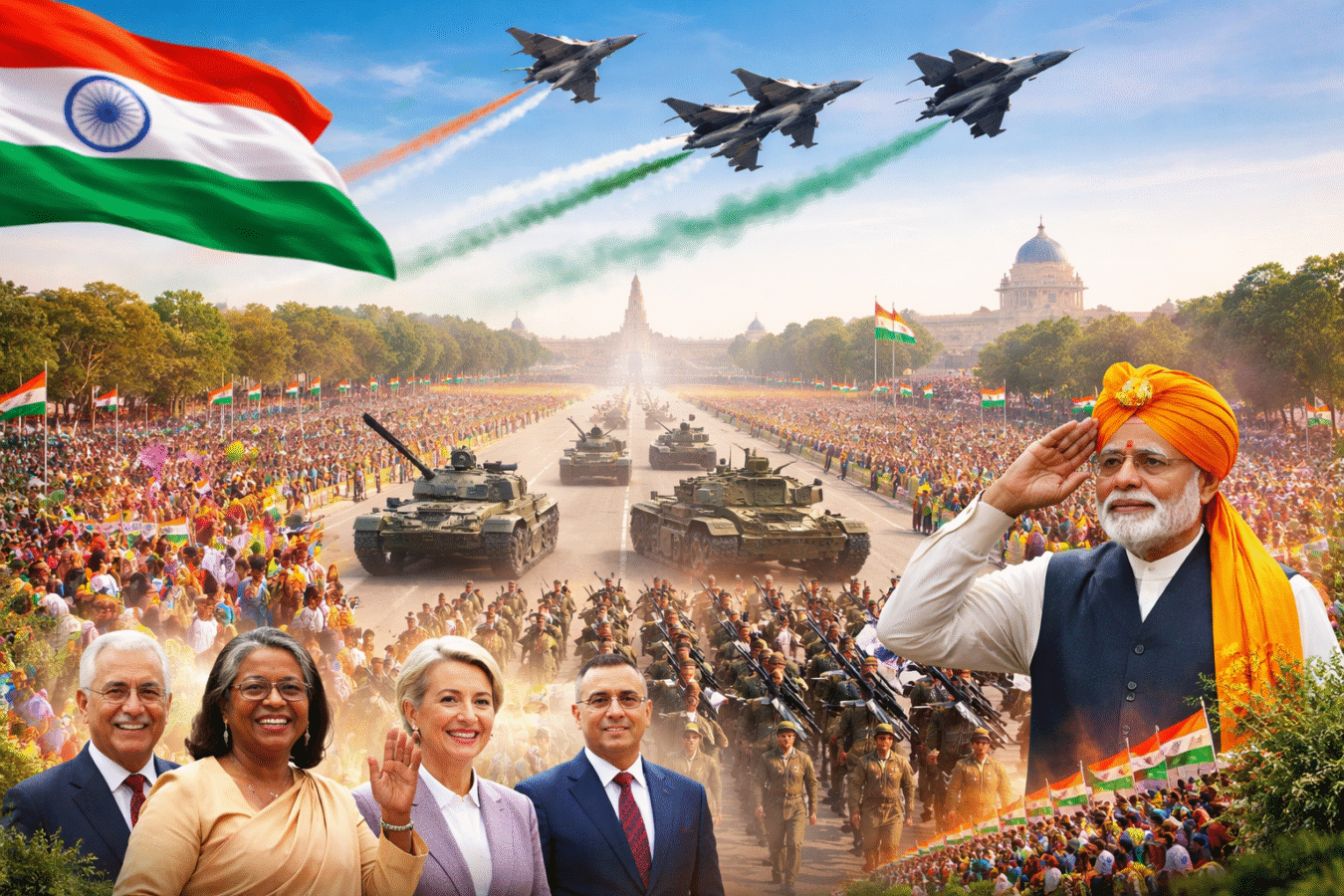
India marked its 77th Republic Day on January 26, 2026, with a grand national celebration on Kartavya Path (formerly Rajpath) in New Delhi. The event blended constitutional pride, military precision, cultural diversity, and mass public participation, while also projecting India’s growing confidence on the global stage.
Why Republic Day Matters
Republic Day commemorates the adoption of the Indian Constitution on 26 January 1950, when India became a sovereign democratic republic. The day also honours the sacrifices of freedom fighters and brave soldiers who made independence possible and continue to safeguard the republic, reinforcing the idea of unity in diversity under one constitutional identity.
2026 Special Significance: 150 Years of “Vande Mataram”
The 2026 celebrations carried added historical weight with the commemoration of 150 years of “Vande Mataram,” India’s national song deeply associated with the freedom struggle and national unity. The tribute positioned the song as a living symbol of national consciousness and continuity.
Key Themes: Patriotism + Self-Reliance
Two central themes shaped the tone of the celebrations: first, 150 years of “Vande Mataram,” linking India’s freedom movement to the republic’s present-day identity; and second, Atmanirbhar Bharat (Self-Reliant India), emphasizing progress toward self-sufficiency in defence, technology, and innovation, visible in modernization and indigenous capability showcases.
Chief Guests from the Foreign World: European Union Leadership
A defining diplomatic highlight was the presence of European Union leadership as Chief Guests: Mr. António Costa, President of the European Council, and Ms. Ursula von der Leyen, President of the European Commission. Their participation symbolized deepening India–EU cooperation and the broader push toward stronger trade, investment, and technology collaboration.
Ceremonial Timeline: From Tribute to Parade
The day began with a solemn homage at the National War Memorial led by Prime Minister Narendra Modi and Defence Minister Rajnath Singh, offered at the eternal flame and Amar Chakra, setting the tone of respect and gratitude. President Droupadi Murmu, accompanied by EU dignitaries, proceeded from Rashtrapati Bhavan to Kartavya Path to preside over the parade as the Supreme Commander of the Indian Armed Forces. The President hoisted the national flag, followed by a ceremonial 21-gun salute and inspection of the armed forces, symbolizing constitutional authority and military discipline. The parade unfolded along the iconic 3 km ceremonial stretch from Rashtrapati Bhavan to the National War Memorial, and the formal ceremony concluded with the President and Chief Guests departing with military honours, while the Prime Minister’s warm interaction with citizens along Kartavya Path stood out as a memorable people-facing moment.
Military Parade Highlights: Strength, Modernization, and Indigenous Capability
The military segment showcased discipline, readiness, and technological progress with emphasis on modernization and indigenous capability. Key displays included infantry and mechanized forces; armoured columns featuring T-90 Bhishma and Arjun MK1 tanks; indigenous artillery systems such as Dhanush and ATAGS; air defence systems including Akash and MR-SAM (Abhr); and unmanned ground vehicles and evolving battlefield technologies. The emphasis on indigenous drone technology and counter-drone systems reflected a shift toward future-ready defence capabilities. Special contingents such as “Him Yoddha (Himalayan warriors)” highlighted operational support in challenging terrains through camels, birds, and indigenous dog breeds. The parade also highlighted Operation Sindur as a marker of readiness and self-reliance, with “Jointness, Self-Reliance, and Innovation” emphasized as a guiding principle.
Cultural Tableaux and Social Themes
Cultural tableaux presented by states and ministries illustrated India’s diverse heritage and developmental priorities. States including Assam, Gujarat, Chhattisgarh, Nagaland, Punjab, Kerala, Himachal Pradesh, Jammu & Kashmir, Odisha, Manipur, Rajasthan, and West Bengal showcased unique cultural identities and contributions. Ministries such as AYUSH, Home Affairs, Education, Power, Panchayati Raj, and Culture highlighted progress in health initiatives, governance, education, energy transition, and cultural preservation. A centerpiece cultural segment curated by the Ministry of Culture featured 2,500+ artists representing every Indian state and union territory, turning “Vande Mataram” into a pan-India performance of unity. Youth participation remained prominent through contingents of the National Cadet Corps (NCC) and the National Service Scheme (NSS).
The Flypast Finale: India’s Aerial Prowess
The Indian Air Force flypast was the grand finale and included formations such as the Arjun Formation, Rafale jets, C130J Super Hercules, and other aircraft formations demonstrating coordinated aerial power, serving as both celebration and capability demonstration.
Awards and Honouring Bravehearts
The ceremony included recognition and honouring of courage and service, including gallantry awards such as the Ashok Chakra, and honouring veterans and decorated soldiers including recipients of the Param Vir Chakra and Ashok Chakra. A special mention was made of Group Captain Shubhanshu Shukla, noted for a 20-day mission aboard the International Space Station, symbolizing India’s strides in space capability and national pride.
Key Numbers: Republic Day 2026 at a Glance
The celebrations highlighted key figures and numbers, including the 77th Republic Day, Kartavya Path length of about 3 km, around 10,000 special guests invited, approximately 80,000 spectators accommodated, 72 Indian Air Force musicians including Agniveers, 148 NCC cadets participating, 42 CRPF women in the motorcycle display, and a 20-day space mission referenced for Shubhanshu Shukla.
Defence + Diplomacy: Why the EU Presence Matters
The participation of EU dignitaries highlighted the strengthening India–Europe relationship, built on shared values such as democracy, rule of law, and multilateralism, and reflected momentum toward deeper cooperation in trade, technology, and strategic partnerships—pointing to India’s expanding global engagement.
Conclusion
The 77th Republic Day celebrations on Kartavya Path blended solemn tribute, military modernization, cultural vibrancy, youth participation, and global diplomacy into one national narrative, reaffirming India’s journey as a resilient republic—rooted in constitutional values, strengthened by self-reliance, and increasingly confident as a globally engaged nation moving toward its 2047 vision.