
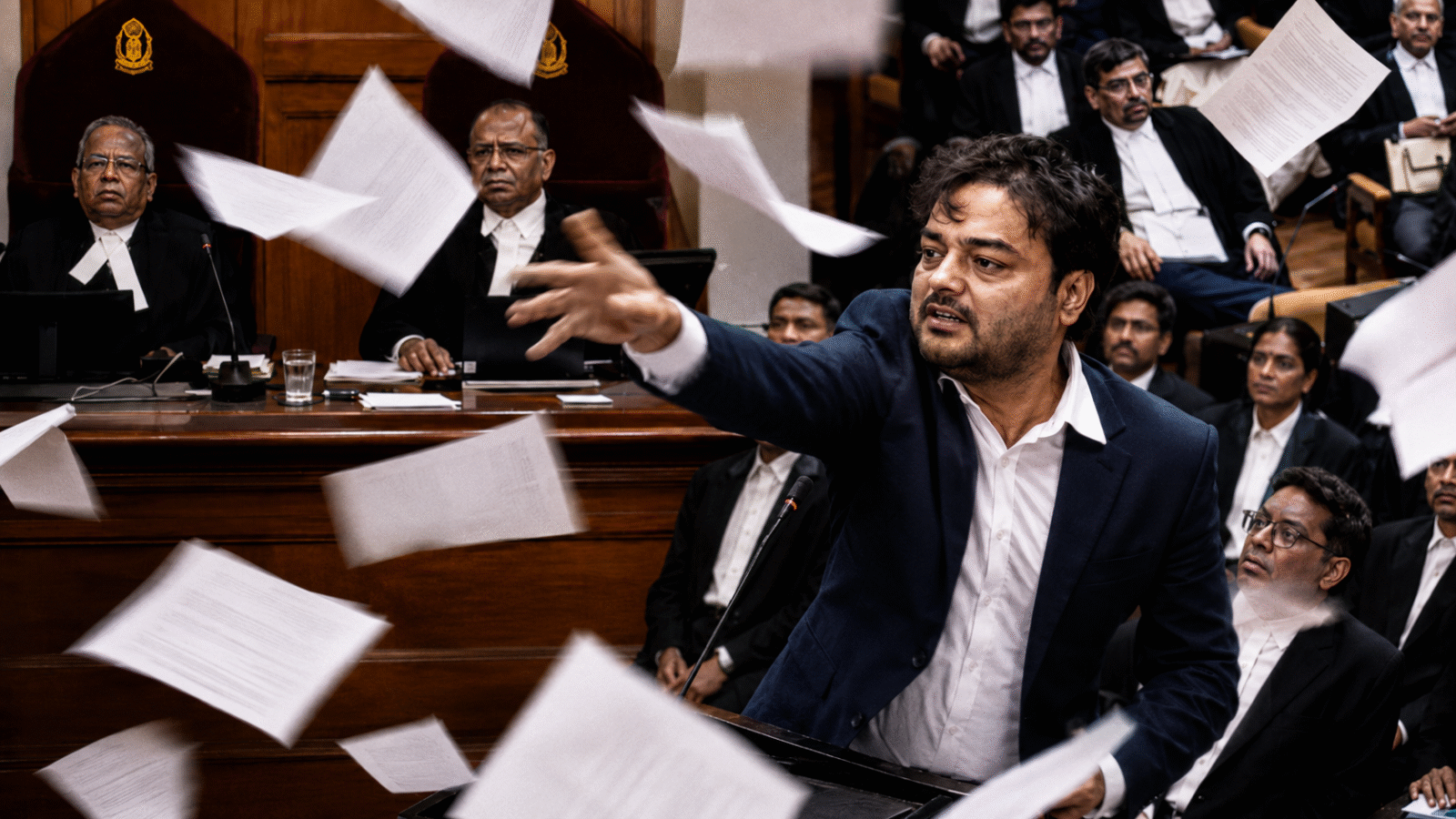
The judicial architecture of a sovereign republic represents the ultimate guarantor of constitutional morality, civil liberties, and the rule of law. Yet, when the structural and operational frameworks of that system remain anchored in colonial-era hierarchies, administrative sclerosis, and procedural complexity, the delivery of justice is severely compromised. On July 10, 2026, Courtroom 14 of the Supreme Court of India became the site of an unprecedented disruption that laid bare these underlying tensions1. A litigant-in-person, identified as Prabal Pratap Yadav, disrupted formal proceedings before a two-judge bench of Justices K.V. Viswanathan and Alok Aradhe1. Dressed in an advocate’s attire and accompanied by co-petitioner Chandra Bhan, Pratap bypassed standard judicial salutations, addressed the presiding bench as “Mr. Judicial Servant,” declared himself “the sovereign,” ordered the court to direct the registration of a First Information Report (FIR) against an Assistant Commissioner of Police (ACP) in Lucknow, and hurled a 185-page bundle of documents into the air before shouting profanities directed at the Chief Justice of India1.
This dramatic incident, while dismissed on its merits and met with judicial forbearance due to the petitioner’s highly disturbed mental state, serves as a revealing entry point for academic analysis2. It is not merely an isolated case of litigant misconduct; rather, it is a symptomatic rupture. The outburst highlights the profound systemic crises afflicting the Indian justice delivery apparatus: the cultural friction between feudal colonial terminology and the constitutional reality of popular sovereignty; the overwhelming psychological and procedural toll of a backlogged case system; the administrative apathy, or “Babugiri,” that characterises both police investigation portals and judicial registries; and the immediate necessity of harmonizing newly enacted procedural laws with access to justice. This article provides a critical analysis of these structural bottlenecks, using the July 10, 2026 incident as a primary case study to chart a path toward holistic judicial and police reform.
Micro-Level Pathologies: Anatomy of Prabal Pratap v. State of Uttar Pradesh
To understand the systemic implications of the Supreme Court incident, it is essential to trace the legal and administrative trajectory that led to Pratap’s courtroom outburst. The case of Prabal Pratap v. The State of Uttar Pradesh did not originate as a high-stakes constitutional dispute but rather as a localized labor and criminal complaint in Lucknow4. Pratap, a resident of Bharthana, Etawah, Uttar Pradesh, had previously worked as an associate or practitioner within the local legal ecosystem, having even been listed as counsel in complex criminal revisions before the Allahabad High Court, such as Diwakar Nath Tripathi v. State of U.P., which challenged the rejection of police investigations under Section 156(3) of the Code of Criminal Procedure (CrPC)4.
Pratap’s personal legal battle began at Duplex Technologies Services Private Limited, an information technology and software development firm registered in Aliganj, Vikas Nagar, Lucknow4. While employed there, Pratap engaged in severe misconduct, including the persistent harassment of a female colleague, which involved sending objectionable and abusive emails4. Despite receiving strict warnings from the management, his behavior persisted, leading to his formal termination4. In retaliation, Pratap launched a campaign of legal actions against his former employer, fabricating allegations that Duplex Technologies was operating an anti-national cyber-crime and data piracy syndicate across the country4.
When local police authorities in Lucknow declined to register an FIR based on these accusations, Pratap sought recourse through the judicial system4. He filed an application before the Special Chief Judicial Magistrate (Customs) in Lucknow, seeking a direction for police registration of an FIR and investigation under Section 173(4) of the newly enacted Bharatiya Nagarik Suraksha Sanhita (BNSS), the procedural successor to Section 156(3) of the CrPC7. On February 21, 2026, the Magistrate declined to order a police investigation, electing instead to convert Pratap’s application into a private complaint case under Section 223 of the BNSS (formerly Section 200 of the CrPC)5.
This procedural conversion meant that the burden of adducing evidence shifted entirely to the complainant, preventing the immediate deployment of state investigative machinery13. Dissatisfied, Pratap challenged the Magistrate’s order before the Lucknow Bench of the Allahabad High Court, seeking a writ of mandamus to compel the Lucknow Police Commissioner to take over the investigation and to quash the Magistrate’s order5. On April 6, 2026, the High Court dismissed the writ petition, observing that the petitioner possessed an efficacious alternative remedy and should present his facts before the lower court5.
Frustrated by these successive procedural roadblocks, Pratap approached the Supreme Court via a Special Leave Petition (SLP), which was registered for listing on June 12, 20266. The ensuing scene on July 10, 2026—characterized by the verbal rejection of judicial hierarchy, the physical throwing of a 185-page document bundle, and targeted profanity—was the culmination of an administrative journey that began in a local police station and wound through multiple tiers of the judiciary1. While the Supreme Court dismissed the SLP on its legal merits and exercised restraint by declining to initiate criminal contempt proceedings due to Pratap’s visible distress, the case highlights how procedural labyrinths can exacerbate litigant frustration, occasionally resulting in institutional disruptions2.
| Date / Phase | Forum / Institution | Procedural Action | Legal Outcome / Systemic Significance |
| Pre-Litigation (2025) | Duplex Technologies Services Pvt. Ltd., Lucknow | Disciplinary inquiry and termination of Prabal Pratap. | Fired for persistent harassment of a female colleague; initiated retaliatory litigation alleging a national cyber-crime syndicate4. |
| November 2025 | Special Chief Judicial Magistrate (Customs), Lucknow | Application under Section 173(4) BNSS / 156(3) CrPC7. | Sought judicial directive to compel local police to register an FIR against the employer and Lucknow police officers4. |
| February 21, 2026 | Special Chief Judicial Magistrate (Customs), Lucknow | Conversion of application into a private complaint under Section 223 BNSS5. | Refused to direct police investigation; placed the evidentiary burden on the complainant, stalling immediate state action13. |
| April 6, 2026 | Allahabad High Court (Lucknow Bench) | Writ Petition challenging the Magistrate’s conversion order5. | Petition dismissed; High Court ruled that the petitioner had an efficacious alternative remedy to pursue the private complaint5. |
| June 12, 2026 | Supreme Court of India Registry | Verification and registration of Special Leave Petition (SLP)6. | Certified as fit to argue in-person by the Judicial Administration registrar under the Supreme Court Rules, 20136. |
| July 10, 2026 | Supreme Court of India (Court No. 14) | Hearing before Justices K.V. Viswanathan and Alok Aradhe1. | Outburst in court; addressal of bench as “judicial servants”1. SLP dismissed on merits; court declined contempt action due to Pratap’s disturbed state3. |
This chronological breakdown demonstrates how a localized private dispute can escalate into a high-voltage disruption at the highest level of the judiciary1. It highlights how litigants can navigate multiple tiers of the court system, driven by personal grievance and enabled by formalistic administrative processes6.
Cultural Anachronisms: The Colonial ‘My Lords’ vs. Democratic ‘Judicial Servants’
At the core of Pratap’s courtroom dialogue lies a profound ideological tension that continues to characterize the Indian legal system: the conflict between colonial-era feudalism and modern constitutional democracy. When asked by Justice Viswanathan if he was appearing as a party-in-person, Pratap responded without the customary honorifics, addressing the bench as “Mr. Judicial Servant” and declaring, “I order you to order the registration of FIR… because I am the sovereign”1.
This exchange illustrates a deep structural contradiction. The preamble to the Constitution of India establishes that sovereign authority originates from “We, the People.” In a constitutional republic, judges, police officers, and civil servants are indeed public servants, deriving their authority from the constitutionally mandated distribution of state power. However, the daily operation of Indian courtrooms remains steeped in the linguistic and physical architecture of British colonial rule, where judges were representatives of the Crown and thus addressed as “My Lords” or “Your Lordships”15.
This linguistic legacy is not merely a matter of form; it shapes the power dynamics within the courtroom. The persistence of feudal honorifics reinforces an asymmetric relationship between the state’s judicial apparatus and the citizenry, reducing the common masses to what some critically describe as a “cattle class” pleading before lords. Over the past several decades, repeated attempts have been made to dismantle this colonial hierarchy:
- The 2006 BCI Rules: The Bar Council of India (BCI) amended the Rules Governing Advocates under Section 49(1)(c) of the Advocates Act, 1961, introducing Chapter IIIA18. This amendment explicitly stated that advocates should address the Supreme Court and High Courts as “Your Honour” or “Hon’ble Court,” and subordinate courts as “Sir” or equivalent regional terms, explicitly discouraging “My Lord” and “Your Lordship” as relics of a colonial past18.
- The 2014 Supreme Court Ruling: In Shiv Sagar Tiwari v. Union of India, an 85-year-old advocate filed a public interest litigation (PIL) seeking a strict ban on colonial honorifics17. A bench comprising Justices H.L. Dattu and S.A. Bobde dismissed the petition, ruling that while addressing judges respectfully is mandatory, the use of “My Lord” or “Your Lordship” is not legally compulsory17. The court noted that “Your Honour” or “Sir” are perfectly acceptable alternatives17.
- Judicial Resistance and Inconsistency: Despite these regulatory and judicial pronouncements, the transition remains highly inconsistent. In 2020 and 2021, a Supreme Court bench led by Chief Justice S.A. Bobde took exception to a litigant addressing the bench as “Your Honour,” remarking that the term belonged to the Supreme Court of the United States or a subordinate magistrate, thereby prompting the litigant to revert to “My Lords”19. Conversely, progressive jurists have actively sought to dismantle this practice. For instance, Justice S. Muralidhar during his tenure at the Delhi and Punjab & Haryana High Courts, and Justice S. Ravindra Bhat as Chief Justice of the Rajasthan High Court, formally requested that advocates desist from using feudal salutations in favor of “Sir” or “Hon’ble Court”17.
Pratap’s subversion of courtroom etiquette, though expressed aggressively, reflects a literal interpretation of constitutional sovereignty1. By reframing judges as “judicial servants” and positioning himself as the “sovereign litigant,” he challenged the hierarchical theater of the court1. The systemic failure to fully implement a decolonized courtroom lexicon alienates the common citizen, reinforcing a perception of the judiciary as an inaccessible, elite, and feudal institution rather than a democratic arbiter of rights.
Structural Strain: The Mathematical Realities of Backlog, Vacancies, and the “Square Wheels” Economy
The anger and instability exhibited by litigants like Pratap cannot be separated from the administrative strain of the Indian judicial system. The Indian judiciary is currently grappling with unprecedented structural pressure, characterized by a massive backlog of pending cases, high judicial vacancy rates, and a severely low judge-to-population ratio.
As of late 2025 and early 2026, the cumulative case backlog across all levels of the Indian judiciary has crossed the threshold of 5.5 crore (55 million) pending cases, marking a dramatic escalation from the 3.2 crore backlog recorded in 201524. Criminal cases constitute approximately 77% of this total backlog24. The physical and emotional exhaustion of navigating this system often drives litigants to extreme frustration.
This backlog is driven by a severe shortage of judicial manpower. As detailed in parliamentary disclosures and the India Justice Report 2025, the actual working judge-to-population ratio in India stands at approximately 15 to 17 judges per million people25. This is far below the target of 50 judges per million recommended by the Law Commission of India in its 120th Report as early as 198725.
To place India’s judicial capacity in a global context, comparative metrics are presented below:
| Metric | India (Sanctioned Strength) | India (Actual Working Strength) | United States | United Kingdom | Europe (Average) |
| Judges per Million Population | ~1927 | 15 – 1725 | 100 – 15026 | ~5030 | ~140 – 22029 |
| Average Caseload per Judge (Annual) | ~2,200 (District)27 | ~2,600 (Disposals)25 | ~81 (Disposals)25 | – | – |
| National Judicial Vacancy Rate | – | 21% (Subordinate) / 33% (High Courts)27 | – | – | – |
This table demonstrates the immense burden placed on the Indian judiciary. While an average American judge disposes of approximately 81 cases annually, an Indian judicial officer handles an average of 2,600 disposals per year, working weekends and holidays to manage the caseload25. In high-workload courts, such as the Allahabad High Court and the Madhya Pradesh High Court, the individual caseload reaches up to 15,000 cases per judge27.
This structural bottleneck is further exacerbated by chronic vacancies. Nationally, High Courts operate with a 33% vacancy rate, and the district judiciary faces a 21% vacancy rate27. This deficit is highly concentrated in northern and eastern states. For instance, Uttar Pradesh and West Bengal alone account for approximately 31% of the national case backlog24. Research shows a strong positive correlation of 0.87 between high judicial vacancies and case pendency in northern states, illustrating that the administrative system is unable to keep pace with the demands of an increasingly litigious and urbanizing population24.
This situation leads to what economic analysts term a “square wheels situation”24. While India seeks to drive forward high-stakes public investments and market-led growth, its administrative and dispute-resolution institutions are forced to rely on slow, ill-fitting governance mechanisms24. This friction increases transaction costs, delays contract enforcement, and places immense psychological pressure on litigants, occasionally resulting in emotional breakdowns within the courtroom1.
Administrative “Babugiri”: Registry Inertia and the Hurdles of Police Bureaucracy under the BNSS
While numerical deficits explain the delays, the everyday experience of litigation is defined by bureaucratic apathy, commonly referred to as “Babugiri.” This administrative inertia operates in two primary arenas: the internal judicial registry and the police-procedural framework governing criminal investigations.
Registry Failures and Checklist Bureaucracy
The Supreme Court incident of July 10, 2026, exposes a critical failure in the judicial branch’s internal administrative machinery6. Under the Supreme Court Rules, 2013, any litigant wishing to appear and argue as a party-in-person must undergo a mandatory interaction with a registrar in the Judicial Administration branch6. The registrar’s legal duty is to evaluate the litigant’s capacity, verify that they can assist the court in a proper manner, and formally certify them as fit to argue6.
In Pratap’s case, the registrar had formally interacted with him and issued a certificate stating, “I am of the opinion that he is able to give assistance in a proper manner”6. Yet, upon standing before the bench, Pratap exhibited incoherent and highly erratic behavior6. When the bench summoned the concerned registrar to explain how an obviously disturbed individual had been certified as fit, the official stood “clueless” in open court6.
This incident reveals a broader systemic pattern: the reliance of judicial administration on formal, checklist-driven compliance rather than substantive evaluation. Registrars and court clerks often treat interaction procedures as a routine exercise, failing to assess the actual psychological readiness or legal competence of self-represented litigants. This bureaucratic detachment compromises courtroom safety and places a heavy burden on presiding judges, who must manage volatile situations in real time6.
The Procedural Labyrinth of the BNSS and Police “Burking”
Beyond the registry, the most challenging administrative bottleneck for citizens is the registration of an FIR. In India, police officers frequently engage in “burking”—the practice of refusing to register FIRs for cognizable offenses to keep reported crime statistics low or due to corruption and administrative apathy31. To counter this, victims historically relied on Section 156(3) of the CrPC, which empowered magistrates to direct the police to register an FIR and conduct an investigation12.
However, the enactment of the Bharatiya Nagarik Suraksha Sanhita (BNSS) has altered this procedural landscape, introducing several administrative hurdles:
| Procedural Stage / Concept | Code of Criminal Procedure (CrPC), 1973 | Bharatiya Nagarik Suraksha Sanhita (BNSS), 2023 | Systemic Impact & Bottlenecks |
| FIR Registration (Cognizable Offence) | Mandatory under Section 154(1) as per the Lalita Kumari precedent14. | Discretionary preliminary inquiry under Section 173(3)34. | Authorizes a 14-day delay for offenses punishable by 3 to 7 years, creating a loophole for police inaction34. |
| Magisterial Investigation Orders | Discretionary under Section 156(3) upon finding a cognizable offense12. | Regulated under Section 175(3), codifying the Priyanka Srivastava requirements12. | Mandates a prior application to the SP under Sec 173(4) and a sworn affidavit, limiting immediate judicial relief12. |
| Public Servant Protections | Handled through separate judicial sanctions and administrative guidelines33. | Codified pre-cognizance hearing/report under Section 175(4)40. | Mandates a report from superior officers and consideration of the public servant’s defense, slowing down accountability39. |
These statutory changes present a double-edged sword for the administration of justice:
- The Preliminary Inquiry Loophole: Under Section 173(3) of the BNSS, an officer-in-charge of a police station, with prior permission from an officer not below the rank of Deputy Superintendent of Police, may defer FIR registration and conduct a “preliminary inquiry” for up to 14 days for offenses punishable by 3 to 7 years of imprisonment34. While designed to filter out frivolous complaints, this provision significantly dilutes the landmark ruling in Lalita Kumari v. State of U.P., which mandated the immediate registration of an FIR upon receipt of information disclosing a cognizable offense31. It gives police officers statutory discretion to delay proceedings, leaving citizens in a state of uncertainty36.
- The Magisterial Bottleneck under Section 175(3): Under the old CrPC, if the police refused to file an FIR, a citizen could immediately petition a magistrate under Section 156(3)12. Under Section 175(3) of the BNSS, this process is strictly regulated12. The law now codifies the stringent requirements established in Priyanka Srivastava v. State of U.P.33. A complainant must first prove they approached the station house officer under Section 173(1) and subsequently the Superintendent of Police under Section 173(4)33. Any application to the magistrate must be accompanied by a sworn affidavit and copies of these prior applications12. Furthermore, the magistrate is required to consider the police officer’s submissions regarding why they declined to register the case before issuing an investigation order12.
- Implications for the Litigant: While these safeguards are highly effective at preventing vexatious litigation and blackmail—as seen in commercial disputes and retaliatory filings—they create significant barriers for genuine, economically marginalized victims14. The requirement to navigate multiple tiers of police hierarchy, draft detailed affidavits, and undergo magisterial inquiries before an investigation even begins creates a procedural hurdle33.
Pratap’s case is a prime example of this procedural tension. When the Lucknow Magistrate converted his Section 173(4) application into a private complaint under Section 223, the court acted in accordance with judicial directives to prevent the abuse of state machinery for personal vendettas4. However, to an increasingly desperate litigant, this procedural transition appeared as a form of institutional collusion and administrative apathy, ultimately contributing to his courtroom outburst1.
Strategic Reform Framework: Restructuring, Decolonization, and Technological Integration
The compounding crises of the Indian judicial system demand a comprehensive structural reform program. The Supreme Court incident of July 10, 2026, must not be dismissed as a minor security breach; it should be recognized as a call to overhaul the administrative and cultural foundation of the nation’s justice apparatus1. This framework must address four key pillars: structural capacity, procedural refinement, cultural decolonization, and technological integration.
Structural Capacity Expansion
The primary bottleneck of the Indian judiciary remains its severe shortage of personnel25. The understaffed bench cannot meet the needs of a nation of 1.4 billion people27.
To address this, the Union government must establish the All India Judicial Service (AIJS) under Article 312 of the Constitution28. Recruiting district judges through a centralized, competitive process will attract high-caliber legal talent, standardize judicial training, and ensure a steady pipeline to fill the 21% vacancy rate in the subordinate judiciary27.
Simultaneously, the Supreme Court Collegium and the Ministry of Law and Justice must adopt a strict, time-bound schedule to eliminate the 33% vacancy rate in High Courts, ensuring that judicial recommendations are made and cleared at least six months before a vacancy arises27. This must be accompanied by the establishment of the National Judicial Infrastructure Authority of India (NJIAI) to provide subordinate courts with the physical and digital facilities required for efficient case management26.
Cultural Decolonization and Litigant Support
Decolonizing the courtroom requires reforming both language and administrative practices. The Bar Council of India, in coordination with the judiciary, must enforce a transition from colonial honorifics like “My Lord” and “Your Lordship” to democratic salutations such as “Your Honour” or “Hon’ble Court,” aligning the courtroom experience with constitutional equality18.
Furthermore, registries must overhaul their approach to self-represented litigants6. Rather than relying on simple, checklist-driven approvals, registries should establish dedicated Litigant-in-Person Support Cells staffed by legal aid counsel and psychological professionals2. These cells would help vulnerable or distressed litigants navigate the court system, reducing procedural errors and lowering the risk of volatile outbursts in the courtroom2.
Procedural Calibration of the BNSS
The procedural rules introduced by the BNSS must be balanced to ensure they do not hinder access to justice. While the safeguards under Sections 173(3) and 175(3) are useful for preventing frivolous or retaliatory cases, they must not be allowed to shield police inaction or create insurmountable barriers for genuine victims12.
The 14-day limit for preliminary inquiries under Section 173(3) must be strictly enforced through real-time digital portals36. If an inquiry is not completed within this timeframe, it should automatically trigger a deemed FIR and initiate disciplinary action against the delinquent officer36.
Furthermore, Section 175(3) should be amended to give magistrates the discretion to waive strict procedural requirements—such as prior written filings with the Superintendent of Police—in urgent cases involving human rights violations, gender-based violence, or extreme socioeconomic vulnerability, ensuring the court remains an accessible avenue for relief12.
Technological Integration and Responsible AI
Technology must be leveraged to improve efficiency across all tiers of the judiciary. The implementation of Phase III of the e-Courts Mission Mode Project should focus on digitizing all subordinate court records and establishing virtual hearing facilities in remote areas30.
Furthermore, the judiciary should institutionalize artificial intelligence tools under strict ethical guidelines47. Tools like the Supreme Court Portal for Assistance in Court Efficiency (SUPACE) can assist judges by summarizing extensive case files and identifying relevant precedents, while the Supreme Court Vidhik Anuvaad Software (SUVAS) can translate judgments into regional languages, improving accessibility in a multilingual society47.
To manage the heavy case backlog, AI-driven case-flow systems can categorize incoming matters by urgency and complexity, routing routine cases to digital summary courts and allowing human judges to focus on complex trials28.
┌───────────────────────────────────────────────────────────────────────────┐
│ Systemic Judicial Reform Program │
└─────────────────────────────────────┬─────────────────────────────────────┘
│
┌────────────────────────────┼────────────────────────────┐
▼ ▼ ▼
┌──────────────────┐ ┌──────────────────┐ ┌──────────────────┐
│ Structural │ │ Procedural │ │ Cultural │
├──────────────────┤ ├──────────────────┤ ├──────────────────┤
│ • Establish AIJS │ │ • Strictly limit │ │ • Abolish feudal │
│ to resolve the │ │ preliminary │ │ honorifics like│
│ 21% subordinate│ │ inquiries to a │ │ “My Lords” in │
│ vacancy rate │ │ maximum of 14 │ │ favor of “Your │
│ [cite: 27, 28].│ │ days [cite: 37]│ │ Honour” [cite: │
│ │ │ │ │ 75, 76]. │
│ • Empower the │ │ • Give │ │ │
│ NJIAI to │ │ magistrates │ │ • Overhaul │
│ modernize physical│ │ discretion to │ │ registries and │
│ infrastructure │ │ waive strict │ │ establish │
│ .│ │ affidavit │ │ Litigant-in- │
│ │ │ barriers in │ │ Person Support │
│ • Complete High │ │ urgent cases │ │ Cells to assist│
│ Court vacancies│ │ .│ │ distressed │
│ within 90 days │ │ │ │ petitioners │
│ [cite: 27, 28].│ │ │ │ . │
└──────────────────┘ └──────────────────┘ └──────────────────┘
This structural reform program addresses the root causes of judicial delay and litigant frustration, providing a clear roadmap toward a more efficient, accessible, and democratic justice system28.
Toward a Sovereign-Centric Administration of Justice
The Supreme Court incident of July 10, 2026, was a symptom of a judicial system under severe strain. When a citizen enters the highest court of the land, rejects its traditional hierarchy, and declares himself the sovereign, he exposes a deep-seated gap between the promise of constitutional democracy and the reality of a hierarchical, colonial legal system.
This systemic crisis is further compounded by a shortage of judicial manpower, resulting in a backlog of over five crore pending cases24. Under these conditions, the pursuit of justice can become a long and exhausting process for litigants, as seen in the volatile shoe-hurling incident of 2025 and Prabal Pratap’s courtroom disruption in 20261. This frustration is exacerbated by administrative hurdles, such as the procedural barriers under Sections 173(3) and 175(3) of the BNSS, which can sometimes make the simple registration of an FIR feel like an insurmountable task12.
To build a more equitable legal system, India must move away from the colonial traditions of the past and embrace a more citizen-centric approach to justice. This requires a comprehensive effort to decolonize courtroom language, fill judicial vacancies, and implement key administrative reforms18. By simplifying procedural laws, establishing the All India Judicial Service, and integrating modern AI tools, the state can make its courts more accessible, transparent, and efficient28. Only by addressing these foundational issues can the Indian judiciary truly honor its constitutional mandate and ensure that “We, the People” remain the true sovereigns of the republic.
Works cited
- “I am the Sovereign”: Litigant escorted out of Supreme Court after hurling file papers, curses at judges, https://www.aninews.in/news/national/general-news/i-am-the-sovereign-litigant-escorted-out-of-supreme-court-after-hurling-file-papers-curses-at-judges20260710210253
- We Only Have Sympathies for Him Supreme Court Declines Action After Litigant Hurls Papers Abuses CJI During Hearing – LawStreet Journal, https://lawstreet.co/judiciary/we-only-have-sympathies-for-him-supreme-court-declines-action-after-litigant-hurls-papers-abuses-cji-during-hearing
- Mr judicial servant, I order you…: Man flings papers, abuses inside SC courtroom, https://www.indiatoday.in/india/law-news/story/supreme-court-complainanat-abuse-removed-after-alleged-abuse-during-allahabad-high-court-hearing-2944891-2026-07-10
- कौन हैं सुप्रीम कोर्ट में वकील के भेष में जज पर पेपर उछालने वाले प्रबल प्रताप? लड़की के कारण गई थी नौकरी, https://www.aajtak.in/education/news/story/prabal-pratap-yadav-supreme-court-paper-throwing-incident-edmm-rptc-2598932-2026-07-11
- Petitioner hurls papers, ‘orders’ SC to file FIR, https://timesofindia.indiatimes.com/india/petitioner-hurls-papers-orders-sc-to-file-fir/articleshow/132323331.cms
- CJI abused, papers thrown: Behind the ruckus in Supreme Court by Lucknow man, https://www.hindustantimes.com/india-news/cji-abused-papers-thrown-behind-the-ruckus-in-supreme-court-by-lucknow-man-101783709274836.html
- Supreme Court Dismisses Plea After Petitioner Throws Papers At Bench; Justice KV Viswanathan Says ‘We Only Have Sympathies’ – LawBeat, https://lawbeat.in/top-stories/supreme-court-dismisses-plea-after-petitioner-throws-papers-at-bench-justice-kv-viswanathan-says-we-only-have-sympathies-1610918
- Supreme Court Dismisses Plea After Petitioner Throws Papers At Bench; Justice KV Viswanathan Says ‘We Only Have Sympathies’ – LawBeat, https://lawbeat.in/amp/top-stories/supreme-court-dismisses-plea-after-petitioner-throws-papers-at-bench-justice-kv-viswanathan-says-we-only-have-sympathies-1610918
- Court No. 67 A.F.R. Judgement Reserved on 23.05.2025 Judgement Delivered on 07.07.2025 IN THE HIGH COURT OF JUDICATURE AT ALLAHA – Verdictum, https://www.verdictum.in/pdf_upload/diwakar-nath-tripathi-v-state-of-upwatermark-1727317.pdf
- DUPLEX TECHNOLOGIES SERVICES PRIVATE LIMITED – 2026 Company Profile & Financials – Tracxn, https://tracxn.com/d/legal-entities/india/duplex-technologies-services-private-limited/__gP2igg1s5HB5iz-byyJO7D4Khi9Why-eYQ27_vcdToo
- Duplex Technologies Services Pvt Ltd: Best Software and Mobile apps Development Company in Lucknow – ERP, CRM, Website Design – magicpin, https://magicpin.in/Lucknow/Vikas-Nagar/Other/Duplex-Technologies-Services-Pvt-Ltd:-Best-Software-And-Mobile-Apps-Development-Company-In-Lucknow-Erp,-Crm,-Website-Design/store/22455c7
- Fahimuddin Ansari vs State Of U.P. Thru. Secy. Home Lko. And … on 7 April, 2026, https://indiankanoon.org/doc/91311163/
- 18.12.2025 Judgment pronounced on – High Court of Delhi, https://delhihighcourt.nic.in/app/showFileJudgment/SKS18032026CRLMM25512025_181233.pdf
- Private Complaints In Bnss: Empowering Citizens Or Overloading Courts? – Zenodo, https://zenodo.org/records/15312121/files/1.Animesh%20Pareek%201-10.pdf?download=1
- Colonial Policy And Administration – Hansard – UK Parliament, https://hansard.parliament.uk/lords/1949-04-13/debates/a5cba5d1-6137-4be3-ba19-0160fe296659/ColonialPolicyAndAdministration
- Colonial Policy – Hansard – UK Parliament, https://hansard.parliament.uk/Lords/1942-12-03/debates/54600e72-1834-47ca-96a5-1b6de942ffc1/ColonialPolicy
- Calling judges ‘lord’, ‘lordship’, ‘your honour’ not mandatory: Supreme Court – NDTV, https://www.ndtv.com/india-news/calling-judges-lord-lordship-your-honour-not-mandatory-supreme-court-546975
- No My Lords, Your Lordships at Rajasthan High Court from now on, https://www.newindianexpress.com/nation/2019/jul/15/no-my-lords-your-lordships-at-rajasthan-high-court-from-now-on-2004251.html?botrequest=true
- Addressing Judges in Indian Courts | PDF | Supreme Court Of India – Scribd, https://www.scribd.com/document/513361258/ADDRESSING-THE-JUDGES-write-up
- How to address judges? ‘My Lord’? ‘Your Honour’? Here’s what SC says – The Federal, https://thefederal.com/news/whats-the-correct-way-to-address-judges-my-lord-your-honour
- “Milaard aur memberane jury”: The ‘Your Honour’ controversy – Bar and Bench, https://www.barandbench.com/columns/milaard-aur-memberane-jury-the-your-honour-controversy
- BCI clarifies on CJI’s objection to use of ‘Your Honor’ to address the Top Court; cites Resolution regarding it – The Legal Code, https://thelegalcode.quora.com/BCI-clarifies-on-CJIs-objection-to-use-of-Your-Honor-to-address-the-Top-Court-cites-Resolution-regarding-it
- ‘Ye de dena… CJI ko’: Drama in Supreme Court as petitioner uses cuss words, ‘orders’ bench to take action, https://www.hindustantimes.com/india-news/cji-br-gavai-i-am-sovereign-petitioner-orders-supreme-court-while-arguing-case-flings-papers-judges-101783680728855.html
- The Weak Visible Hand Behind India’s Market-Led Growth | Department of Land Economy, https://www.landecon.cam.ac.uk/node/7321
- Don’t Blame The Judges – LiveLaw, https://www.livelaw.in/law-firms/dont-blame-the-judges-539028
- [Solved] As per India Justice Report 2025, how many judges does India – Testbook, https://testbook.com/question-answer/as-per-india-justice-report-2025-how-many-judges–68e53e29e4037fba938247ee
- 2025 India Justice Report: Only 15 Judges Per Million Population; 38% Of Judges In District Judiciary Are Women – ETV Bharat, https://www.etvbharat.com/en/!bharat/2025-india-justice-report-only-15-judges-per-million-population-38-percent-of-judges-in-district-judiciary-are-women-enn25041506047
- Rising Judicial Pendency in India – Drishti IAS, https://www.drishtiias.com/daily-updates/daily-news-analysis/rising-judicial-pendency-in-india
- ‘India has only 15 judges per million population’ – MillenniumPost, https://www.millenniumpost.in/big-stories/india-has-only-15-judges-per-million-population-606743
- India Has 22 Judges per Million—And 5 Crore Pending Cases! – SPOINDIA, https://spoindia.org/news/India-Has-22-Judges-per-Million%E2%80%94And-5-Crore-Pending-Cases!
- From Lalita Kumari to Section 173(3) BNSS: FIR Registration, Police Discretion, and the Constitution after the BNSS – Law School Policy Review, https://lawschoolpolicyreview.com/2026/03/22/from-lalita-kumari-to-section-1733-bnss-fir-registration-police-discretion-and-the-constitution-after-the-bnss/
- Magistrate’s Power to Order an FIR under Section 156(3) CrPC – Supreme Court Observer, https://www.scobserver.in/supreme-court-observer-law-reports-scolr/sadiq-b-hanchinmani-v-state-of-karnatakamagistrates-power-to-order-an-fir-under-section-1563-crpc/
- Magistrate’s Power to Order Investigation under Section 175(3) of the BNSS: From Judicial Discretion to Procedural Rigidity – RGNUL Student Research Review, https://www.rsrr.in/post/magistrate-s-power-to-order-investigation-under-section-175-3-of-the-bnss-from-judicial-discretion
- SC refuses contempt proceedings against litigant who verbally abused CJI, threw papers in courtroom – Scroll.in, https://scroll.in/latest/1094202/sc-refuses-contempt-proceedings-against-litigant-who-verbally-abused-cji-threw-papers-in-courtroom
- Preliminary Enquiry Under Section 173(3) Of The BNSS — The Supreme Court Solves The Riddle – LiveLaw, https://www.livelaw.in/articles/supreme-court-judgment-imran-pratapgadhi-vs-state-of-gujarat-explains-preliminary-inquiry-section-173-bnss-287964
- critical analysis of section 173 of bnss – INTERNATIONAL JOURNAL OF LEGAL AFFAIRS AND EXPLORATION, https://ijlae.com/wp-content/uploads/2025/06/CRITICAL-ANALYSIS-OF-SECTION-173-OF-BNSS-By-Chandra-Mauli-Mishra.pdf
- No.D1-41943/2026/PHQ Police Headquarters, Thiruvananthapuram Vazhuthacaud Pincode:695010 phq.pol@kerala.gov.in 04712721547 Dated, https://keralapolice.gov.in/storage/orders/iaps/e2d975c52bcc30cb6e0f2bccf76f1252.pdf
- Dinesh Kumar Mishr @ Dinesh Mishr And 7 … vs State Of U.P. Thru. Prin. Secy. Home … on 18 May, 2026 – Indian Kanoon, https://indiankanoon.org/doc/181272217/
- Section 156 (3) of CrPC v. Section 175 (3) of BNSS – Drishti Judiciary, https://www.drishtijudiciary.com/current-affairs/section-156-3-of-crpc-v-section-175-3-of-bnss
- Section 156(3) CrPC vs. S.175(3) BNSS | BNSS Requires Magistrate to Hear Police Officer Before Rejecting FIR Registration, Ensuring a Reasoned Order: Supreme Court – Legalspace.ai, https://legalspace.ai/news/section156-crpc-vs-s175-bnss-bnss-requires-magistrate-to-hear-police-officer-before-rejecting-fir-registration-ensuring-a-reasoned-order-supreme-court
- Section 175 in Bharatiya Nagarik Suraksha Sanhita, 2023 – Indian Kanoon, https://indiankanoon.org/doc/25110765/
- Scope of Section 175(4) under BNSS, 2023 – Supreme Court Observer, https://www.scobserver.in/supreme-court-observer-law-reports-scolr/scope-of-section-1754-under-bnss-2023/
- Section 156(3) CrPC & 175(3) BNSS: SC Limits on FIR Orders – King Stubb & Kasiva, https://ksandk.com/corporate/section-1563-crpc-1753-bnss-sc-magistrates/
- Supreme Court Bar Association Seeks Guidelines On Courtroom Videos After Supreme Court Outburst – LawBeat, https://lawbeat.in/amp/top-stories/supreme-court-bar-association-seeks-guidelines-on-courtroom-videos-after-supreme-court-outburst-1611248
- SOP for Zero FIR – e-FIR and Preliminary Enquiry under BNSS – Puducherry Police, https://police.py.gov.in/SOP%20for%20Zero%20FIR%20-%20e-FIR%20and%20Preliminary%20Enquiry%20under%20BNSS.pdf
- A legal study on minimum cases pendency in our judicial system by ULSI techniques – RJ Wave, https://www.rjwave.org/jaafr/papers/JAAFR2606154.pdf
- AI in Judiciary: Need, Benefits, Ethical Concerns & Challenges – PMF IAS, https://www.pmfias.com/ai-in-judiciary/