
Background of the Case
The case arose from Sanjay Dubey v. Registrar General, High Court of Delhi, where the petitioner had approached the Supreme Court in connection with the process of senior advocate designation in the Delhi High Court. The petitioner was reportedly aggrieved by the delay or alleged non-compliance with guidelines relating to conferment of senior advocate status.
However, during the hearing, the focus shifted from the petitioner’s grievance to wider questions of professional conduct, institutional discipline, and the integrity of the legal profession. The Court reportedly questioned the petitioner’s conduct, including his language on social media, particularly Facebook. According to reports, the petitioner eventually apologised and withdrew his plea after the bench expressed strong disapproval of his approach. Bar & Bench
The senior advocate designation issue is important because it is not an ordinary professional promotion. A senior advocate designation is a court-conferred distinction. It reflects professional ability, standing at the Bar, integrity, contribution to the administration of justice, and the confidence of the court. Justice Joymalya Bagchi reportedly observed that senior designation is not meant to be ornamental or treated as a status symbol to be pursued through litigation. LawBeat
CJI’s Concern Over Alleged Fake Lawyers
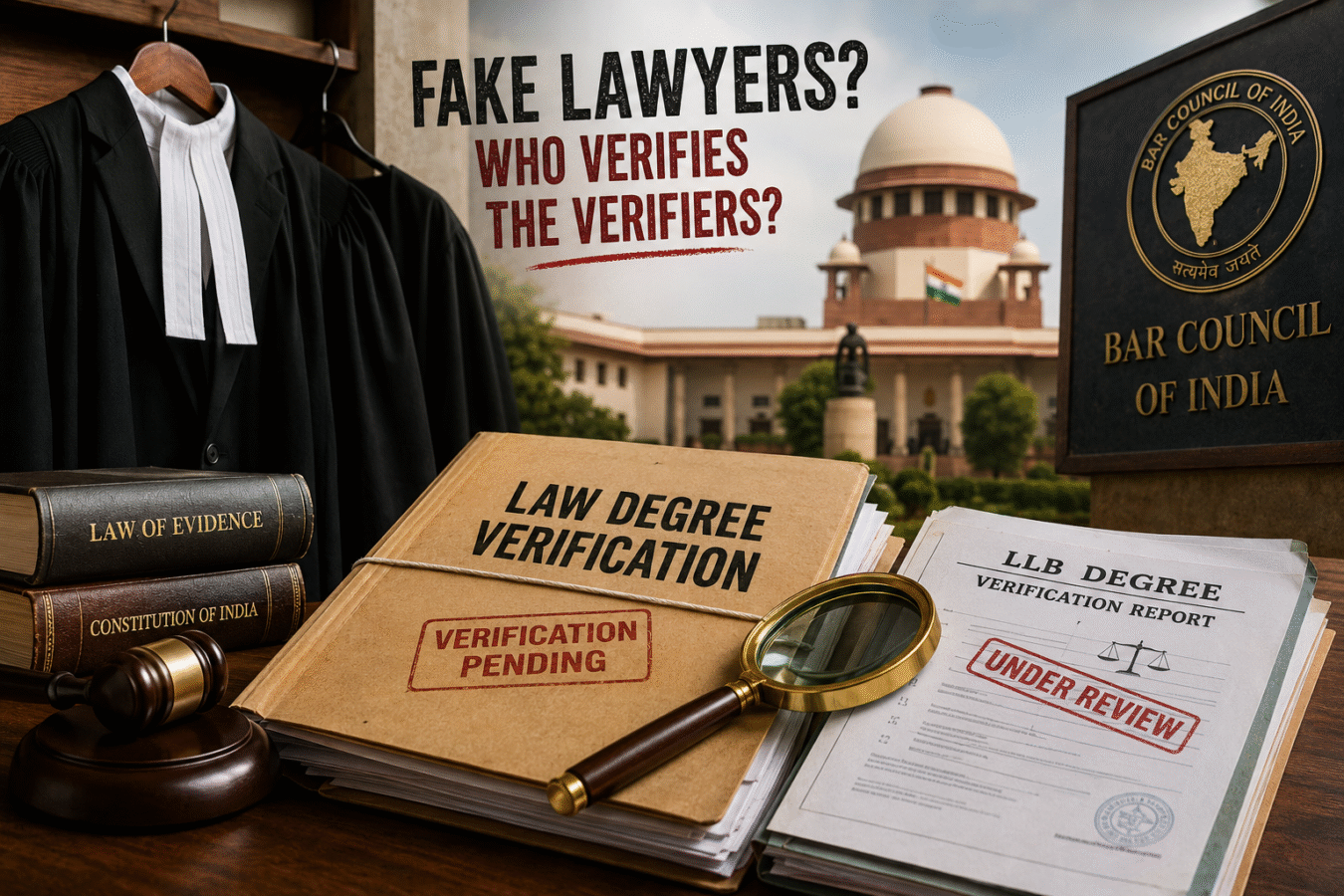
During the hearing, CJI Surya Kant reportedly made strong oral observations about lawyers allegedly practising with doubtful credentials, particularly in Delhi. LiveLaw reported that the CJI said he had serious doubts about the genuineness of several law degrees and wanted the CBI to verify the LLB degrees of many such lawyers. The New Indian Express also reported that the Court said a CBI probe may be needed into the authenticity of law degrees held by some advocates. LiveLaw The New Indian Express
According to reports, the CJI referred to “thousands” of allegedly fraudulent people wearing black robes and suggested that the CBI may have to verify doubtful law degrees.
The significance of this statement is not limited to one hearing or one petitioner. If advocates are practising with forged or doubtful law degrees, the issue affects litigants, courts, criminal trials, bail proceedings, property disputes, matrimonial litigation, constitutional matters, and access to justice itself. A person falsely practising as an advocate is not merely misusing a professional title. Such conduct can directly affect liberty, property, reputation and legal rights.
Criticism of the Bar Council System
The sharpest institutional concern in the reports is the CJI’s criticism of the Bar Council of India. According to LiveLaw, the CJI reportedly observed that the Bar Council of India would not act effectively because it was allegedly “hands in glove” or in collusion with such lawyers. This is a serious observation because the Bar Council system is the statutory framework responsible for regulating entry into the legal profession, maintaining rolls of advocates, and enforcing professional discipline. LiveLaw
If the regulator itself is perceived as inactive, compromised, or unable to act because of internal electoral politics, the problem becomes structural. It is no longer only about fake degrees. It becomes a question of whether the profession’s own gatekeeping system is strong enough to protect the dignity of the Bar and the confidence of the public.
Social Media Conduct and Judicial Restraint Debate
The hearing also became controversial because of sharp language reportedly used by the CJI while criticising certain individuals who attack the judiciary through social media, media platforms, RTI activism or other public channels. Deccan Herald and Hindustan Times reported the “cockroaches” remark, while The Economic Times published commentary questioning the departure from judicial restraint even as it acknowledged the broader issue of questionable law degrees. Deccan Herald The Economic Times
This part of the controversy requires caution. Unprofessional social media conduct by lawyers may raise questions of discipline and dignity. However, social media criticism, unemployment, journalism, RTI activism or online commentary cannot automatically prove that someone has a fake degree. A fair response must separate genuine regulatory concerns from broad generalisations.
Why Degree Verification Matters
The demand for law degree verification cannot be dismissed. Legal practice is not an ordinary occupation. Advocates advise clients, draft pleadings, appear in court, handle criminal defence, argue bail matters, deal with matrimonial and property disputes, and assist in matters affecting constitutional and statutory rights. If an unqualified person enters this system, the harm is not only professional misconduct. It can become an injury to the justice system itself.
A credible verification process should include:
- Direct digital verification of law degrees from universities;
- Mandatory cross-checking at the time of Bar enrolment;
- Periodic audit of State Bar Council rolls;
- Public complaint mechanisms for doubtful credentials;
- Criminal prosecution where forged degrees are established;
- Protection for genuine advocates from reputational damage caused by rumours or selective targeting.
Such a process must be uniform, transparent, technology-backed and legally fair. It cannot become selective, vindictive or faction-driven. The purpose should be institutional cleansing, not public spectacle.
The BCI’s Reputational Challenge
The Bar Council of India and State Bar Councils now face a serious reputational challenge. Even if they dispute allegations of collusion or inaction, the only effective response is transparency. The Bar Council system should proactively disclose what verification mechanisms exist, how many doubtful cases have been detected, what disciplinary action has been taken, and whether universities are integrated into a reliable digital verification framework.
The legal profession cannot demand public respect while avoiding internal scrutiny. The black robe carries authority because the public assumes that the person wearing it is qualified, enrolled, accountable and bound by professional ethics. If that assumption begins to collapse, public trust in courts also suffers.
Senior Advocate Designation Is Not a Personal Entitlement
The senior advocate designation angle should not be lost in the wider controversy. Senior designation is not a private trophy. It is a recognition of professional excellence and contribution to the justice system. If the profession itself is facing concerns over fake degrees, doubtful credentials and online indiscipline, courts are likely to be even more cautious in conferring such status.
This is why the Court’s reported approach in the Sanjay Dubey matter is significant. It suggests that professional dignity and personal conduct are not separate from claims of recognition. An advocate seeking senior designation must demonstrate not only legal ability but also restraint, credibility and respect for the justice system.
Conclusion
CJI Surya Kant’s remarks have opened a larger question: who verifies those who speak in the name of law? If the legal profession expects society to trust advocates with liberty, property, reputation and justice, then the profession must also be willing to undergo credible scrutiny.
The real test now is whether this episode leads to reform or fades as another controversial courtroom exchange. If the Bar Council system acts transparently, it can restore public confidence. If it does not, calls for external investigation, including CBI verification, will only become stronger.
This is not just about alleged fake lawyers. It is about whether India’s legal profession is willing to prove that its own gatekeepers are also governed by law.
Disclaimer: This article is based on publicly available media reports and reported oral observations made during court proceedings. The references to fake or doubtful degrees are allegations and concerns reported from the hearing. No individual should be treated as guilty unless established through a lawful verification process.
© 2026 KANOONPLUS | All Rights Reserved.
KanoonPlus | Adv Ravi Kumar decodes legal headlines, constitutional issues, public policy, governance, court cases, and major developments affecting citizens and institutions. Authentic legal and political analysis by Adv Ravi Kumar. Subscribe for more @kanoonplus.